Every denied claim is a tax on your enterprise. It costs your team time, money, and patient trust. Across US healthcare providers, claim denial rates have climbed past 11.8%, and the rate keeps rising. If your claims are getting denied, reimbursements are slowing down, or your billing team is constantly fixing avoidable errors, your billing infrastructure is likely the problem.
That is why investing in modern medical billing software in healthcare has moved from nice-to-have to revenue infrastructure.
Yet, many healthcare enterprises aren’t able to adapt to that medical billing software. The trouble is not the lack of options. The trouble is that most software on the market is built for the average clinic, not for enterprise complexity.
A platform that works for a small practice may fail completely under enterprise operational complexity.
What healthcare enterprises need is a custom platform engineered around their actual workflows.
At this point, various questions arise – Should you buy an existing platform? Build a custom solution? Integrate with your current EHR? Add AI automation? How much will it cost?
This guide is built to help you make that decision with clarity. In this guide, you will learn:
- What medical billing software is used in healthcare?
- Why do enterprises need it?
- Key features of a medical billing software
- Step-by-step process to build or commission your billing platform
- Cost to build medical billing software
By the end of this guide, you will have a clear framework to evaluate your options, avoid costly implementation mistakes, and make a more informed decision for your healthcare organisation.
Quick-Answer: Medical Billing Software at a Glance
Want the executive view before the deep dive? Here is the quick overview of building a medical billing software for healthcare enterprises:
| Factors | At-a-Glance |
|---|---|
| Cost (custom build) | $30K basic, $55K to $150K mid-range, $150K to $300K+ enterprise |
| MVP timeline | 4 to 6 months core RCM, 12 to 18 months full enterprise platform |
| Mandatory compliance | HIPAA + HITECH (US), GDPR (EU/UK), ABDM (India), ICD-10/CPT/HCPCS |
| Core integrations | EHR, clearinghouses, payment processors, and practice management |
| Recommended stack | Node.js / Python / Java backend, React frontend, PostgreSQL, AWS or Azure HIPAA-eligible |
| Ideal for | Hospital enterprises, multi-specialty groups, telehealth platforms, EHR vendors |
What Is Medical Billing Software in Healthcare and Why Enterprises Need It?
Medical billing software in healthcare is a digital platform that automates the healthcare revenue cycle, from insurance verification and claim submission to patient billing, payment processing, reimbursement tracking, and denial management.
Think of it as the financial nervous system of your healthcare organisation. It replaces a fragmented chain of spreadsheets, billing clerks, and disconnected tools with a single auditable workflow running in real time.
Hospital networks, multi-specialty groups, and large healthcare organisations handle thousands of claims across multiple providers, payers, and locations. Managing that complexity with outdated systems often leads to billing errors, delayed reimbursements, compliance risks, and revenue leakage.
Here are six reasons why healthcare enterprises need it:
- Managing high claim volumes efficiently: Automates billing workflows and batch claim processing, making it easier to handle thousands of claims without increasing manual workload.
- Improving revenue cycle visibility: Provides real-time insights into collections, unpaid claims, denial trends, and reimbursement performance so teams can make faster decisions.
- Reducing billing errors and denied claims: Checks coding accuracy, validates claims, and catches common payer-related errors before submission.
- Supporting regulatory compliance: Helps protect sensitive patient data with secure access controls, audit logs, and healthcare compliance safeguards like HIPAA.
- Connecting with EHR systems seamlessly: Syncs patient records, treatment details, and clinical data directly into billing workflows to avoid duplicate work.
- Boosting operational efficiency: Cuts repetitive administrative tasks, allowing billing teams to focus on revenue recovery and critical exceptions.
8 Must-Have Features in Enterprise Medical Billing Software
Enterprise medical billing software in healthcare should focus on capabilities that directly improve reimbursements, reduce claim errors, strengthen compliance, and support operational scale. Here are the key features of medical billing software that matter most:
1. Real-Time Insurance Eligibility Verification
Insurance verification is one of the most critical steps in the billing cycle because inaccurate coverage information often leads to denied claims and delayed reimbursements. Enterprise billing software should verify patient insurance coverage, copays, deductibles, and prior authorization requirements in real time before services are delivered. This helps billing teams reduce claim rejections, improve upfront collections, and prevent revenue leakage caused by avoidable eligibility issues
2. Automated Claim Scrubbing and Validation
Even minor billing errors can delay reimbursements and increase rework. Automated claim scrubbing reviews claims before submission, checks for coding mistakes, incomplete information, and payer-specific rule mismatches, helping healthcare organisations improve claim acceptance rates and reduce preventable denials.
3. Seamless EHR and EMR Integration
Enterprise billing systems should connect directly with EHR and EMR platforms so patient records, diagnoses, and treatment data flow automatically into billing workflows. This reduces manual data entry, improves billing accuracy, and ensures no billable services are missed due to disconnected systems.
4. Medical Coding Support
Accurate coding directly impacts reimbursement outcomes. A strong billing platform should support ICD-10, CPT, and HCPCS coding standards while helping teams validate codes and identify potential errors before claims are submitted. This improves billing accuracy while supporting regulatory compliance.
5. Denial Management and Appeals Workflow
Denied claims can quickly become lost revenue without a structured recovery process. Enterprise billing software should help teams track denial reasons, organise follow-ups, manage appeals, and monitor recovery performance so unresolved claims do not quietly impact cash flow.
6. Payment Posting and Remittance Reconciliation
Reconciling payments manually is time-consuming and often inaccurate at scale. Automated payment posting helps match payer remittances with submitted claims, identify underpayments, and maintain accurate financial records, allowing billing teams to focus on exception handling instead of repetitive manual tasks.
7. Patient Billing Portal and Digital Payment Support
Patient financial expectations have changed significantly. Modern billing software should offer secure self-service portals where patients can view statements, make payments, and manage payment plans, improving the payment experience while reducing collection friction for providers.
8. Security, Compliance, and Access Controls
Medical billing systems handle highly sensitive financial and patient data, making security a business-critical requirement. Enterprise platforms should include encryption, audit trails, role-based access controls, and compliance-ready safeguards to support HIPAA and other healthcare regulatory obligations.
Custom vs Off-the-Shelf vs Hybrid: Which Fits Your Enterprise?
There is no one-size-fits-all answer when choosing medical billing software in healthcare for your enterprise. The right choice depends on your organisation’s size, workflow complexity, integration needs, budget, and long-term goals.
| Factor | Custom Development | Off-the-Shelf Software | Hybrid Approach |
| Best fit for | Large healthcare enterprises with complex workflows, multiple specialties, or unique billing needs | Providers with standard billing workflows and faster deployment needs | Enterprises needing both flexibility and faster implementation |
| Implementation time | 6 to 18 months | 2 to 8 weeks | 2 to 6 months |
| Upfront cost | High | Lower | Medium |
| Long-term cost | Often more cost-effective at scale | It can become expensive with recurring subscription fees | Balanced long-term cost |
| Customization | Full control over workflows, features, and integrations | Limited customization | Custom where it matters most |
| Integration flexibility | Built around your existing systems | Limited by vendor capabilities | Flexible for critical integrations |
| Scalability | Ideal for long-term enterprise growth | May become restrictive as operations expand | Strong scalability with flexibility |
| Compliance & security control | Full control over security and compliance workflows | Dependent on vendor capabilities | Shared control |
| Best advantage | Maximum flexibility and ownership | Fast deployment with lower initial effort | Balance of speed, flexibility, and cost |
| Key limitation | Higher investment and longer build time | Vendor lock-in and limited flexibility | More planning required |
Step-by-Step Process to Build Enterprise Medical Billing Software in Healthcare
Here is the practical step-by-step roadmap to build a medical billing software for healthcare enterprises:
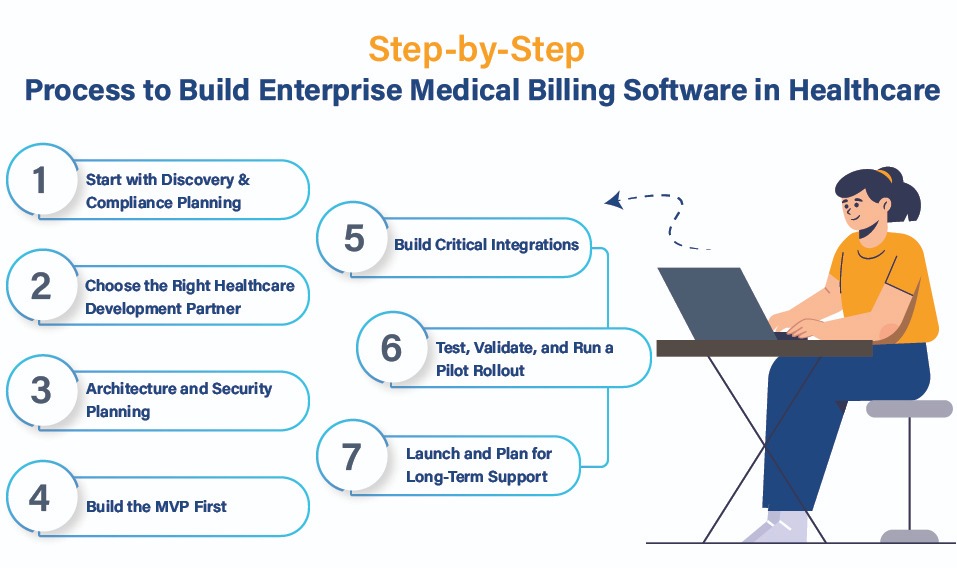
Step 1. Start with Discovery and Compliance Planning
Before writing a single line of code, you need complete clarity on what you are building and why.
This stage involves working closely with your billing teams, RCM leaders, compliance teams, and clinical stakeholders to understand current workflows, denial patterns, payer requirements, reporting gaps, and integration needs.
This is also where compliance requirements are defined, whether that includes HIPAA, GDPR, ABDM, SOC 2, or other healthcare regulations relevant to your organisation.
Think of this as your project foundation. If the foundation is weak, everything built on top of it becomes unstable. Spending extra time here saves major rework later.
Step 2. Choose the Right Healthcare Development Partner
The quality of your development partner can directly shape the success or failure of the project.
Healthcare billing software is highly specialised. It involves complex compliance requirements, healthcare data standards, payer workflows, and critical integrations with systems like EHRs and clearinghouses.
That is why choosing a general software company is often a costly mistake.
Look for a reliable healthcare software development partner with proven experience in healthcare software, HIPAA-ready delivery practices, HL7 and FHIR integration expertise, and real case studies in medical billing or healthcare platforms. The right partner should bring healthcare knowledge, not just engineering capacity.
Also Read: How to Choose the Right AI Development Company for Healthcare Business
Step 3. Architecture and Security Planning
Once you have the right development partner in place, the next step is designing the technical foundation of your platform.
At this stage, your development team will define how the system should be structured, how different modules will communicate, and how healthcare data will move securely across the platform.
This includes decisions around database architecture, deployment model, cloud infrastructure, API frameworks, interoperability standards like HL7 or FHIR, and security controls such as encryption, audit logs, and role-based access permissions.
These early architecture decisions matter because they directly impact scalability, compliance readiness, system performance, and how easily your platform can evolve in the future.
Step 4. Build the MVP (Minimum Viable Product) First
With the architecture approved, development typically begins with an MVP rather than a full-scale product.
This is where many enterprises make a costly mistake by trying to build every feature at once.
A better approach is to focus only on the core billing workflows needed to get the platform operational. This usually includes patient registration, insurance verification, claim generation, electronic submission, payment posting, and essential reporting.
The goal here is simple: launch the revenue-critical foundation first, validate it in real-world use, and then expand gradually.
Step 5. Build Critical Integrations
As development moves forward, your platform will need to connect with the rest of your healthcare systems.
This usually includes EHR or EMR platforms, clearinghouses, payment processors, practice management tools, and speciality systems such as labs, imaging, or pharmacy platforms.
This phase often takes longer than expected because external systems bring dependencies, approval processes, certification requirements, and technical limitations that are outside your direct control.
If your timeline feels too optimistic at this stage, it probably is.
Step 6. Test, Validate, and Run a Pilot Rollout
Before launching across the organisation, the platform needs to be tested thoroughly.
This includes functional testing, performance testing, security validation, compliance checks, and complete claim lifecycle testing using realistic billing scenarios.
Once testing is complete, the safest next step is a pilot rollout.
Instead of going live everywhere at once, launch in one department, specialty, or location first. This gives your team the chance to identify workflow issues, integration gaps, or adoption challenges before they affect the wider organisation.
Step 7. Launch and Plan for Long-Term Support
Once the pilot performs successfully, the platform can move into full deployment.
For enterprise healthcare organisations, phased rollout is usually the safest approach. Many teams run the new platform alongside the existing billing system for a short transition period to avoid operational disruption.
But the project does not end after launch.
Medical billing software in healthcare requires continuous support because payer rules change, coding standards evolve, compliance requirements shift, and third-party integrations require ongoing maintenance.
The most successful healthcare organisations treat post-launch support as part of the long-term operating strategy, not as a one-time technical expense.
Following this step-by-step process helps reduce implementation risk, improve time-to-value, and ensure your medical billing platform is built for long-term scalability, compliance, and revenue performance.
Cost to Develop Medical Billing Software
The average cost of developing medical billing software in healthcare ranges between $30,000 to $300,000+. However, the actual cost varies based on several cost-affecting factors. Here’s the estimated cost breakdown:
| Software Type | Typical Features Included | Estimated Cost |
| Basic Platform | Patient registration, claim creation, claim submission, payment tracking, and standard reporting | $30,000 to $55,000 |
| Mid-Range Platform | Everything in the basic platform, plus insurance eligibility verification, denial management, EHR integration, and patient billing portal | $55,000 to $150,000 |
| Enterprise-Grade Platform | Advanced analytics, AI-powered automation, multi-location workflows, custom integrations, stronger security controls, and enterprise compliance architecture | $150,000 to $300,000+ |
Key Factors That Influence Development Cost
The final cost depends on several technical and business factors, including:
- Feature complexity: More advanced functionality increases development effort. A simple billing platform costs far less than one with AI automation, denial management, analytics, and enterprise workflow customization.
- Integration requirements: Connecting with EHR systems, clearinghouses, payment processors, practice management software, or specialty healthcare platforms adds significant development complexity and testing effort.
- Compliance and security needs: Meeting healthcare regulations such as HIPAA or GDPR requires additional investment in encryption, audit trails, access controls, compliance validation, and secure infrastructure.
- Team location and delivery model: Development costs vary significantly by geography. Onshore teams typically cost more, while hybrid delivery models can help optimize budget without compromising expertise.
- Scalability requirements: Enterprise platforms designed for multiple locations, larger user volumes, and future expansion require stronger architecture and higher upfront engineering investment.
- UI/UX and workflow design: Well-designed billing software improves team productivity and adoption, but creating intuitive enterprise workflows also adds to development effort.
Why Choose DreamSoft4u for Medical Billing Software Development?
Building enterprise medical billing software requires more than development expertise. It demands deep healthcare domain knowledge, regulatory understanding, and proven experience working with complex healthcare ecosystems.
DreamSoft4u brings that experience.
With over 22 years of healthcare-focused software development, we have helped healthcare organisations build secure, scalable, and compliance-ready digital health solutions, including medical billing platforms, EMR systems, telemedicine applications, and revenue cycle management software.
What sets us apart:
- End-to-end healthcare product development support
- 1600+ projects delivered, with 98% client retention
- 100+ engineers specialised in HL7, FHIR, DICOM, and EHR integration
- HIPAA, GDPR, and ISO 27001 certified delivery processes
- Global delivery across the US, India, UK, UAE, and Australia
Ready to build your medical billing software platform?
Book your free consultation with our experts and get a personalised roadmap, cost estimate, and expert guidance for your project.
Conclusion
Medical billing software is no longer just a back-office tool for healthcare organisations. It plays a direct role in improving revenue cycle efficiency, reducing claim denials, maintaining compliance, and creating a smoother patient billing experience.
As billing workflows become more complex and healthcare systems continue to scale, relying on outdated or disconnected processes becomes increasingly expensive.
Whether you choose a custom, off-the-shelf, or hybrid approach, the right solution depends on your organisation’s operational needs, integration requirements, and long-term growth plans.
We hope this guide helped you better understand what it takes to build enterprise-grade medical billing software, from essential features to development costs and implementation planning.
Now, it’s your turn to hire an experienced software development company and let the experts build your custom medical billing software from scratch.
FAQs
1. What is medical billing software in healthcare?
Medical billing software in healthcare automates the complete revenue cycle, from insurance verification and claim submission through to payment posting and denial management. Enterprise-grade platforms also include EHR integration, AI-powered scrubbing, and patient self-service portals.
2. How much does it cost to develop custom medical billing software?
Basic builds start around $30K to $55K. Mid-range platforms with EHR integration and denial management run $55K to $150K. Enterprise platforms with AI, multi-location, and advanced integrations typically cost $150K to $300K+.
3. How long does it take to build an enterprise medical billing platform?
A core RCM MVP usually ships in four to six months. Full enterprise platforms with advanced integrations, AI features, and multi-specialty support typically take 12 to 18 months end-to-end.
4. Should enterprises build custom or buy off-the-shelf medical billing software?
Build custom when workflows are unique, multi-payer complexity is high, or competitive differentiation matters. Buy off-the-shelf for standard single-specialty practices. Hybrid models work best at most enterprise scales.
5. Which compliance standards apply to medical billing software in healthcare?
HIPAA and HITECH apply in the US, GDPR in the EU and UK, and ABDM in India. Every platform must also support ICD-10/CPT/HCPCS coding standards and ANSI X12 EDI for electronic transactions. Enterprise security posture typically requires SOC 2 Type II and ISO 27001 certifications, too.
6. Can medical billing software in healthcare integrate with an existing EHR?
Yes. Modern billing platforms integrate bidirectionally with Epic, Cerner, athenahealth, and custom EHRs using HL7 v2 and FHIR R4 standards. Integration depth determines whether charge capture, eligibility, and denials flow cleanly between systems.