Building or upgrading an EMR/EHR system is now a straightforward budget question for most healthcare leaders: what will EMR EHR development cost actually run in 2026? The honest answer depends on the path you choose. Off-the-shelf SaaS licensing can start around $300 per provider per month, while a full custom, compliance-grade EHR build typically lands between $250,000 and $1,000,000 or more — and the gap between those two numbers is where most planning mistakes happen.
This guide breaks down EMR EHR development cost across every buying model, the hidden line items most teams underestimate (compliance engineering, FHIR depth, AI features, data migration), and a practical framework for choosing a development partner who won’t blow your budget six months into the build. If your platform still moves data slowly, struggles with FHIR, or fights with telemedicine workflows, the cost of standing still is usually higher than the cost of fixing it.
For years, providers used these tools just to store records. That has changed. Modern EMR and EHR in digital healthcare now run the entire care experience, from patient bookings and clinical notes to billing, compliance, telemedicine, and AI-powered insights. They are no longer record books; they are the operating core of how care gets delivered.
Adoption is no longer the differentiator. Roughly nine in ten US office-based physicians used a certified EHR in 2024, and non-federal acute care hospitals reached near-universal adoption years ago, according to the Office of the National Coordinator for Health IT. The frontier has moved from having an EHR to what that EHR can actually do.
The shift in how EMR and EHR benefit modern care is no longer a tech upgrade; it is a business decision with real money attached.
If your platform still moves data slowly, struggles with FHIR, or fights with telemedicine workflows, you are not just behind on tech; you are losing patients, doctors, and revenue.
In this guide, you will learn:
- What EMR and EHR are, and how they differ
- Why EMR and EHR are redefining digital healthcare
- 10 key trends reshaping EMR and EHR
- The core benefits of modern EMR and EHR systems
- The biggest adoption challenges, and how to solve them
- What interoperability and compliance really require
- What it costs to build or modernize an EMR/EHR system
- A 7-step framework to choose the right development partner
By the end of this guide, you will know where EMR and EHR in digital healthcare are heading, what it takes to build a compliance-grade system, and how to pick the right partner to build it.
EMR/EHR Development Cost – Quick Snapshot
| Approach | Typical Cost Range |
|---|---|
| Off-the-shelf SaaS EHR licensing | $300–$1,200 / provider / month + $25K–$200K setup |
| Customization on existing EHR | $50,000 – $250,000 |
| Modular FHIR-first build (MVP) | $100,000 – $400,000 |
| Full custom EMR/EHR build | $250,000 – $1,000,000+ |
| Annual maintenance & compliance | 15%–20% of build cost per year |
Key takeaways:
- A future-ready EHR is defined by FHIR R4 interoperability, embedded AI, and multi-region compliance mapped together (HIPAA, GDPR, ISO 27001, ABDM, TEFCA).
- Choosing the right development partner matters as much as the architecture, and healthcare domain depth plus proven interoperability engineering are the signals that separate real partners from generic ones.
- Build-or-buy decisions swing on more than budget — the right approach depends on your compliance scope, integration depth, and how differentiated the EHR needs to be for your platform. (See the full cost breakdown below.)
Quick Summary: EMR & EHR at a Glance
Here’s a quick look at EMR & EHR:
| Dimension | Traditional EMR | Traditional EHR | Modern Future-Ready EHR |
|---|---|---|---|
| Scope | Single practice records | Shared across providers | Connected across providers, payers, patients, and devices |
| Data Sharing | Internal only | Within network | FHIR-first, cross-network, real-time |
| AI Integration | None | Add-on at best | Embedded ambient AI, predictive risk, clinical decision support |
| Interoperability | Limited | HL7 v2, some FHIR | FHIR R4, HL7, DICOM, TEFCA-aligned |
| Compliance | HIPAA basic | HIPAA, GDPR | HIPAA, GDPR, ISO 27001, ABDM, region-specific by design |
| Deployment | On-premise | Cloud-supported | Cloud-native, modular, API-first |
| Ideal User | Small specialty clinics | Hospital networks | Any compliance-grade healthcare platform with growth ambitions |
The table above shows where the market is heading. The detail underneath is where decisions actually get made, starting with the definitions themselves.
Not Sure Which EMR/EHR Path Fits Your Platform?
Get a free 30-minute technical assessment from our healthcare engineering team.
Book a Free ConsultationWhat Are EMR and EHR?
1. Electronic Medical Records (EMR)
An EMR is the digital version of a clinician’s paper chart inside a single practice. It captures patient history, allergies, medications, lab orders, immunizations, vitals, and progress notes, all stored in one practice’s database. The strength of an EMR is depth within a single setting, but the data does not travel well outside that setting. For a multi-specialty hospital network or a telehealth platform, EMR-only thinking caps the value of the data.
2. Electronic Health Records (EHR)
An EHR carries everything an EMR does, then extends it. The same record can move across hospitals, labs, imaging centers, pharmacies, payer systems, and patient apps. A patient who walks into an emergency department in another city can have their full history surfaced within seconds when EHRs are wired correctly. That cross-network design is exactly why EHRs sit at the center of modern care models and why service pages for EMR / EHR / PHR Solutions anchor on this distinction.
3. The Shift from Record-Keeping to Intelligent Care Platforms
The most useful EHRs are no longer record stores; they behave like clinical operating systems. They listen during consults, summarize notes, predict deterioration, surface care gaps, route prior authorizations, and feed analytics dashboards in real time. For broader context on how this fits into hospital operations, see how the hospital information management system works. The record becomes a by-product of the workflow, not the workflow itself.
EMR EHR Development Cost: Full Breakdown by Approach
he cost ranges below are practical estimate bands for buying or commissioning a system. Specific quotes always depend on scope, integrations, and compliance burden.
1. Off-the-Shelf Licensing vs Customization vs Custom Build
Three buying patterns dominate. The off-the-shelf route licenses a vendor product and lives within its constraints. The customization route layers configurations and modules on top of an existing EHR. The custom-built route engineers a system end-to-end against your exact workflows, compliance, and roadmap. The market has consolidated sharply around a few large vendors, with the top three hospital EHR developers growing from a 35 percent share in 2010 to over 80 percent in 2024 (ONC), which is exactly why differentiated platforms often justify a custom or modular build.
2. EMR EHR Development Cost Ranges by Approach
- Off-the-shelf SaaS EHR licensing: roughly $300 to $1,200 per provider per month, plus implementation and training fees that can run from $25,000 to $200,000 or more depending on scale.
- Customization on an existing EHR: typically $50,000 to $250,000 for a focused engagement, scaling higher with multi-region rollouts.
- Modular FHIR-first build (composable): typically $100,000 to $400,000 for an MVP, with progressive expansion.
- Full custom EMR/EHR build: typically $250,000 to $1,000,000 or more for a production-grade, compliance-grade system across multiple specialties.
3. Key Cost Drivers Most Teams Underestimate
Compliance engineering, FHIR depth, third-party integrations, AI features, mobile applications, and data migration drive most of the underestimation. Telemedicine, e-prescribing, and payer integrations also add line items that rarely appear in early budgets.
4. Hidden Costs That Increase EHR Development Cost Over Time
Audit prep, penetration testing, ongoing certifications, and security operations work continuously. Integration maintenance grows linearly with the number of connected systems. Plan for roughly 15 percent to 20 percent of the build cost annually on maintenance and compliance for a serious platform.
Now that you understand the numbers, the harder question becomes who builds the system. Picking the right partner takes more discipline than picking the architecture.
EMR vs EHR: Key Differences That Now Matter
The differences between EMR and EHR used to be a definition exercise. They are now operational, financial, and regulatory, and they decide which platform a hospital, telehealth startup, or digital health brand can actually scale on.
1. Scope of Data and Sharing Boundaries
With an EMR, clinical data lives inside the four walls of one practice or specialty clinic. The record is rich, but the perimeter is hard, and sharing with an outside lab or an external specialist usually means manual exports or one-off integrations.
On the EHR side, the record was built to move. It flows across providers, labs, pharmacies, payers, and patient apps through standardized APIs, with consent management built into the workflow rather than added as a legal afterthought.
2. Interoperability and Cross-Provider Access
EMRs traditionally support basic HL7 v2 messaging, and FHIR coverage tends to be partial when present at all. Custom integrations stay expensive, slow, and brittle as new specialty modules get bolted on.
Modern EHRs flip this. They are FHIR R4 native, layered with HL7 for legacy systems and DICOM for imaging, and they connect to TEFCA networks, regional health information exchanges, and India’s ABDM stack as a baseline. That posture is what separates an EHR built for the next decade from one rebadged from a previous one.
3. Compliance and Regulatory Fit
For most EMR vendors, baseline HIPAA controls are the finish line. For a small single-country clinic, that may be enough, but for any organization operating across geographies, this posture creates audit risk and procurement friction.
Compliance-grade EHRs treat this differently. Controls for HIPAA, GDPR, ISO 27001, ABDM, and TEFCA are mapped simultaneously, and encryption, role-based access, audit trails, and data residency live inside the architecture from day one.
4. AI, Analytics, and Modern Architecture Readiness
An EMR’s structure typically treats AI as a future roadmap item. Without structured FHIR data and clean APIs, even off-the-shelf AI tools struggle to plug in, and documentation stays manual, decisions stay reactive, and analytics stay batch.
Future-ready EHRs assume AI everywhere. Ambient scribes, predictive risk scoring, clinical decision support, and generative summaries all rely on the structured, interoperable data the platform was built to produce. That foundation is what makes AI genuinely useful in clinical practice rather than a demo that never reaches the bedside.
5. Use-Case Fit Across Hospitals, Specialty Clinics, and Digital Health Startups
Single-specialty clinics, small group practices, and standalone outpatient centers usually extract more value from a focused EMR. System depth-per-dollar is high, the workflows are tighter, and cross-network sharing is rarely the bottleneck.
Hospital networks, telehealth platforms, multi-region healthcare brands, and digital health startups building API-first products belong on a modern EHR. The cross-provider data flow, AI readiness, and FHIR depth pay back exactly where an EMR’s perimeter starts to hurt.
5 Reasons EMR & EHR Are Redefining Digital Healthcare
Here are five major reasons why EMR and EHR are redefining digital healthcare:
1. Healthcare Data Volume Is Outpacing Human Capacity
Healthcare data is expanding faster than any clinical team can read manually, driven by imaging, genomics, remote monitoring, and the shift to digital-first care. No clinician absorbs that volume by reading screens, and no static record system indexes its use. EHRs that surface the right signal at the right moment are the only practical answer.
2. Regulatory Pressure Is Forcing Open, Interoperable Systems
The 21st Century Cures Act in the US, ABDM in India, GDPR-aligned digital health frameworks across Europe, and TEFCA’s expansion all push in the same direction. Information blocking is now a regulatory and reputational risk, and EHRs built without FHIR-first interoperability are aging out of procurement shortlists.
3. Patient Expectations Have Shifted to Digital-First Care
Patients expect online scheduling, secure messaging, lab access on a phone, prescription refills with a tap, and visible care plans. International software product teams report that portals and mobile front doors directly affect retention, no-show rates, and patient satisfaction scores. EHRs that ignore the patient experience layer keep losing in the market.
4. AI Has Moved from Pilot to Production Inside the EHR
Vendors and engineering-led platforms now ship ambient documentation, AI scribes, predictive risk modeling, and generative summaries as production features inside the EHR. Late-mover penalties are real, and organizations still planning pilots are competing against teams already measuring AI-driven gains in clinician hours saved.
5. Workforce Strain Has Made Clinical Efficiency a Survival Metric
Clinician burnout, documentation fatigue, and nursing shortages are now strategic risks. EHRs that automate documentation, simplify orders, and reduce inbox load directly affect staff retention and care quality, which is why workforce sustainability has joined cost and compliance as a top buying criterion.
10 Key Trends Redefining EMR & EHR
Here are the top 10 trends redefining EMR and EHR:
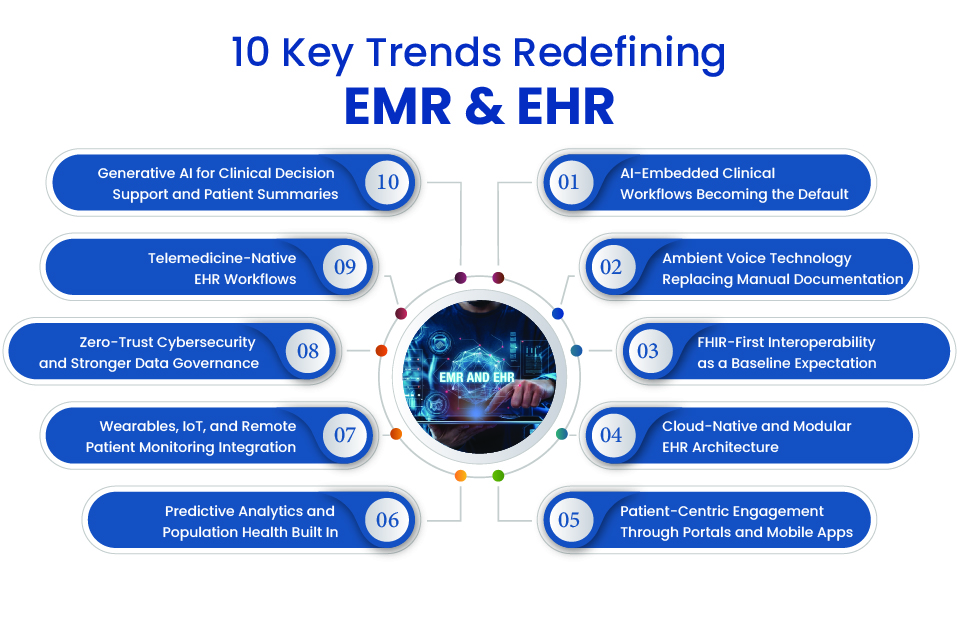
1. AI-Embedded Clinical Workflows Becoming the Default
AI inside the EHR is no longer a buzzword. Ambient documentation, predictive risk scores, voice agents, and decision support are embedded into clinical workflows rather than offered as add-ons. Healthcare brands worldwide that delay this shift are starting to feel the productivity and recruiting gap widen.
2. Ambient Voice Technology Replacing Manual Documentation
Ambient voice scribes capture the consultation in real time and structure it into the chart automatically. Clinicians report meaningful reductions in documentation time and recover hours of after-hours work each week. The result is more patient-facing time and noticeably less burnout.
3. FHIR-First Interoperability as a Baseline Expectation
FHIR R4 is the assumed default for healthcare data exchange. Procurement teams routinely reject systems with weak FHIR coverage, and EHRs are being rebuilt around resources, APIs, and SMART-on-FHIR apps rather than monolithic data models.
4. Cloud-Native and Modular EHR Architecture
The monolithic, all-in-one EHR is fading. Modular, API-driven platforms let providers compose the EHR they need, swapping modules for documentation, billing, imaging, or telehealth without ripping out the core. Engineering teams call this composable healthcare for a reason.
5. Patient-Centric Engagement Through Portals and Mobile Apps
Patient portals, mobile-first front doors, and consumer-grade scheduling are now expected, not impressive. Engagement-rich EHRs see better appointment adherence, faster bill collection, and stronger retention. The mobile front end is now a serious engineering project of its own.
6. Predictive Analytics and Population Health Built In
Forward-leaning EHRs embed predictive models directly into the chart, flagging high-risk patients, surfacing care gaps, and feeding population health dashboards in real time. This shift is what makes value-based contracts genuinely operable.
7. Wearables, IoT, and Remote Patient Monitoring Integration
Wearables, home devices, and remote patient monitoring streams flow into the EHR continuously. That feed enables virtual wards, chronic disease management at scale, and earlier interventions, especially for cardiology, diabetes, and post-discharge care.
8. Zero-Trust Cybersecurity and Stronger Data Governance
Healthcare cyberattacks keep climbing, and breach economics keep getting worse. Future-ready EHRs are secure-by-design: zero-trust networks, encryption at rest and in transit, role-based access, full audit trails, and continuous monitoring are baseline expectations rather than premium add-ons.
9. Telemedicine-Native EHR Workflows
Telemedicine is no longer a parallel system; it is a routine pathway inside the EHR. Virtual consults, e-prescriptions, follow-ups, and remote monitoring all share the same record, identity, and compliance stack.
10. Generative AI for Clinical Decision Support and Patient Summaries
Generative AI drafts discharge summaries, after-visit instructions, patient-friendly explanations, and early-stage clinical decision support, always with a clinician in the loop. The productivity lift is real, and the governance frameworks around it are maturing quickly.
6 Major Benefits of Modern EMR & EHR Systems
The benefits below explain why hospital networks, telehealth platforms, and international software product teams keep increasing their EMR and EHR spend.
1. Reduced Medical Errors and Safer Prescribing
A modern EHR cross-checks allergies, interactions, and dose ranges at the moment of order entry, not after the fact. Computerized order entry with clinical decision support is one of the most studied EHR safety features precisely because it catches the kind of preventable prescribing errors that are hard to spot by hand, especially in busy inpatient settings.
2. Faster, More Accurate Diagnoses
When labs, imaging, prior history, and clinical notes surface in one view, diagnostic delays shrink, and clinicians have fewer blind spots. The same data backbone is what makes specialty referrals smoother and second opinions faster.
3. Stronger Care Coordination Across Providers
Care teams operating across primary care, specialists, home health, and pharmacy benefit when records flow without friction. Coordination at this level is what separates fragmented care from genuinely continuous care, and patients feel the difference immediately.
4. Higher Patient Engagement and Retention
Patient portals, mobile access, and secure messaging make patients active participants in their care. Engaged patients are more likely to adhere to treatment plans, show up to appointments, and stay loyal to providers, all of which compound into clinical and financial gains.
5. Lower Operational Overhead and Documentation Burden
Automation around scheduling, intake, charting, billing, and patient communication trims operational overhead. Combined with ambient scribes and AI coding, the documentation tax on clinicians drops noticeably, freeing capacity for clinical work.
6. Population Health Insights at Scale
Modern EHRs aggregate cohorts, risk-stratify populations, and feed dashboards that population health teams can act on. That ability is the operational foundation of value-based care contracts and accountable care models.
Now you have seen the upside. Every benefit also carries a real obstacle, and the leaders who plan for both are the ones who actually deliver.
Ready to See These Benefits in Your Own EMR/EHR Platform?
We’ve built 1,600+ healthcare projects. Let’s scope yours.
Talk to Our EHR ExpertsMajor Challenges in EMR & EHR Adoption (and How to Solve Them)
Challenge 1. Migrating Data from Legacy Systems Without Loss
Moving years or even decades of patient data from old EMRs, paper records, or spreadsheets is rarely simple. Missing records, incorrect mapping, or broken data formats can create serious problems that may affect patient care later.
Solution: The safest approach is a structured migration plan. This should include data mapping, FHIR-based data transformation, test migrations, parallel system runs, and clinician validation before full deployment. Careful planning reduces risk and ensures clean data transfer.
Challenge 2. Closing Interoperability Gaps Between Vendors
Many healthcare systems claim to support interoperability, but in reality, data sharing is often incomplete or unreliable. Connecting EHRs with labs, pharmacies, external providers, or third-party apps can quickly become complicated.
Solution: Build a practical interoperability layer using FHIR APIs, HL7 support, middleware, and reusable connectors. Tools like Mirth Connect can help bridge older systems with modern platforms, making smoother communication possible.
Challenge 3. Carrying the Weight of HIPAA, GDPR, and ABDM Compliance
Healthcare organizations operating across different regions must handle multiple compliance frameworks like HIPAA, GDPR, ABDM, and other local regulations. Trying to add compliance later often creates expensive delays and security gaps.
Solution: Make compliance part of the system architecture from the beginning. Strong access controls, audit logs, consent management, encryption, and region-specific data rules should be built into the platform from day one.
Challenge 4. Clinician Burnout and Documentation Fatigue
Doctors and clinical staff already deal with heavy workloads. Poorly designed EHR systems often make things worse by adding excessive documentation work, manual data entry, and inefficient workflows.
Solution: Reduce administrative burden with AI scribes, voice-based charting, smart templates, and workflow automation. A better user experience improves productivity and helps healthcare organizations retain clinical talent.
Challenge 5. Integrating Third-Party Systems, Labs, and Imaging
Modern healthcare systems must connect with many external services, including labs, imaging platforms, billing systems, pharmacies, telemedicine tools, and wearable devices. Poor integration increases cost and operational complexity.
Solution: Use standardized APIs, FHIR resources, and scalable integration architecture. Building reusable connectors makes future integrations faster, easier, and more cost-effective.
Challenge 6. Defending Against Rising Cybersecurity Threats
Healthcare data is highly valuable, making hospitals and digital health platforms common targets for ransomware attacks, phishing, and data breaches. A single security failure can damage trust and create major financial risk.
The scale of the risk is not hypothetical. The February 2024 ransomware attack on Change Healthcare, a UnitedHealth Group company, affected roughly 192.7 million people and stands as the largest healthcare data breach on record, and investigators traced the initial access to a remote-access system that lacked multi-factor authentication (US Department of Health and Human Services).
Solution: Adopt a zero-trust security model with encryption, continuous monitoring, role-based access controls, enforced multi-factor authentication, regular penetration testing, and a tested incident response plan. Security must be treated as an ongoing business priority.
Challenge 7. Justifying the Cost and ROI to Leadership
EMR and EHR investments can be expensive, and leadership teams often need clear proof that the investment will deliver measurable business value.
Solution: Build a strong business case around practical outcomes such as reduced clinician workload, faster billing cycles, lower denial rates, better patient retention, fewer compliance risks, and long-term operational savings. Clear ROI makes decision-making easier.
Interoperability and Compliance: The Backbone of Future-Ready EHR
A modern EHR’s value depends on how cleanly it talks to other systems and how rigorously it protects the data it holds.
1. FHIR as the Universal Standard for Healthcare Data Exchange
FHIR R4 has become the common language for healthcare data. SMART-on-FHIR apps, FHIR APIs, and FHIR-native data models are what allow modular composition and third-party innovation. Any EHR you evaluate should have first-class HL7 FHIR coverage, not partial support.
2. HL7 and Mirth Connect for Legacy System Bridges
HL7 v2 is still everywhere because legacy hospital systems still run on it. Mirth Connect and similar engines bridge older HL7 traffic into modern FHIR pipelines. The pragmatic approach is to keep both lanes open until the long tail of legacy systems retires.
Consolidation is part of this story too. Among US hospitals, the share using the same EHR developer across inpatient and outpatient settings rose from 62 percent in 2010 to 90 percent in 2024, according to the Office of the National Coordinator for Health IT, which makes internal continuity easier but raises the stakes for connecting across organizations.
3. DICOM and PACS for Medical Imaging Integration
X-rays, MRIs, and CT scans should sit in the same place as patient notes, not in a separate tool. DICOM and PACS make that possible. Doctors can view scans next to lab results and patient history in one screen, and AI tools can read those scans without extra setup work.
4. HIPAA, GDPR, and ISO 27001 for Global Data Protection
Multi-region healthcare platforms must align with HIPAA in the US, GDPR in Europe and the UK, and ISO 27001 across enterprise deals. A modern HIPAA-compliant EHR architecture treats these frameworks as overlapping controls rather than separate projects.
5. ABDM, TEFCA, and Region-Specific Mandates
India’s ABDM integration is now central there, TEFCA is expanding across the US, and other regions have their own equivalents. A serious EHR roadmap accounts for these from the start, because retrofitting region-specific compliance late is expensive and risky.
How to Choose the Right EMR/EHR Development Partner: A 7-Step Framework
Here is the step-by-step process to choose the right EMR/EHR development partner:
Step 1: Verify Deep Healthcare Domain Experience
Generic engineering teams underestimate healthcare. The space is dense with clinical workflows, regulatory edges, payer logic, and patient safety considerations that take years to internalize. A real healthcare partner will speak fluently about EMR, EHR, PHR, HIMS, telemedicine, and mHealth without translation help.
Ask for a clear breakdown of healthcare-only projects, named clinical workflows handled, and the specialties they have shipped for. Vague answers here usually predict expensive lessons later, and the gap is easy to spot once you press for specifics.
Step 2: Audit Their Compliance and Certification Track Record
A credible partner can demonstrate HIPAA-aligned engineering, GDPR-ready architectures, ISO 27001 controls, and ABDM integration experience where relevant. They can also show how compliance lives in their build process, not just their marketing.
Look for documented audit cycles, secure-by-design practices, penetration testing cadence, and clear data residency options. Compliance theater is easy to spot once you ask for specifics, and the right partner welcomes the scrutiny.
Step 3: Evaluate Interoperability Engineering Capability
Ask how they have implemented FHIR R4 resources, how they bridge HL7 v2 with modern stacks, and how they have wired DICOM and PACS into clinical workflows. Concrete examples should appear immediately, not after a follow-up call.
Bonus signals include experience with Mirth Connect, EDI integrations, TEFCA-aligned exchanges, ABDM stacks, and SMART-on-FHIR app composition. These are not edge skills now; they are core competencies, and any modern partner should treat them as table stakes.
Step 4: Assess AI and Modern Architecture Expertise
Look for partners who can engineer ambient scribes, integrate predictive models, embed generative AI features safely, and ship cloud-native modular architectures. Equally important, they should know when not to apply AI.
Press them on governance: how they validate AI outputs, monitor drift, implement human-in-the-loop review, and document the entire stack for audit. The best partners answer in technical depth, not with slide decks, and the difference shows up in their first response.
Step 5: Review Case Studies, Client Retention, and Healthcare Proof Points
Ask for healthcare case studies with names, scope, integrations involved, and measurable outcomes. Client retention matters: a partner with high multi-year retention on healthcare accounts has earned that trust the hard way.
Look beyond logos. Probe for named workflows shipped, clinical sign-offs achieved, and post-launch performance data. Real healthcare proof points stand up to scrutiny, and a serious partner will hand them over without resistance.
Step 6: Test Communication, Engagement Models, and Post-Launch Support
The right partner offers flexible engagement: fixed-scope, dedicated teams, staff augmentation, and managed delivery. They run agile delivery with transparent reporting, time zone overlap, and direct access to the engineering team, not layers of account management.
Equally important is what happens after go-live. Post-launch support, ongoing maintenance, security patching, and feature evolution should be defined upfront, with clear SLAs and engineering continuity baked in.
Step 7: Confirm Long-Term Vendor Roadmap Alignment
The partner you pick today is making bets about FHIR R4, generative AI, multi-region compliance, and modular architecture that affect your platform for years. A clear technology roadmap belongs in every serious vendor conversation, not in a post-contract surprise.
Ask how they invest in research and tooling, how they certify new engineers in healthcare standards, and how they plan to absorb the next wave of EHR features. Partners who answer in concrete terms, with timelines and proof points, are the ones whose architecture will still be relevant when your platform crosses its next growth threshold.
What the Future Holds for EMR and EHR?
The redefinition does not stop with this year’s roadmap. Four patterns will keep shaping the space.
1. From Records to Real-Time Clinical Intelligence Platforms
The next iteration of the EHR behaves less like a chart and more like a clinical intelligence platform, with real-time risk surfacing, autonomous workflow triggers, and live coordination across the care team. The record becomes a by-product of decisions, not their starting point.
2. Multi-Region Compliance Becoming a Single Engineering Discipline
HIPAA, GDPR, ABDM, ISO 27001, and TEFCA will increasingly be treated as overlapping controls in one compliance framework. Engineering teams that build for this multi-region reality from day one will have a meaningful procurement advantage with international software product teams.
3. Patient-Held Records and Truly Portable Health Data
PHR adoption, NHS App-style patient access models, and consumer-grade health wallets are moving the record closer to the patient. Future EHRs will treat the patient as a first-class data holder, not a passive subject, and consent workflows will be designed around that shift.
4. Vertical EHRs for Specialty Care Becoming the Norm
Generic EHRs struggle to serve cardiology, oncology, dermatology, ophthalmology, and behavioral health equally well. Specialty-optimized EHRs are emerging with dedicated workflows, code sets, and AI models tuned for each domain. The platforms that win in those specialties will look more like vertical SaaS products than horizontal hospital systems.
Why Does DreamSoft4U Stand Out for EMR/EHR Development?
Choosing the right EMR/EHR development partner is about more than technical skills.
In healthcare, you need a team that understands compliance, interoperability, patient workflows, and the real challenges of building secure, scalable healthcare platforms.
DreamSoft4u brings that experience with 23+ years in healthcare technology, 1600+ successful projects, and a 98% client retention rate across global healthcare markets.
Why choose us?
- Expertise in EMR, EHR, telemedicine, and digital health
- HIPAA, GDPR, ISO 27001, and ABDM-ready development
- Strong FHIR, HL7, DICOM, and interoperability capabilities
- AI, ML, and generative AI healthcare integration expertise
- Dedicated teams, fixed-cost, and flexible engagement models
- Global delivery experience across the US, UK, India, the Middle East, and Australia
- Direct access to engineering teams with transparent execution
Turn Your EMR/EHR Vision Into a Secure, Scalable Healthcare Solution
Talk to our tech experts — 23+ years of EMR/EHR delivery experience.
Book Your Free ConsultationConclusion
EMR and EHR in digital healthcare are no longer about records. They are about intelligence, interoperability, and clinical outcomes. The organizations winning today treat the EHR as a compliance-grade, AI-embedded, FHIR-first operating system for care, not a paperwork upgrade. The trends, benefits, challenges, and cost ranges in this guide give you the structural view, and the decision framework gives you a way to act on it.
We hope this guide helped you understand how EMR and EHR in digital healthcare are being redefined and what it takes to engineer a system fit for the next decade.
Now it is your turn to evaluate a vendor, modernize a legacy stack, or build a new platform from the ground up.
Still deciding? Talk to our tech experts, a team that has shipped 1600+ projects and retained 98% of its clients across 22+ years of work in EMR and EHR in digital healthcare.
Frequently Asked Questions
An EMR holds a patient’s chart within one practice. An EHR carries that same record across providers, labs, pharmacies, and patient apps. A modern EHR also embeds AI, predictive analytics, and FHIR-based sharing as default capabilities.
Not automatically. A system must be engineered with HIPAA controls: encryption, access control, audit logging, breach reporting, and signed business associate agreements. Compliance-grade EHRs build these in from the start.
A focused MVP usually takes 4 to 8 months. A production-grade, compliance-grade EHR with FHIR, AI, telemedicine, and multi-region readiness typically runs 9 to 18 months. Timelines hinge on integrations, compliance scope, and the number of clinical workflows in scope.
Off-the-shelf SaaS licensing runs roughly $300 to $1,200 per provider per month, plus implementation. Customization runs $50,000 to $250,000. A modular FHIR-first build sits near $100,000 to $400,000. A full custom build typically lands between $250,000 and $1,000,000 or more.
Yes, when they offer modern APIs. FHIR R4 and HL7 interfaces let telemedicine, mHealth, and patient portals connect to the EHR without rebuilds. Older EHRs often need middleware like Mirth Connect to bridge into modern apps and devices.
AI powers ambient documentation, predictive risk scoring, clinical decision support, generative summaries, coding assistance, and prior authorization. The most valuable AI features sit inside clinician workflows under strict governance and human-in-the-loop controls.
HL7 v2 is the older messaging standard that most legacy hospital systems still run on. FHIR R4 is the modern resource-and-API standard powering newer apps and integrations. Real-world healthcare platforms still bridge both because legacy systems are not retiring overnight.
It depends on differentiation and scale. If the EHR is core intellectual property, a custom or modular FHIR-first build pays off long-term. If it is supporting infrastructure for a different product, licensing an existing EHR is usually faster and more cost-effective.