Most healthcare platforms in India are growing fast. But many still face one big problem. Their systems are not connected. Patient data stays in different places. Doctors don’t get the full medical history. Sharing records is slow and sometimes not even possible. And now, with the government pushing ABDM integration solutions across India, this gap is becoming serious.
If your platform is not ready for ABDM, you are already falling behind. But here’s the challenge.
ABDM integration services are not just a simple feature you can add. It involves ABHA IDs, doctor and hospital registration, consent-based data sharing, and multiple APIs. Many teams start without clarity and get stuck in the middle.
This guide will help you avoid that.
In this guide, you will learn what ABDM really is, how it works, and how to integrate it step-by-step into your healthcare platform. So, let’s dive in!
What is ABDM (Ayushman Bharat Digital Mission)?
The Ayushman Bharat Digital Mission, or ABDM, is a government initiative launched in 2021. Its goal is to build a connected and digital healthcare system across India.
It allows patients to store and access their health records digitally. This makes it easier to get the right treatment without delays or missing information.
At the center of ABDM is the ABHA number, a unique 14-digit health ID. It helps patients link their medical records and share them with doctors or hospitals when needed.
ABDM also connects different parts of the healthcare system. It brings together doctors, hospitals, labs, and digital health platforms into one network.
To support this, it creates national registries for healthcare professionals and facilities. This ensures verified data and better trust across the system.
Consent is at the core of ABDM. The system shares health data only when the patient allows it, keeping everything secure and reliable.
In simple terms, ABDM builds a healthcare system where patients and providers can access connected, secure data whenever they need it.
Key Components of ABDM Integration
To understand how ABDM works, you need to look at the core components that power the entire system. Each one plays a specific role in making healthcare data connected and usable.
Here are the key components you need to know:
- ABHA (Ayushman Bharat Health Account): This is a unique 14-digit health ID for every patient. It helps link all medical records in one place and allows patients to share their data with providers when needed.
- HFR (Health Facility Registry): A central database of all healthcare facilities, such as hospitals, clinics, and labs. It ensures every facility is verified and part of the national system.
- HPR (Healthcare Professionals Registry): A verified registry of doctors, nurses, and healthcare staff. It helps platforms confirm the identity and credentials of professionals.
- Consent Manager (HIE-CM): This manages secure data sharing between systems. Every data request requires patient approval before anyone can access or share it — making privacy a core part of ABDM.
- UHI (Unified Health Interface): A digital layer that connects different healthcare apps and services. It allows features like appointment booking and teleconsultation across platforms.
- NHCX (National Health Claims Exchange): A system designed to streamline insurance claim processing. It helps improve speed and transparency in claim settlements.
The 3 Modules of ABDM Integration
ABDM integration Guide solutions work through three main modules. Each one has a clear role and helps your platform connect with the national healthcare system.
M1: Healthcare Professionals Registry (HPR) & ABHA
This module registers and verifies doctors and healthcare staff, ensuring only valid professionals enter the system. Learn about ABDM incentives for doctors who complete this registration. It also lets your platform create and link ABHA IDs for patients, so you can manage their health records in one place.
M2: Health Facility Registry (HFR)
This module is used to register hospitals, clinics, and labs. Each facility gets a unique ID after registration. This helps make the facility verified and part of the national network.
M3: Health Data Sharing and Consent Management
This module lets systems share health records directly with each other. It links all data to the patient’s ABHA ID and shares it only when the patient gives permission – keeping everything secure and private.
Step-by-Step ABDM Integration Process For Your Healthcare Platform
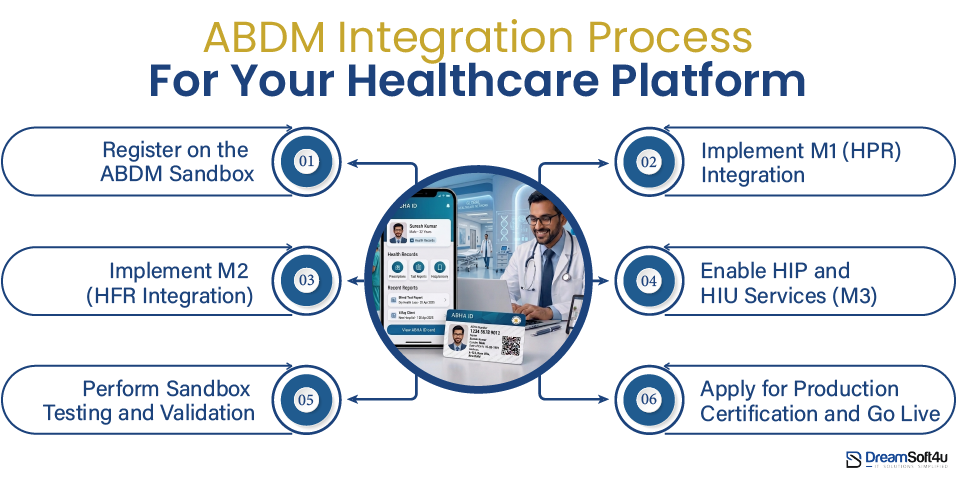
If you’re planning ABDM integration, the biggest mistake is treating it like a simple API task. It is not. It is a structured process where each step builds on the previous one.
Follow this step-by-step process for successful ABDM integration solutions with your healthcare platform:
Step 1: Register on the ABDM Sandbox
Start by registering your platform on the ABDM Sandbox at sandbox.abdm.gov.in. This is where every integration begins.
Create your developer account and get your Client ID and Client Secret. These are required to access ABDM APIs.
Now, go through the API documentation and understand how authentication, request formats, and response handling work.
Set up your Bridge URL so your system can communicate with the ABDM gateway.
At this stage, go through the API documentation carefully. Set up authentication using OAuth and ensure your system can send and receive API requests properly.
This step is not just a setup. It is where you understand how ABDM works technically. If you rush here, you will face confusion in every next step.
Step 2: Implement M1 (HPR) Integration
This step focuses on patient identity, which is the foundation of ABDM.
Your platform should be able to create, verify, and link ABHA IDs using mobile or Aadhaar-based flows. This ensures every patient has a unique digital identity in your system.
You need to make sure:
- ABHA creation flow is smooth and quick
- Existing patients can easily link their ABHA
- Duplicate records are avoided
- ABHA is used consistently across workflows
Also, make sure:
- Doctor profiles are accurate and complete
- Duplicate or unverified entries are avoided
- Each doctor is mapped correctly within your system
This step is important because ABDM is built on verified data. If your provider layer is weak, your entire system loses credibility.
Step 3: Implement M2 (HFR Integration)
Now bring your facility into the system.
Register your hospital or clinic in the Health Facility Registry. Submit accurate details like name, type, address, and licenses. After approval, you receive a unique HFR ID.
But don’t stop at registration.
You should:
- Link doctors with your registered facility
- Keep facility data accurate and updated
- Ensure your system reflects the same structure as the ABDM registry
This step officially brings your platform into the national healthcare network. Without this, your integration remains incomplete.
Step 4: Enable HIP and HIU Services (M3)
This is the most important and most complex step.
Now your platform starts handling real patient data.
Start by enabling ABHA ID verification and linking it with every patient record. Then build the consent flow. No data should be shared without patient approval.
You also need to:
- Structure your data in FHIR format
- Enable secure data exchange using APIs
- Ensure encryption during data transfer
As a system, you will act as both:
- HIP to share patient data
- HIU to request and use data
This step decides whether your integration actually works in real healthcare workflows.
Step 5: Perform Sandbox Testing and Validation
Before going live, test everything thoroughly in the sandbox.
Validate all major flows:
- ABHA creation and linking
- HPR and HFR registration
- Consent requests and approvals
- Data sharing and retrieval
Also check:
- Data encryption and security standards
- API response handling
- Error scenarios and fallback logic
This step helps you identify gaps early and ensures your system works reliably in real conditions.
Step 6: Apply for Production Certification and Go Live
Once testing is complete, apply for production access.
You will need to pass all required test cases and meet ABDM guidelines for security, privacy, and data handling. This includes proper consent flow, correct data formats, and stable APIs.
After approval, you receive production credentials and keys. Then your platform can go live and start handling real user data.
At this stage, your system becomes part of the national digital health ecosystem and can scale with real-world usage.
Do ABDM integration solutions feel complex or too technical to handle on your own?
Stuck in the Middle of ABDM Integration?
Our experts handle M1, M2 and M3 end-to-end — sandbox setup to production go-live. No confusion, no delays.
Get Free ABDM Integration Help ↗Why is ABDM Integration Required for Healthcare Platforms?
Here are six reasons why ABDM integration solutions are required for every healthcare platform:
1. Seamless Data Sharing Across Systems
Most healthcare platforms work in isolation. Labs, hospitals, and clinics store data separately, which slows everything down. ABDM fixes this by connecting all systems into one network. Your platform can send and receive health data smoothly, without manual effort or delays. This also reduces duplication of tests and missing information, which are common problems in disconnected systems.
2. Better Patient Control and Experience
Patients no longer have to carry reports or repeat their history at every visit. With ABHA, they can access and share their records instantly. This not only saves time but also builds trust, because patients stay in control of their own data. Over time, this leads to a more consistent and seamless patient journey across different providers.
3. Verified and Trusted Healthcare Network
One major issue in healthcare is data reliability. ABDM solves this by using verified registries for doctors and facilities. When you integrate, your platform works only with authenticated providers, which improves trust and reduces risk. It also helps maintain a standard level of quality across the ecosystem.
4. Secure and Consent-Based Data Sharing
Health data is sensitive. ABDM makes sure it is never shared without the patient’s permission. Every data request goes through a consent layer. This protects privacy and also gives users confidence in your platform. It creates a system where data access is transparent, controlled, and legally aligned.
5. Improved Operational Efficiency
Manual work slows teams down. From handling records to processing claims, everything takes time. ABDM reduces this load by digitizing workflows. Data moves faster, paperwork drops, and your operations become more efficient. This also helps teams focus more on care delivery instead of administrative tasks.
6. Better Clinical and Policy Decisions
When doctors get a full patient history in one place, their decisions improve. There is less guesswork and fewer errors. At the same time, structured data helps healthcare systems track trends and improve outcomes at a larger level. This supports better planning, monitoring, and overall healthcare quality.
5 Common Challenges in ABDM Integration & How to Fix Them
ABDM integration solutions look structured on paper. In real implementation, this is where most teams struggle. Here are the five most common challenges and how to handle them properly:
Challenge 1: Handling Consent and Asynchronous Workflows
ABDM does not work like normal APIs, where you get an instant response. Here, when you request patient data or send a consent request, the response comes later through a callback. If your system is not built to handle this delay, you may face issues like failed requests, missing updates, or data not syncing properly. This becomes a big problem when you are dealing with real patient data.
Solution: You need to design your system to handle delayed responses smoothly. Set up webhook handlers that can receive callbacks and process them correctly. Add retry logic so even if something fails once, it is handled again. You can also use middleware to manage these flows and keep your system updated in real time.
Challenge 2: Mapping Patient Identity Across Systems
In most healthcare platforms, patient data is already stored in different systems. A patient may have one ID in the hospital system, another in lab software, and another in radiology. When you try to connect everything using ABHA, it becomes difficult to match the correct records. This can lead to wrong data being shared or an incomplete patient history.
Solution: You need one central system to manage patient identity. Use a Patient Master Index that connects ABHA with all internal IDs. This ensures that no matter where the request comes from, your system always pulls the correct patient data without confusion.
Challenge 3: Converting Data into FHIR Format
ABDM requires all data in FHIR format. Most existing systems do not follow this standard. They store data differently, so even when your APIs work correctly, other systems may reject your data.
Solution: Add a conversion layer between your system and ABDM. Use middleware that converts your existing data into FHIR format before you send it. This structures your data correctly and allows every platform in the network to receive and use it without issues.
Challenge 4: Managing Connectivity and Infrastructure Issues
ABDM depends on internet-based APIs and OTP verification for many actions. In real-world setups, especially in smaller hospitals or clinics, internet connectivity is not always stable. This can cause failures in ABHA creation, consent approval, and data sharing.
Solution: Plan for such situations. Make sure you have a stable internet with backup options. Add fallback methods like biometric authentication if OTP fails. You can also allow offline data entry and sync it later when the internet is stable, so your workflow does not stop.
Challenge 5: Time, Cost, and Compliance Complexity
ABDM integration solutions are not a one-time task. It requires continuous updates, proper compliance with guidelines, and technical effort. Many teams think they can build it quickly, but later realize it takes more time and costs more than expected.
Solution: Instead of building everything from scratch, use ABDM-ready solutions or middleware. These already support the required APIs and standards. This helps you save time, reduce development effort, and achieve compliance faster without unnecessary complexity.
How DreamSoft4U Can Help in ABDM Integration?
At this point, you already understand one thing clearly – ABDM integration is not a simple integration and requires technical expertise.
If it is done right, your system becomes reliable and future-ready. If it is done wrong, it leads to delays, compliance issues, and constant rework.
This is where DreamSoft4U comes in.
We understand not just how ABDM works, but how to implement it smoothly in real healthcare systems. We take responsibility for getting it done.
Why do businesses choose us?
- 23+ years of real-world experience
- 1600+ projects delivered
- Complete ABDM integration ownership
- ABHA, HPR, and HFR setup done right
- HIP and HIU implementation with working consent workflows
- Expert FHIR data mapping
- End-to-end testing and certification support
- Custom integration strategy tailored to your platform
If you want to avoid delays, reduce complexity, and get ABDM integration done the right way from the start, this is the right time.
Ready to Integrate ABDM the Right Way?
From ABHA setup to production certification — DreamSoft4U delivers complete ABDM integration solutions with zero disruption to your existing platform.
Book a Free Consultation Today ↗Conclusion
ABDM integration is no longer something you can delay. It is becoming the base of how digital healthcare systems will work in India. If your platform is not ready, you will start facing gaps in data, compliance, and patient experience.
This guide walked you through everything about ABDM integration — what it does, why it matters, the challenges you may face, and exactly how to start with ABDM integration solutions for your healthcare platform.
Now it’s your turn.
You can either try to figure it out step by step and risk delays, or hire an experienced ABDM integration solutions partner like DreamSoft4U for seamless ABDM integration.
FAQs
Start by registering on the ABDM sandbox to get API access. Then implement ABHA for patient identity, integrate HPR and HFR for verification, and build HIP and HIU flows for consent-based data sharing. Proper testing and certification are required before going live.
ABDM integration solutions are built on three core modules. M1 covers ABHA and HPR for identity and verification. M2 covers HFR for facility registration. M3 handles HIP, HIU, consent management, and FHIR-based data exchange. All three are required for a complete and compliant setup.
Consent is the core of ABDM. No health data can be accessed or shared without patient approval. Every request goes through a consent flow where the patient allows or denies access. This ensures privacy, security, and legal compliance.
Most integrations fail due to poor planning. Common reasons include incorrect FHIR mapping, weak handling of asynchronous APIs, poor patient data mapping, and incomplete testing. These issues usually appear when teams start without understanding the full system.
FHIR is the standard format used to structure and share health data in ABDM. It ensures that data from different systems can be understood and used correctly. Without proper FHIR mapping, your platform will not be able to exchange data successfully.
ABDM connects different systems into one network. It allows faster data sharing, reduces manual work, improves patient experience, and helps doctors make better decisions with a complete medical history. This makes your platform more efficient and reliable.
The main challenges include handling asynchronous consent workflows, mapping patient identity across systems, converting data into FHIR format, and managing compliance requirements. These are the areas where most teams struggle during implementation.
If your team has deep experience in healthcare APIs, FHIR, and compliance systems, you can build it in-house. But in most cases, working with an experienced ABDM integration solutions partner helps you avoid delays, reduce risk, and go live faster with a stable system.