In healthcare, time is the scarcest resource, yet clinicians spend much of it at the keyboard instead of with patients. Research from Tebra found that for every 15 minutes a physician spends with a patient, they spend roughly 9 minutes charting in the EHR, and documentation now ranks as a leading driver of physician burnout.
AI in EHR software is the practice of embedding technologies such as machine learning, natural language processing, and generative AI directly into electronic health record and EMR systems, so the record can predict risk, draft documentation, surface guidance, and turn raw patient data into usable insight. Traditional EHR and EMR software mostly stores information. AI-powered EHR software acts on it.
For healthcare organizations, the question is no longer whether to adopt AI, but how to adopt it responsibly, inside workflows that clinicians actually trust.
In this guide, you will learn:
- How AI is reshaping traditional EHR and EMR software
- How predictive analytics improves patient care
- How AI supports faster and safer clinical decisions
- Real examples of AI running in healthcare systems today
- The core technologies behind intelligent EHR development
- A practical roadmap to add AI to your existing software
- How to handle compliance, security, and implementation challenges
Key Takeaways
- AI in EHR software embeds machine learning, NLP, and generative AI into electronic health records to predict risk, automate documentation, and support clinical decisions.
- Predictive analytics is the core shift: risk stratification, readmission and sepsis early warning, and operational forecasting from routine EHR data.
- AI-powered clinical decision support replaces noisy pop-up alerts with context-aware, prioritized guidance at the point of care.
- The fastest early ROI is often documentation automation. Multi-center studies show ambient AI scribes cut EHR time modestly but measurably and reduce clinician burnout.
- Success depends less on the model and more on clean data, interoperability (HL7, FHIR), compliance (HIPAA, GDPR, ABDM), and clinician trust.
Quick Snapshot: How AI Transforms EHR and EMR Software
Here is how AI changes the core functions of an EHR or EMR system at a glance:
| AI Capability | Use in EHR/EMR | Impact |
|---|---|---|
| Predictive Analytics | Detects patient risks like readmission, sepsis, and disease progression | Better outcomes, lower costs |
| Clinical Decision Support | Assists with diagnosis, treatment suggestions, and drug safety checks | Faster, safer decisions |
| AI Documentation | Converts conversations into clinical notes | Less paperwork, reduced burnout |
| Medical Coding Automation | Suggests billing and diagnostic codes | Faster claims, fewer errors |
| Patient Chatbots | Handles appointments, refills, and basic queries | Better patient engagement |
| Remote Monitoring AI | Tracks wearable and home health data | Early intervention, better chronic care |
| Population Health Analytics | Finds care gaps and high-risk patients | Improved preventive care |
| Generative AI Summaries | Summarizes patient records and discharge notes | Faster chart review |
| Scheduling Optimization | Predicts no-shows and improves scheduling | Better resource use |
Role of AI in EHR/EMR Software
AI turns EHR and EMR software from passive record systems into platforms that actively support clinical care and daily operations. Four capabilities do most of the work.
1. Administrative Automation
AI reduces the time healthcare teams spend on repetitive administrative work. It can draft clinical notes from doctor-patient conversations, assist with medical coding and billing, and speed up tasks such as prior authorization, so providers spend less time on paperwork and more on patient care.
2. Clinical Decision Support
AI helps clinicians decide faster and more accurately by analyzing patient history, lab results, medications, and vital signs in real time. It can flag potential health risks, catch drug interactions, and highlight care gaps before they turn into serious problems.
3. Personalized Patient Care
By combining data from EHR records, wearables, remote monitoring tools, and other health sources, AI gives providers a clearer view of each patient and helps them build treatment plans around individual needs rather than one-size-fits-all protocols.
4. Operational Efficiency
AI improves operations by optimizing appointment scheduling, predicting no-shows, triaging incoming messages, and helping staff prioritize urgent tasks. The result is smoother workflows and better use of beds, staff, and equipment across the organization.
AI-Powered EHR vs Traditional EHR: What Actually Changes
Before going deeper into the use cases of AI in EHR Software System, the side-by-side comparison below shows what has structurally changed.
| Dimension | Traditional EHR | AI-Powered EHR |
|---|---|---|
| Documentation | Manual typing, copy-forward templates, hours of after-hours charting, copy-paste errors that propagate | Ambient capture drafts the note while you talk, and clinicians shift to a review-and-sign workflow |
| Decision support | Static rules-based pop-ups, alert fatigue baked in, most clinicians dismiss on muscle memory | Context-aware ML recommendations tuned to your population, with clear reasoning surfaced inline |
| Data retrieval | Click-heavy tab navigation, manual keyword search through scanned PDFs that no one indexed | Conversational NLP query, semantic understanding of free text, structured answers in seconds |
| Interoperability | Brittle HL7 point-to-point feeds, batch ETL, silent drift that goes undetected for days | FHIR-native APIs, event streams, and agent-orchestrated exchange are treated as continuous product work |
| Patient engagement | Portal logins, reactive replies, mass email outreach with no personalization | Proactive nudges, AI chatbots, and RPM-driven alerts routed to clinical review by urgency |
| Coding and billing | Manual ICD-10 selection, frequent denials, weeks-long claim cycles | NLP-driven code suggestion, denial-pattern learning, near-real-time payer interaction |
| Clinical risk visibility | Retrospective dashboards, problems caught after the fact | Live risk scoring across vitals, labs, and notes with proactive alerts to the care team |
Why AI in EHR Software Matters Now
Five pressures are pushing AI from optional to expected in healthcare software.
1. Rising Physician Burnout
Doctors and healthcare staff spend too much time on documentation, data entry, and administrative tasks. This not only reduces time for patient care but also increases stress and burnout. AI helps by automating repetitive work and reducing manual effort.
2. Too Much Patient Data to Manage Manually
Healthcare providers now deal with far more patient data than before, including lab reports, imaging, wearable device data, remote monitoring records, and clinical notes. Managing and analyzing all this information manually is difficult, while AI can quickly turn this data into useful insights.
3. Stricter Compliance and Regulations
Healthcare organizations must meet strict privacy, security, and interoperability rules. Regulations such as HIPAA, GDPR, and ABDM require software to be secure, transparent, and standardized, so any AI system has to be built to satisfy those requirements from day one.
4. Growing Focus on Better Patient Outcomes
Payment models increasingly reward quality of care over volume of treatment. Reducing readmissions, improving chronic disease management, and delivering preventive care are now core priorities, and each is an area where AI can contribute directly.
5. AI is Now a Strategic Business Priority
Healthcare organizations are actively investing in AI to improve efficiency, reduce costs, and enhance patient care. What was once framed as future technology has become a practical business necessity.
Predictive Analytics in EHR: The Core Transformation
Predictive analytics in healthcare is the first half of the title hook. Once AI in EHR Software Development sits on a clean longitudinal record, it can forecast clinical and operational outcomes far more accurately than a traditional dashboard.
1. Risk Stratification Across Patient Cohorts
Machine learning models learn from large volumes of patient trajectories and assign individual risk scores for conditions such as heart failure, COPD, diabetes, and chronic kidney disease. Care teams use those scores to triage outreach and prioritize the highest-risk patients before complications escalate.
2. Hospital Readmission Prediction
CMS readmission penalties make 30-day returns costly. AI in EHR software predicts readmission risk using diagnoses, comorbidities, social determinants, and discharge data, helping care teams identify high-risk patients early and intervene before avoidable readmissions occur.
3. Sepsis and Clinical Deterioration Early Warning
Sepsis is a leading cause of in-hospital death, making early detection critical. AI analyzes live EHR data to identify early signs of deterioration, enabling faster intervention for conditions like sepsis, cardiac arrest, and post-operative complications. However, these models should be locally validated and carefully tuned before clinical deployment to ensure reliable performance.
4. Disease Progression and Chronic Care Modeling
AI can forecast disease trajectory for conditions such as diabetes, inflammatory bowel disease, oncology, and chronic kidney disease. Endocrinology teams use these signals to time medication changes and avoid emergency visits, and precision oncology workflows use treatment-response prediction to guide therapy selection closer to real time.
5. No-Show, Capacity, and Operational Forecasting
The same techniques forecast no-show probability, bed turnover, operating-room utilization, and emergency-department arrival patterns. AI-driven scheduling has been used to reduce cancellations by matching patients with appointment slots they are most likely to keep, and the operational ROI here often pays for an entire AI program within the first year.
Also Read: How to Develop an EHR Software System: Step-by-Step Guide
AI-Powered Clinical Decision Support: From Alert Fatigue to Smarter Clinical Decisions
Traditional clinical decision support often became more frustrating than helpful. Endless pop-up alerts, many of them irrelevant, trained clinicians to ignore warnings rather than act on them. AI changes that by making decision support smarter, faster, and far more useful at the point of care.
1. Faster Diagnostic Support
AI helps clinicians and clinical decision support software narrow down possible diagnoses by analyzing symptoms, history, lab results, and patient patterns in real time. Instead of manually connecting every data point, providers get faster insight that supports quicker and more confident decisions.
2. Smarter Treatment Recommendations
AI can suggest treatment options based on clinical guidelines, patient history, existing conditions, and even genetic factors, helping clinicians choose suitable plans while reducing decision delays.
3. Intelligent Drug Safety Alerts
Unlike rule-based alerts that mostly create noise, AI checks medications against allergies, current prescriptions, kidney function, and patient context, so it surfaces only meaningful risks such as dangerous interactions or incorrect dosing.
4. Real-Time Access to Clinical Guidelines
Medical guidelines change constantly and are hard to keep up with. AI-powered systems can surface the latest evidence and recommendations inside the EHR while decisions are being made, helping clinicians act on current information.
5. Continuous Patient Risk Monitoring
AI can continuously track vitals, lab trends, and health changes to catch early signs of complications. Whether it is sepsis risk, a drop in oxygen levels, or sudden deterioration, AI helps care teams respond earlier, before conditions become critical.
12 Ways AI in EHR Software Is Transforming Healthcare Beyond Predictive Analytics and CDS
Predictive analytics and clinical decision support get most of the attention, but the everyday value of AI in EHR software reaches well beyond them. Modern systems use AI to improve documentation, communication, operations, billing, and care delivery at every level. Here are 12 practical examples.
1. Ambient AI Documentation
Documentation is a major driver of physician burnout. Ambient AI automatically converts conversations into structured clinical notes, reducing manual documentation time. Studies show these tools consistently save clinicians time, helping reduce administrative burden and allowing more focus on patient care.
2. Voice-Based EHR Interaction
AI voice assistants make EHR systems easier to use. Clinicians can dictate notes, place orders, retrieve patient information, or navigate records by voice instead of clicking through screens, which improves speed and workflow during busy clinical hours.
3. Automated Medical Coding and Billing
Accurate coding is critical for clean claims and faster reimbursement. AI can review documentation, identify relevant diagnoses and procedures, and suggest billing codes automatically, which reduces coding errors, improves claim accuracy, and streamlines revenue cycle operations.
4. AI-Enhanced Medical Imaging Workflows
AI helps teams process imaging data faster and more accurately. It can analyze X-rays, CT scans, MRI reports, and pathology images to detect abnormalities and route findings directly into the EHR, which shortens diagnostic and reporting delays.
5. Intelligent Chart Summaries
Reviewing long patient histories is slow, especially in urgent care. Generative AI can summarize records, previous visits, discharge details, and treatment history into readable overviews, helping clinicians make faster decisions.
6. AI Chatbots for Patient Communication
AI chatbots connected to EHR systems can handle routine interactions such as appointment booking, refill requests, symptom intake, and basic questions, which reduces front-desk workload and improves response times for patients.
7. Smart Scheduling and Resource Planning
Missed appointments and inefficient scheduling create real losses. AI can predict no-shows, estimate visit durations, optimize clinician schedules, and improve allocation of beds, staff, and operating rooms.
8. Remote Patient Monitoring Intelligence
Care is moving beyond the clinic, and AI is central to that shift. It can process data from wearables, glucose monitors, blood pressure devices, and home tools to detect abnormal patterns early and alert care teams when intervention may be needed.
9. Personalized Treatment Planning
AI supports personalized care by analyzing patient history, lifestyle data, treatment responses, and clinical patterns, helping providers move away from one-size-fits-all care toward plans tailored to the individual.
10. Population Health Management
Managing care across thousands of patients by hand is nearly impossible. AI in EMR systems identifies high-risk groups, detects missed screenings, uncovers care gaps, and prioritizes outreach, which makes preventive and value-based care far more effective.
11. Fraud Detection and Revenue Protection
AI can flag unusual billing behavior, suspicious claim patterns, and revenue leakage by continuously analyzing financial and operational data, which helps organizations reduce fraud risk and protect reimbursement accuracy.
12. AI Clinical Copilots
The next generation of EHR systems includes AI copilots that assist with multi-step tasks such as drafting prior authorizations, preparing referrals, reconciling medications, and organizing documentation. They act as digital assistants that reduce repetitive workload and lift productivity across clinical teams.
See AI-Powered EHR Solutions We Have Already Built
Real healthcare AI projects – from predictive analytics to revenue cycle automation – delivered by DreamSoft4U.
Key AI Technologies Behind Intelligent EHR Software
AI in EHR software is not a single technology. It is a stack of methods, each suited to a different job.
- Machine learning: Powers predictive analytics such as risk scores, readmission and sepsis prediction, and no-show forecasting.
- Natural language processing (NLP): Reads unstructured clinical notes, extracts structured data, and enables conversational search across the record.
- Generative AI and large language models: Draft notes, summarize charts, and answer clinical questions in context. Healthcare-specific and smaller domain models are increasingly used where privacy and accuracy matter most.
- Speech recognition and ambient AI: Capture doctor-patient conversations and turn them into draft documentation automatically.
- Computer vision: Analyzes medical images such as X-ray, CT, MRI, and pathology, then routes findings into the EHR.
- Retrieval-augmented generation (RAG): Grounds AI output in a patient’s actual record and current guidelines, which reduces hallucination.
Under all of it sits the data layer: standardized terminologies such as ICD-10, SNOMED CT, LOINC, and RxNorm, and interoperability standards such as HL7 and FHIR, which let these models read and write clean, portable data.
How to Build an AI-Powered EHR/EMR System: 8 Steps
If you are planning to build a new AI-powered EHR/EMR system or upgrade your existing one, here is a practical step-by-step roadmap to follow:
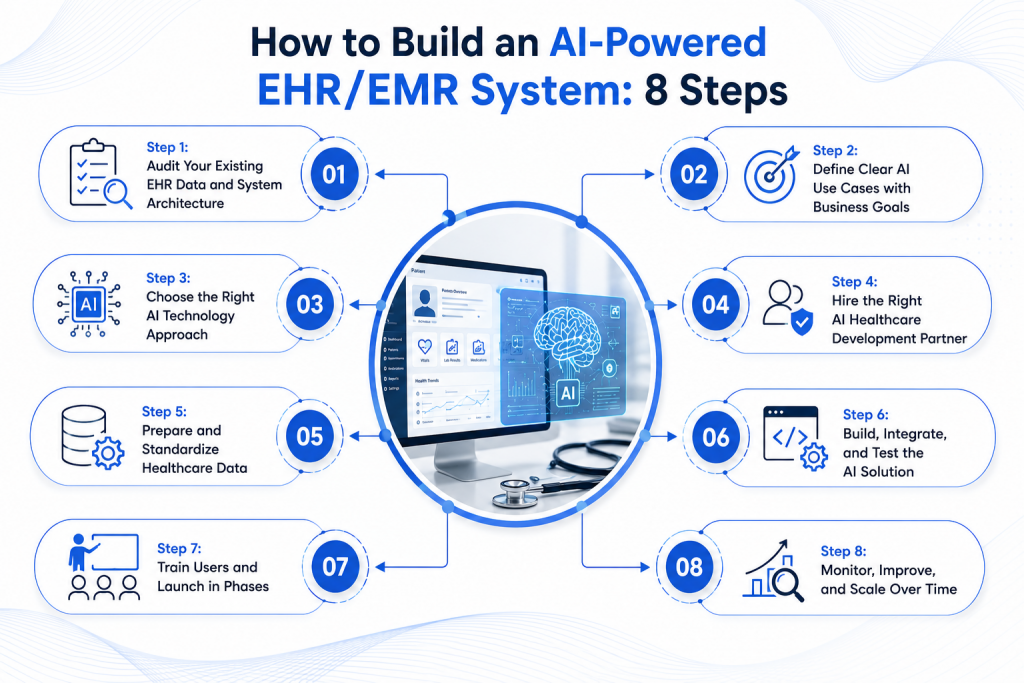
Step 1: Audit Your Existing EHR Data and System Architecture
Before thinking about AI features, understand what you already have. Review your current system, data quality, integrations, workflows, and infrastructure. Check whether your data is clean, structured, and usable across clinical notes, lab records, imaging, billing, and historical records. This step surfaces hidden issues like incomplete records, disconnected systems, outdated integrations, or inconsistent formats. If the foundation is weak, AI will only amplify the problems.
Step 2: Define Clear AI Use Cases with Business Goals
Do not start with AI just because it sounds innovative. Start from real problems you want to solve. Do you want to cut documentation time, predict readmissions, improve coding accuracy, or automate scheduling? Pick high-impact use cases with measurable goals, because clear targets make ROI easier to prove and keep the project focused.
Step 3: Choose the Right AI Technology Approach
Different AI problems need different solutions. Predictive analytics may call for machine learning; documentation automation may need NLP and speech AI; chatbots and summaries may fit generative AI. The goal is not to chase the latest trend, but to choose technology that solves your problem and can scale safely in a healthcare environment.
Step 4: Hire the Right AI Healthcare Development Partner
This is one of the most important decisions in the process. Healthcare AI is not like building a regular software product. It involves compliance, patient data security, interoperability standards, workflow complexity, and clinical accuracy.
Look for a healthcare AI development partner with proven healthcare software expertise and working knowledge of HIPAA, GDPR, HL7, FHIR, and DICOM. The right partner helps you avoid technical debt, reduce compliance risk, and move faster with confidence.
Step 5: Prepare and Standardize Healthcare Data
Once the partner is in place, focus on data preparation. AI depends on high-quality data, so your team will organize, clean, standardize, and structure it so models can use it. This may include mapping records to FHIR, organizing HL7 data, cleaning duplicates, normalizing terminology, and preparing secure datasets for training. It is unglamorous work that directly determines AI performance.
Step 6: Build, Integrate, and Test the AI Solution
This is where development begins. Your team builds the models, integrates them into EHR workflows, and makes sure the system runs smoothly during daily operations. The AI should feel like a natural extension of the software, not an extra burden. Testing is critical here: accuracy, usability, compliance, performance, and real-world reliability all need to be verified before go-live.
Step 7: Train Users and Launch in Phases
Even the best AI system fails if healthcare teams do not trust or use it. Start with a phased rollout rather than launching everything at once. Train clinicians, administrative staff, and other users properly, gather feedback early, and refine the workflows based on real usage. Adoption matters as much as development.
Step 8: Monitor, Improve, and Scale Over Time
AI is not a one-time implementation. Healthcare data, patient behavior, and regulations all change, and models can lose accuracy if left unmanaged. Continuous monitoring is essential: track performance, watch for errors, review compliance, retrain models when needed, and keep improving. Once your first use case proves successful, you can expand into additional features and larger deployments with confidence.
Compliance, Security, and Interoperability Considerations
AI in EHR software handles sensitive patient information, so security, compliance, and clean data exchange cannot be an afterthought. A powerful AI system is only useful if it is safe, compliant, and able to work with other healthcare systems.
1. Data Security and HIPAA Compliance
Patient data must be protected at every stage. That means strong encryption, secure access controls, multi-factor authentication, audit logs, and proper agreements with any third-party vendors handling patient information.
2. Regional Healthcare Regulations
Different countries have different rules. The US follows HIPAA, Europe follows GDPR, and India uses ABDM standards. If your software serves multiple regions, the AI system must satisfy every relevant compliance requirement.
3. Smooth System Integration
Healthcare systems rely on shared standards to exchange data. HL7 and FHIR move patient records between systems, while DICOM handles medical imaging. AI should integrate cleanly with these standards, so workflows stay uninterrupted.
4. Safe Use of Patient Data for AI Training
Models often need large volumes of data for training. To protect privacy, patient information should be anonymized or replaced with synthetic data wherever possible, especially when it is shared across teams or locations.
5. Transparency in AI Decisions
Providers need to understand why an AI system makes a given recommendation. Decisions should be traceable, explainable, and easy to review, particularly when they influence diagnosis or treatment.
6. Ongoing AI Monitoring and Risk Management
AI systems are not set-and-forget. Their performance has to be monitored to catch errors, behavior changes, or stale predictions. Continuous testing and updates are what keep them safe and reliable over time.
Also Read: How to Choose the Right AI Development Company for Healthcare
How Much Does AI in EHR Software Cost?
The cost of adding AI to EHR or EMR software depends on four main drivers: the complexity of the AI capability, the number and difficulty of integrations, the compliance and security requirements for your regions, and how much custom work your existing system needs. A single focused feature is very different from a full AI-native platform, and the ranges below reflect that spread.
| Project Type | Estimated Cost | Best For |
|---|---|---|
| Feature-Level AI Add-On | $25,000 to $80,000 | Smaller AI features such as AI documentation, basic risk prediction, or patient chatbots. Best for testing AI with lower investment and faster ROI. |
| Mid-Scale AI Module Integration | $80,000 to $250,000 | Adding predictive analytics, clinical decision support, coding automation, or workflow AI into existing EHR/EMR systems. Common for mid-sized organizations. |
| Full Custom AI-Powered EHR/EMR Development | $250,000 to $1.5M+ | Building a custom AI-native EHR platform or large-scale modernization across hospitals or networks. Ideal for enterprise-level transformation. |
These ranges are planning estimates. Your actual number depends on scope, data readiness, and the compliance footprint of the regions you serve.
Not Sure What AI in EHR Would Cost for Your Project?
Share your goals and get a clear, no-obligation cost estimate tailored to your system.
Common Challenges in AI in EHR Software Implementation (and How to Solve Them)
Every AI in EHR software projects runs into a familiar set of obstacles. The teams that succeed plan for them upfront instead of being surprised mid-build.
1. Data Quality and Standardization Gaps
Treat data preparation as a first-class workstream with a dedicated budget and timeline, not a checkbox during sprint planning. Most project delays trace back to this single area.
2. Legacy EHR Integration Friction
Use integration middleware such as Mirth Connect, Redox, or custom adapters with a phased migration plan rather than forcing a lift-and-shift. Plan for at least one surprise interface per legacy system.
3. Clinical Adoption and Trust Deficits
Involve clinical leadership from day one, run shadow-mode validation, and expose model reasoning through explainable AI before going live. Clinicians who feel ignored will quietly route around the AI for months.
4. Explainability and Transparency Demands
Select explainable architectures where feasible, layer techniques such as SHAP or LIME on top of complex models, and document decision paths for audit. Regulators and clinical staff increasingly expect both.
5. Scalability and Ongoing Model Maintenance
Build MLOps pipelines with drift monitoring, scheduled retraining, and clear ownership for production AI assets. A model nobody owns is a model nobody updates.
6. Vendor Lock-In Risk
Favor open standards such as FHIR and ONNX, keep training data and model artifacts under your control, and architect for portability from the start. The AI vendor landscape will keep shifting for years.
Future Trends: Where AI in EHR/EMR Software is Heading
The direction is reasonably clear if you watch where vendor investment and clinical research are converging.
1. Agentic AI Clinical Copilots as Default
Multi-step task agents become standard inside major EHR and EMR platforms, handling routine documentation, prior authorization, and order workflows with less clinician intervention.
2. Multimodal Models Combining Text, Image, and Voice
Single models that read notes, interpret images, and process audio start to replace separate specialized tools, and the integration burden drops sharply as model capability expands.
3. Continuous Monitoring via Wearables and RPM Convergence
AI-powered records become a continuous care record rather than an episodic one. Patients live inside the record between visits, not only during them.
4. Hyper-Personalized Care from Genomics and AI Integration
Polygenic risk scores combined with EHR and EMR data drive precision medicine workflows for cardiovascular, oncology, and metabolic conditions, and the average-patient model steadily loses ground to individualized care plans.
Why DreamSoft4U for AI-Powered EHR/EMR Development?
Building AI into healthcare software takes more than technical skill. It demands deep healthcare expertise, regulatory understanding, and proven integration experience, and that is where DreamSoft4U fits.
DreamSoft4U helps healthcare organizations build and modernize AI-powered EHR and EMR solutions with capabilities like predictive analytics, clinical decision support, AI documentation, interoperability integration, and custom healthcare software development.
Why choose us?
- 22+ years of healthcare software expertise
- 1600+ successful projects delivered
- HIPAA, GDPR, ISO 27001, and ABDM-ready development
- Strong interoperability expertise
- End-to-end AI development capabilities
- Proven EHR/EMR product experience
- Flexible engagement models
Ready to bring AI into your EHR/EMR software without breaking compliance or your timeline?
Conclusion
AI in EHR software is no longer just an emerging trend in healthcare. It is becoming a practical part of modern EHR and EMR systems, helping organizations improve patient care, reduce administrative workload, support faster clinical decisions, and run operations more efficiently.
From predictive analytics and clinical decision support to automation, remote monitoring, and personalized care, AI is creating real opportunities for healthcare businesses ready to modernize their systems.
The organizations that win will be the ones that pair the right use cases with clean data, solid interoperability, and genuine clinician trust.
Ready to Make Your EHR Software Smarter with AI?
We build compliant, scalable AI-powered EHR systems – from planning to deployment.
FAQs
AI in EHR software is the use of technologies like machine learning, natural language processing, and generative AI inside electronic health record systems. These tools automate repetitive tasks, analyze patient data faster, support clinical decisions, and improve overall healthcare workflows.
Traditional EHR analytics mostly look at past data and produce reports through dashboards. AI goes further by analyzing patient information in real time, spotting patterns, predicting risk, and offering recommendations while care decisions are being made.
The difference is the system, not the AI. EMR software is usually used within a single organization, while EHR systems are built to share patient data across multiple providers and networks. AI works in both, but EHR platforms typically operate on broader, more connected data.
Yes, AI in EHR software can be HIPAA-compliant when it is built correctly. That means secure encryption, access controls, audit tracking, protected data handling, and adherence to all required privacy and security standards.
It depends on complexity. A small AI feature or pilot may take a few weeks, while larger integrations involving predictive analytics, automation, or custom workflows can take several months. Full-scale AI-powered EHR development takes longer based on requirements.
AI can deliver strong returns by reducing documentation time, improving coding accuracy, lowering operational costs, reducing readmissions, and helping staff work more efficiently. The actual ROI depends on the use case and how well the solution is implemented.