

A pharmacy does not fail when it runs out of medicine. It fails when systems slow down decisions. Many pharmacies still rely on outdated data, manual checks, and slow workflows, which increase errors, raise costs, and reduce time for patient care.
Traditional pharmacy management software cannot handle this level of complexity. This is where AI in pharmacy management software helps by predicting demand, reducing risks, and automating key processes with better accuracy.
From inventory optimization and prescription validation to personalized patient support and compliance tracking, AI is turning pharmacy systems into smarter, decision-driven platforms.
Yet, many hospitals and clinics aren’t aware of the full potential of using AI in pharmacy management software.
So, if you’re facing challenges and don’t know how to handle them, then it’s time to understand the true potential of AI and how it can revolutionize your operations.
In this guide, you will see how AI is actually being used inside pharmacy systems, where it creates the most impact, how it solves real operational challenges, and what you should expect as AI adoption grows.
So, without any further delay, let’s dive in!
Role of AI in Pharmacy Management Software
AI in pharmacy management software makes your system smarter and more useful in daily operations.
Instead of just storing data, it helps you make better decisions. It uses past data and trends to predict medicine demand, so you can avoid stockouts and reduce waste. At the same time, it checks prescriptions in real time, detects drug interactions, and helps reduce errors, which improves patient safety.
AI also handles routine tasks like billing, prescription processing, and record management. This saves time and allows pharmacists to focus more on patients instead of manual work.
It also improves patient care by tracking medication adherence and sending reminders, making treatment more consistent and personalized.
Overall, AI connects everything in one system. It improves accuracy, reduces workload, and helps your pharmacy run more efficiently without depending on guesswork.
10 Key Use Cases of AI in Pharmacy Management Software
AI is not just improving pharmacy systems. It is solving the exact problems you deal with daily. From stock issues to patient safety and operational delays, these use cases show where AI creates real impact.
Here are the 10 most important use cases that matter in real-world pharmacy management:
1. Predictive Inventory Management
You no longer have to rely on assumptions to manage stock. AI studies past sales, seasonal demand, and local health patterns to predict what medicines you will need and when. This means fewer stockouts, less expired inventory, and better control over costs. You move from reacting to shortages to planning ahead with confidence.
2. Prescription Validation and Drug Interaction Detection
Manual checks are not enough when patient safety is at stake. AI reviews prescriptions in real time, checks dosage accuracy, and flags potential drug interactions or allergies. It acts as a safety net that catches what is easy to miss, helping you reduce errors before they reach the patient.
3. Medication Adherence Monitoring
The problem is not just prescribing the right medicine. It is making sure patients actually follow it. AI tracks adherence patterns and sends timely reminders when doses are missed. This improves treatment outcomes, especially for chronic conditions where consistency matters the most.
4. Automated Billing and Insurance Claims
Billing delays and claim rejections slow down operations more than most teams realize. AI automates claim processing, reduces errors, and ensures accurate documentation. The result is faster reimbursements, fewer disputes, and smoother financial workflows.
5. Workflow Automation
A large part of pharmacy time is spent on repetitive tasks. AI removes that burden by automating prescription processing, inventory updates, and record management. This not only improves speed and accuracy but also gives your team more time to focus on patients.
6. Personalized Patient Care
Every patient is different, but traditional systems treat them the same. AI changes that by using patient data to offer personalized medication guidance and health insights. This improves engagement, builds trust, and leads to better long-term outcomes.
7. Intelligent Chatbots and Virtual Assistants
Patients expect quick responses, not long wait times. AI-powered chatbots handle routine queries, refill requests, and basic support instantly. They work 24/7, reduce staff workload, and ensure patients always have access to information when they need it.
8. Supply Chain Optimization
Supply chain issues often show up when it is already too late. AI tracks the movement of medicines, predicts disruptions, and helps you plan better deliveries. It also ensures proper handling of sensitive drugs, reducing losses and improving reliability.
9. Data-Driven Clinical Decision Support
Pharmacies generate a lot of data, but very little of it is used effectively. AI turns that data into insights. It helps you identify patterns, predict risks, and make faster, more informed decisions that directly impact patient care.
10. Fraud Detection and Compliance Monitoring
Fraud and compliance issues are hard to track manually. AI identifies unusual patterns in prescriptions and billing, helping you detect problems early. It also maintains proper records and audit trails, making it easier to stay compliant without extra effort.
Want to implement these AI use cases in your pharmacy?
Turn insights into real results with DreamSoft4U – expert AI strategy and seamless integration for your pharmacy.
How to Implement AI in Pharmacy Management Software? 7 Steps
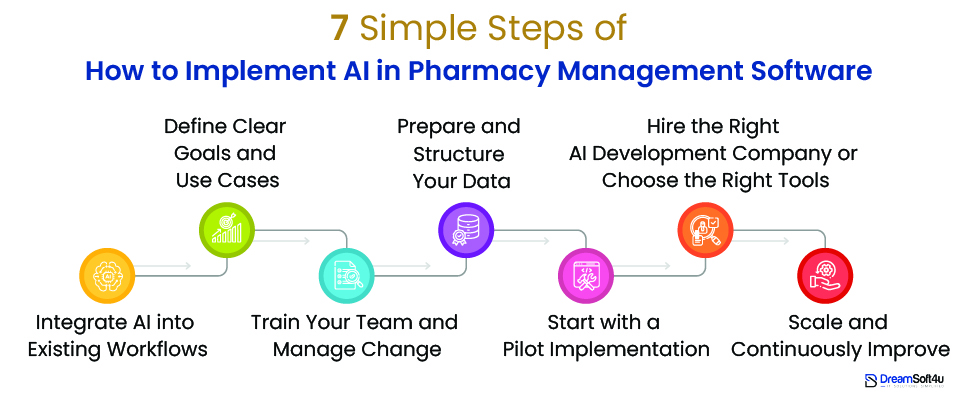
Here’s the step-by-step process to implement AI in pharmacy management software:
Step 1: Define Clear Goals and Use Cases
Start by identifying where your pharmacy system is actually struggling, such as inventory gaps, manual billing errors, or medication risks. Instead of applying AI everywhere, focus on high-impact areas where it can create immediate value. This keeps your implementation focused and ensures you solve real operational problems.
Step 2: Prepare and Structure Your Data
AI depends on clean and well-organized data to deliver accurate results. You need to collect, clean, and centralize data from inventory systems, patient records, and billing processes. At the same time, ensure data privacy and compliance standards are maintained so your system remains secure and reliable.
Step 3: Hire the Right AI Development Company or Choose the Right Tools
Choosing the right technology partner is critical for success. You can either integrate existing AI tools or work with an experienced AI development company that understands healthcare systems and compliance requirements. The right partner ensures smooth integration, scalability, and long-term reliability.
Step 4: Integrate AI into Existing Workflows
AI should fit into your current workflow instead of disrupting it. Design the system so that AI provides suggestions, flags risks, or automates tasks while keeping pharmacists in control of final decisions. This approach makes adoption easier and ensures trust in the system.
Step 5: Train Your Team and Manage Change
Your team needs to understand how to use AI effectively. Provide training on how AI insights work and how they should be used in daily operations. It is also important to address concerns and make it clear that AI supports their work by reducing manual tasks, not replacing them.
Step 6: Start with a Pilot Implementation
Before full deployment, test AI in a controlled environment such as a single pharmacy or a specific use case. Monitor performance, accuracy, and workflow impact during this phase. This helps you identify issues early and refine the system before scaling.
Step 7: Scale and Continuously Improve
Once the pilot is successful, expand AI across your operations. Continue monitoring performance, collecting feedback, and improving data quality over time. AI works best when it is continuously refined based on real-world usage and evolving needs.
By following this approach, you move from trial-and-error implementation to a system that is accurate, efficient, and aligned with real pharmacy needs.
Benefits of Using AI in Pharmacy Management Software
Here are six core benefits of using AI in pharmacy management software:
1. Improved Patient Safety & Care
AI adds a strong safety layer by analyzing patient history, detecting drug interactions, and flagging dosage risks in real time. It can identify issues that are often missed during manual checks, reducing medication errors significantly. At the same time, it supports personalized care through medication reminders and adherence tracking, helping patients follow treatments correctly and reducing hospital readmissions.
2. Optimized Inventory Management
AI uses predictive analytics to forecast medicine demand based on historical data, seasonal trends, and local health patterns. This helps you maintain optimal stock levels, avoid shortages of critical drugs, and minimize overstock that leads to expired inventory. It also monitors expiry cycles and improves overall inventory control, making your supply more reliable and cost-efficient.
3. Streamlined Operations & Workflow
AI automates repetitive tasks such as prescription processing, billing, insurance claims, and record management. This reduces administrative burden, improves accuracy, and speeds up daily operations. As a result, pharmacy teams can focus more on patient care instead of manual work, while overall productivity improves without increasing staff load.
4. Financial Efficiency & Cost Reduction
AI helps reduce operational costs by minimizing wastage, improving inventory planning, and reducing billing errors. It speeds up insurance claim processing, lowers rejection rates, and ensures accurate documentation. In addition, AI can detect unusual billing patterns or fraud risks, helping pharmacies protect revenue and maintain better financial control.
5. Enhanced Customer Service & Patient Experience
AI enables more personalized and responsive patient interactions. From automated reminders and refill notifications to AI-powered chat support, patients receive timely assistance without delays. This improves engagement, builds trust, and ensures a better overall experience, especially for patients managing long-term treatments.
6. Data-Driven Decision Making
AI analyzes large volumes of operational and clinical data to identify patterns, predict risks, and provide actionable insights. This helps pharmacy teams make faster and more informed decisions across inventory planning, workflow optimization, and patient care. It removes guesswork and ensures decisions are backed by real data.
6 Current Challenges in Hospital Pharmacy Management Software and How AI Resolves Them
Here are six common challenges in hospital pharmacy management software and how AI resolved them:
Challenge 1. Medication Waste and Stockouts
You often face two extremes at the same time. Either medicines sit in inventory and expire, or critical drugs run out when demand suddenly increases. This usually happens because traditional systems cannot predict demand accurately or track usage patterns in real time. The result is financial loss, emergency purchases, and delays in patient care.
Solution:
AI solves this by analyzing historical usage, seasonal trends, and real-time demand signals to predict what medicines will be needed. It helps you maintain the right stock levels, flags near-expiry medicines early, and supports smarter procurement decisions. This reduces waste, prevents shortages, and keeps your inventory balanced and reliable.
Challenge 2. Medication Errors and Patient Safety Risks
In a busy hospital environment, manual prescription checks can lead to missed drug interactions, incorrect dosages, or wrong medication selection. Even experienced pharmacists can miss details when dealing with high volumes, and these small errors can directly impact patient safety.
Solution:
AI acts as an additional safety layer by continuously verifying prescriptions against patient history, allergies, and known drug interactions. It flags risks instantly before dispensing, helping you prevent errors rather than correcting them later. This improves accuracy, reduces adverse drug events, and builds trust in your system.
Challenge 3. Operational Inefficiencies and Staff Overload
A large part of your team’s time goes into repetitive administrative work like billing, documentation, inventory updates, and claim processing. This slows down operations, increases workload, and reduces the time available for patient care, especially when staffing is already limited.
Solution:
AI automates these routine tasks, improving speed and accuracy across workflows. It handles prescription processing, billing, and data entry without manual effort, allowing your team to focus on patient interaction and clinical responsibilities. This improves productivity without increasing staff pressure.
Challenge 4. Data Silos and Lack of System Integration
In many hospitals, pharmacy data is scattered across different systems that do not communicate properly. This leads to inconsistent records, delays in accessing information, and poor visibility across operations, making decision-making slower and less reliable.
Solution:
AI connects these systems by integrating data into a single, unified view. It brings together inventory data, patient records, and operational workflows, giving you real-time insights. This improves coordination, reduces errors, and helps you make faster and more informed decisions.
Challenge 5. Regulatory Compliance and Documentation Burden
Meeting regulatory requirements and maintaining accurate records is a constant challenge. Manual documentation increases the risk of missing details, which can lead to compliance issues, penalties, or failed audits.
Solution:
AI simplifies compliance by automatically maintaining audit trails, tracking documentation, and ensuring processes follow required standards. It reduces manual effort while keeping your system audit-ready, helping you stay compliant without adding extra workload.
Challenge 6. Rising Operational Costs
Costs continue to rise due to wastage, inefficient inventory management, billing errors, and operational inefficiencies. Without proper control, these issues affect profitability and overall system performance.
Solution:
AI helps reduce costs by optimizing inventory, minimizing waste, automating workflows, and improving billing accuracy. It also detects inefficiencies early, allowing you to take corrective action. This leads to better financial control while maintaining high-quality patient care.
Top 5 Future Trends: What’s Next for AI in Pharmacy?
AI in pharmacy is moving fast. What you are seeing today is just the beginning. The next phase is not just about automation, but smarter systems that can predict, adapt, and even make decisions with minimal human input.
Here are the five most important trends you should watch:
1. Generative AI in Drug Discovery
AI is now moving from analyzing data to actually creating new drug possibilities. Generative AI can design new molecules, predict how they will behave, and filter out weak candidates early. This reduces the time and cost of research while improving the chances of success. For you, this means faster innovation cycles and quicker availability of new treatments.
2. Digital Twins and Smarter Clinical Trials
Clinical trials are becoming more data-driven and less dependent on traditional methods. Digital twins allow researchers to create virtual patient models and test treatments in a simulated environment. Combined with AI, this helps detect risks earlier, improve trial accuracy, and reduce time and cost. You can expect faster approvals and more reliable outcomes.
3. AI-Driven Personalized Medicine
Treatment is shifting from general protocols to patient-specific care. AI analyzes medical history, genetics, and behavior patterns to recommend the most effective treatment for each individual. This improves outcomes, reduces side effects, and increases patient adherence. For pharmacies, this means delivering more targeted and value-driven care.
4. Autonomous and Resilient Supply Chains
Supply chains are becoming smarter and more self-reliant. AI will not just track inventory but predict disruptions, suggest alternate sourcing, and adjust supply plans automatically. This reduces delays, prevents shortages, and ensures critical medicines are always available, even during demand spikes or external disruptions.
5. AI Automation in Compliance and Operations
Regulatory processes and daily operations are becoming more automated with AI. From maintaining audit trails to preparing compliance documents, AI reduces manual work and errors. At the same time, specialized AI systems are handling focused tasks like reporting, monitoring, and decision support, making operations faster, more accurate, and easier to manage.
How DreamSoft4U Can Help Build AI-driven Pharmacy Management Software?
Building an AI-driven pharmacy system is not just about technology. It is about solving real operational problems without breaking what already works.
That is where DreamSoft4U stands out. With over 23+ years of experience in healthcare and software development, we understand how pharmacy systems function at a ground level. We do not build generic AI solutions. We design systems that fit your workflows, improve accuracy, and scale as your operations grow.
Why choose us?
- End-to-end AI development
- 1600+ successful projects delivered
- 1000+ satisfied clients worldwide
- 98% client retention rate
- Expertise in AI, analytics, and healthcare systems
- Post-launch support and maintenance
Not Sure How to Implement AI in Your Pharmacy System?
Let DreamSoft4U design and implement your AI-driven pharmacy solution with seamless integration and faster results.
Conclusion
Pharmacy management is no longer just about managing medicines. It is about making the right decision at the right time, every single time. And that is exactly where most traditional systems fall short.
AI in pharmacy changes the way your pharmacy operates.
Instead of reacting to errors, shortages, or delays, you start predicting them. Instead of relying on manual checks, you work with systems that guide decisions, reduce risks, and improve accuracy across every step, from inventory and prescriptions to compliance and patient care.
We hope this guide helped you understand how AI is actually used in pharmacy management software, where it creates real impact, and how you can implement it the right way.
Now it’s your turn to take action. If your current system is slowing you down or creating risks, this is the right time to upgrade.
FAQs
1. How do you know if your pharmacy needs AI or just a system upgrade?
If your system is only slow or outdated, a basic upgrade can fix performance issues. But if you are facing repeated problems like stock mismatches, medication errors, heavy manual workload, or lack of decision visibility, then AI is the right step. AI is useful when your system needs to predict demand, automate tasks, and support decisions, not just manage data.
2. Which AI use cases deliver the fastest results in pharmacy management?
Inventory forecasting, prescription validation, and billing automation deliver the fastest and most visible results. These areas directly impact daily operations by reducing wastage, preventing medication errors, and speeding up financial processes. Starting with these use cases helps you see quick improvements without complex implementation.
3. How does AI reduce medication errors in pharmacy systems?
AI reduces medication errors by checking prescriptions in real time against patient history, allergies, and known drug interactions. It flags risks before dispensing, acting as a safety layer that supports pharmacists. This helps prevent errors instead of correcting them later, improving both safety and trust in the system.
4. How does AI improve inventory management in pharmacies?
AI improves inventory by predicting medicine demand using historical data, seasonal trends, and usage patterns. It helps maintain optimal stock levels, prevents shortages of critical medicines, and reduces overstock that leads to expired inventory. This makes your inventory more accurate, reliable, and cost-efficient.
5. What are the biggest challenges when implementing AI in pharmacy software?
The biggest challenges include poor data quality, unclear goals, and choosing the wrong implementation approach. If your data is not clean or structured, AI will not deliver accurate results. Without clear use cases, the system becomes complex without adding value. Planning and the right partner play a critical role here.
6. How can AI be integrated into existing pharmacy workflows without disruption?
AI works best when it supports your existing workflow instead of replacing it. It can suggest actions, flag risks, and automate repetitive tasks while pharmacists continue to make final decisions. This approach ensures smooth adoption and builds trust without interrupting daily operations.
7. What should you prioritize first when adopting AI in pharmacy management software?
You should start with one high-impact problem, such as inventory issues, medication errors, or billing inefficiencies. A focused approach helps you see measurable results faster, reduces implementation risk, and makes it easier to scale AI across other areas later.
8. Is AI in pharmacy management software worth the investment?
AI is worth the investment because it directly improves accuracy, reduces operational costs, and increases efficiency. Over time, the savings from reduced errors, better inventory control, and faster workflows outweigh the initial cost, making it a long-term value-driven decision.