







Choosing the wrong platform is one of the most expensive mistakes a business can make during eCommerce store development. It may seem like the right fit today, but as your store grows, you could face higher costs, limited flexibility, slower performance, and even a costly migration.
That is why the Magento vs Shopify vs WooCommerce debate matters. Each platform is built for different business needs.
Shopify focuses on speed and simplicity, WooCommerce gives you complete ownership, and Magento, now officially known as Adobe Commerce, is designed for large, complex businesses that need maximum flexibility.
The challenge is knowing which one fits your business, not which one has the longest feature list.
In this guide, you’ll compare Magento, Shopify, and WooCommerce on cost, features, scalability, and SEO to find the right platform for your business.
By the end, you’ll know exactly which platform is the best fit for your business today and which one can support your growth tomorrow.
Magento vs Shopify vs WooCommerce: The Quick Answer
Here is the Magento vs Shopify vs WooCommerce call in one table, before we get into why:
| Platform | Built for | Walk away if |
|---|---|---|
| Shopify | Fast launches, lean teams, D2C brands that want the infrastructure handled | You need deep backend logic, custom checkout rules, or zero platform fees |
| WooCommerce | Content-led brands already on WordPress that want full ownership | You have no developer and no appetite for hosting, patching, and plugin upkeep |
| Magento (Adobe Commerce) | Complex catalogs, B2B workflows, multi-store and multi-market operations | Your catalog is simple, and you cannot fund a dedicated engineering team |
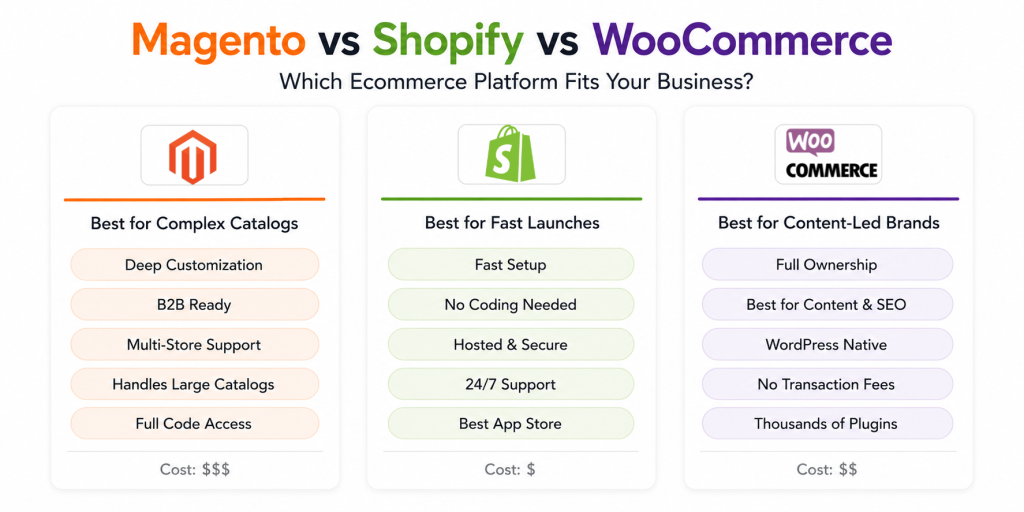
In short, Shopify wins on speed, WooCommerce wins on ownership, and Magento wins on depth.
What Each Platform Actually Is
Before you weigh Magento vs Shopify vs WooCommerce on any factor, it helps to be precise about what you are choosing between. These three are not variations of one product. They are three different bargains.
1. Shopify: The Fully Hosted SaaS Platform
Shopify handles hosting, security, updates, and payment compliance for you. You rent the infrastructure and get on with selling. Its app store covers most of what a growing store needs without a line of code, which is why lean teams reach for it first.
2. WooCommerce: The Open-Source WordPress Plugin
WooCommerce is not a standalone platform. It is a free plugin that turns a WordPress site into a store, which means you inherit the largest content ecosystem on the web. You also inherit the servers, the patching, and the plugin conflicts.
3. Magento (Adobe Commerce): The Enterprise Open-Source Platform
Magento is built for complexity that breaks other platforms. Multi-store from one admin, native B2B, code-level control of every workflow. The open-source edition costs nothing to download, and the real bill arrives as hosting, engineering, and maintenance.
Magento vs Shopify vs WooCommerce: Side-by-Side Comparison Table
This is the Magento vs Shopify vs WooCommerce comparison in full. Read it top to bottom, then jump to the factors that decide your case.
| Criterion | Magento (Adobe Commerce) | Shopify | WooCommerce |
|---|---|---|---|
| Type | Self-hosted or Adobe Cloud | Hosted SaaS | Self-hosted WordPress plugin |
| Core cost | Free (Open Source) | Subscription tiers | Free plugin |
| Hosting | Yours | Included | Yours |
| Time to first sale | Weeks to months | Hours to days | Days to weeks |
| Technical skill needed | Developer team essential | None | WordPress comfort |
| Catalog ceiling | Hundreds of thousands of SKUs | Unlimited, capped variants | Tens of thousands with tuning |
| Customization | Code-level, unlimited | Front-end freedom, backend limits | High via plugins and code |
| SEO control | Full server-side control | Good, some URL constraints | Full via Yoast or RankMath |
| Content and CMS | Capable, multi-store | Basic blogging | Best in class (WordPress) |
| Security and PCI | Yours to manage | Handled for you | Yours to manage |
| Transaction fees | None from the platform | Applies outside Shopify Payments | None from the platform |
| B2B and wholesale | Native and deep | Strong on the Plus tier | Plugin-dependent |
| Multi-store | Native, one admin | Plus tier only | Multisite workaround |
| Headless ready | GraphQL and PWA Studio | Hydrogen and Oxygen | REST and GraphQL |
| Official support | Paid tier only | 24/7 chat and phone | Community only |
Shopify vs Magento: Key Differences at a Glance
Shopify and Magento serve fundamentally different business profiles. Shopify is a fully hosted SaaS platform built for speed — you can launch a store in days with no developer and no infrastructure to manage.
Magento (Adobe Commerce) is an open-source enterprise platform built for complexity — multi-store operations, B2B workflows, and deep cataloge customization that Shopify cannot handle natively. If your priority is fast launch and lean operations, Shopify wins. If you need code-level control, layered pricing, or multi-market management from one backend, Magento is the stronger long-term choice.
Magento vs Shopify vs WooCommerce: 12 Factors That Decide the Call
These 12 factors tell you what it feels like to run one. We pulled them from the criteria that surfaced across every serious comparison, then ranked them by how often they end up driving the decision.
1. Ease of Use and Time to Launch
Shopify is the only one of the three that a non-technical founder can run alone. You sign up, pick a theme, load products, and take money the same week.
WooCommerce asks for WordPress literacy. Installing the plugin takes minutes. A store you would actually put a brand behind takes a few weeks of theme work, plugin selection, and hosting setup.
With Magento, the timeline stretches into months, and the work belongs to engineers. The admin panel rewards people who know it and punishes everyone else.
2. Total Cost of Ownership
The sticker price misleads on all three. Shopify looks expensive and often is not, because the subscription absorbs hosting, security patching, and compliance you would otherwise pay a team to handle.
WooCommerce inverts that math completely. A free core plus budget hosting looks like a bargain, until premium plugins, developer hours, and performance tuning land on the same invoice.
Magento is honest about being costly. The spend arrives up front as build and infrastructure, then flattens out once the platform absorbs workflows that would need custom apps elsewhere.
3. Customization and Flexibility
If you can describe the workflow, Magento can build it. Full source access, modular architecture, and no vendor deciding what your checkout is allowed to do.
Shopify draws a firmer line. Themes and Liquid give you real front-end freedom, but deep backend logic means apps, middleware, or a jump to the Plus tier.
WooCommerce lands between them. You own the code, so nothing is technically off-limits, though heavy customization tends to surface performance problems that Magento’s architecture handles natively.
4. Design, Themes and Front-End Control
Look at what ships in the box and Shopify wins immediately. Its curated theme library is polished, mobile-ready, and needs almost no setup to look credible.
WooCommerce trades polish for choice. Thousands of WordPress themes mean you will find something close to your brand, though quality swings hard between marketplaces.
Magento gives you a blank canvas and a demo theme, which is a fair description of the whole platform. Most brands commission a custom build, and most budgets feel it.
5. Content and CMS Capability
WooCommerce simply has the better foundation. It sits inside WordPress, which means every taxonomy, editorial workflow, and content type you could want already exists.
Magento handles content competently and manages it across multiple storefronts, but there is no native drag-and-drop editor, and marketers usually need help.
Shopify gives you a working blog and stops there. For product-led brands, that ceiling is usually high enough to ignore.
6. SEO Control
Technical SEO is where self-hosted platforms earn their maintenance burden. Magento hands you server-level access, native URL rewrites, canonical control, and structured data you can shape for multi-market catalogs.
WooCommerce matches most of that through Yoast or RankMath, and beats Magento on the content side of search because WordPress was built for publishing.
Shopify has closed the gap and now covers what most stores need. Fixed URL prefixes and limited server access still block advanced faceted navigation and complex multi-domain setups.
7. Performance and Page Speed
Out of the box, nothing beats Shopify. Every store sits behind a global CDN on infrastructure Shopify tunes, so a fast site is the default rather than a project.
Magento is the widest spread on this list. Put it on budget hosting, and pages crawl; give it Varnish, Redis, Elasticsearch, and a CDN, and it runs as fast as anything in commerce.
WooCommerce follows the same logic on a smaller scale. Managed WordPress hosting with object caching performs well, while shared hosting quietly costs you mobile conversions.
8. Scalability and Catalog Complexity
Magento was engineered for catalogs that break other systems. Hundreds of thousands of SKUs, layered attributes, multi-warehouse inventory, and pricing rules that change by customer segment.
Shopify scales beautifully on volume and less well on complexity. Product counts are unlimited, but variant limits and rigid attribute handling bite once your catalog gets genuinely intricate.
WooCommerce runs far larger stores than its reputation suggests, though it needs dedicated infrastructure and database indexing to get there. The default setup starts labouring in the low thousands of products.
9. Security and Compliance
Shopify’s real product is that you never think about this. PCI DSS at the highest level, SSL, patching, DDoS protection, and uptime all sit on their side of the line.
On WooCommerce, security is a habit you have to keep. One neglected plugin update is the most common way a WordPress store gets compromised, and nobody is coming to fix it for you.
Magento gives you granular control and expects you to use it. Adobe ships patches regularly, and stores that skip them stay exposed until someone notices.
10. Payment Gateways and Transaction Fees
This one is pure arithmetic. WooCommerce and Magento take nothing from your transactions, so you pay your gateway and nothing else.
Shopify adds a platform fee on every order that does not run through Shopify Payments. The fee shrinks as you climb the plans, but it never disappears outside the Plus tier.
At low volume that difference is noise. At high volume it becomes a line item worth modelling before you commit, particularly in markets where Shopify Payments is unavailable.
11. Apps, Extensions and Enterprise Integrations
Shopify’s app store is the most frictionless marketplace in commerce. Thousands of apps, installed in clicks, each with a monthly fee that quietly compounds into a real budget.
WooCommerce inherits tens of thousands of WordPress plugins, most of them free. The tradeoff is that nobody tests them against each other, so conflicts are part of the job.
Magento’s marketplace is smaller, and that misses the point entirely. Its REST and GraphQL layers exist for ERP, CRM, and PIM integration, which is why complex operations land there. If your commerce layer must talk to a custom ERP software development stack, this factor outranks most others.
12. B2B and Wholesale Capability
Magento treats B2B as a first-class citizen. Company accounts with roles, request-for-quote workflows, negotiated pricing, purchase orders and shared catalogs all ship natively.
Shopify Plus has moved hard into this space and now covers company accounts, price lists, quantity rules and payment terms. For a lot of wholesale operations, that is genuinely sufficient.
WooCommerce depends on plugins here, which works for straightforward wholesale and strains under layered pricing logic. Teams comparing B2B eCommerce development companies usually hit this ceiling first.
What Each Platform Really Costs to Own
Cost is where Magento vs Shopify vs WooCommerce comparisons usually go soft. Here are the ranges we see on real projects, and the ones nobody advertises.
Build and Launch Costs
This is your one-time spend to get live with something you would actually promote.
| Cost layer | Magento | Shopify | WooCommerce |
|---|---|---|---|
| Design and theme | $2,000 to $20,000 (custom) | $0 to $500 | $0 to $2,000 |
| Development and setup | $25,000 to $150,000+ | $2,000 to $25,000 | $4,000 to $40,000 |
| Data migration | $5,000 to $30,000 | $2,000 to $15,000 | $2,000 to $12,000 |
| Integrations (ERP, CRM, PIM) | $10,000 to $60,000 | $3,000 to $25,000 | $4,000 to $30,000 |
| Typical launch total | $40,000 to $250,000+ | $5,000 to $60,000 | $10,000 to $80,000 |
Ongoing Annual Running Costs
The recurring bill is what separates a comfortable platform from a painful one.
| Cost layer | Magento | Shopify | WooCommerce |
|---|---|---|---|
| Licence or subscription | $0 (Open Source), or heavy annual licence on Adobe Commerce | Roughly $470 to $28,000 per year across tiers | $0 |
| Hosting and infrastructure | $2,400 to $60,000 per year | Included | $360 to $6,000 per year |
| Extensions and apps | $1,000 to $15,000 per year | $1,200 to $20,000 per year | $500 to $6,000 per year |
| Maintenance and patching | $12,000 to $90,000 per year | $0 to $6,000 per year | $3,000 to $30,000 per year |
| Platform transaction fees | None | Applies outside Shopify Payments | None |
Get a Real eCommerce Development Cost Estimate, Not a Guess
Magento, Shopify, and WooCommerce development costs vary widely by catalog size and integrations. Get a cost breakdown scoped to your actual needs.
Request a Free eCommerce Cost BreakdownWho Should Choose Which Platform
Here’s the quick overview to choose between Magento vs Shopify vs WooCommerce:
Shopify Works Best If:
- Speed matters most: You need to be selling in weeks, not quarters, and every week of delay costs revenue.
- You have no developer: Nobody on your team wants to own hosting, patching, or uptime, and nobody should have to.
- Your catalog is straightforward: Products, variants, and standard checkout cover what you sell.
- You sell across channels: Website, social, marketplaces, and physical retail all need to share one inventory.
- Predictable cost wins: You would rather pay a known monthly figure than manage a variable infrastructure bill.
WooCommerce Is the Right Call If:
- Content drives your growth: Organic search and publishing are your acquisition engine, not a side channel.
- You already run WordPress: Your site has content equity you are not prepared to abandon.
- Ownership is non-negotiable: You want your data, your code, and your hosting under your own control.
- Transaction fees hurt: Your volume makes a platform cut on every order genuinely expensive.
- You have technical support: A developer or partner agency actively maintains the site.
Choose Magento if:
- Your catalog is complex: Thousands of SKUs with layered attributes, bundles or multi-warehouse inventory.
- B2B is core: You need company accounts, negotiated pricing and quote workflows without plugin gymnastics.
- You run multiple storefronts: Several brands, regions, currencies or languages from a single backend.
- Integration depth decides everything: Your ERP, CRM and PIM stack has to sit at the centre of commerce.
- You can fund a team: Dedicated engineering capacity is available, in-house or through a partner.
Why DreamSoft4u Is the Right Partner Behind Your Platform Call
We have spent 22+ years building commerce systems on all three, so we will tell you when the answer is not the expensive one. That perspective is what clients pay us for.
- Cross-platform, not vendor-locked:We engineer stores on Shopify, Magento, WooCommerce and Salesforce, plus custom eCommerce development when none of them fit.
- Proof at volume: 1600+ projects delivered and 100+ engineers across a global delivery footprint spanning the US, India, the UK, Europe, the Middle East and Australia.
- Compliance-grade by default: Layered security with encryption and tokenization, built against PCI DSS and GDPR from the first sprint rather than bolted on before launch.
- Migration without data loss: We move legacy stores onto modern frameworks with SEO preserved, redirects mapped and downtime measured in minutes.
- Integration depth: Payment gateways, ERP, CRM, inventory, shipping and marketing automation connected as one system, not a chain of plugins.
- Outcomes you can point at: Our OmniCart eCommerce platform rebuilt a checkout that was leaking carts, and the abandonment rate dropped where it mattered.
Book your free consultation with our software experts today and get a clear, practical roadmap.
Conclusion
The Magento vs Shopify vs WooCommerce decision comes down to a trade you have to make deliberately. Shopify sells you speed and takes some control. WooCommerce hands you ownership and hands you the maintenance with it. Magento gives you depth and asks for a team to wield it.
None of them is the best platform, and one of them is the best platform for you. Work the seven steps, price three years rather than three months, and check the exit cost before you sign anything.
We hope this guide helped you understand how the three platforms genuinely differ, and where each one stops making sense. Now it is your turn to run your own numbers against the framework above.
Not Sure Which Platform Fits Your Business?
Tell us your requirements and we’ll recommend the right eCommerce platform — no sales pitch, just honest advice.
Book a Free Consultation TodayFrequently Asked Questions
None of them wins outright. Shopify suits businesses that want speed with no infrastructure burden. WooCommerce suits content-led brands that want ownership. Magento suits complex catalogs and B2B operations with engineering support behind them.
Magento Open Source is free to download and run. You still pay for hosting, extensions, development and maintenance, and Adobe Commerce carries a substantial annual licence on top of all of that.
Yes, with the right infrastructure. Dedicated hosting, object caching, and proper database indexing let WooCommerce run tens of thousands of products. The default setup starts slowing well before that threshold.
WooCommerce and Magento give you the most control, since both allow full URL customization and server-level access. Shopify has improved considerably and covers what most stores need, with some structural URL limits remaining.
Shopify applies a platform fee on orders processed outside Shopify Payments, and that fee reduces as you move up plans. Neither Magento nor WooCommerce takes any cut of your transactions.