
Every day, healthcare organizations exchange claims, eligibility checks, prescriptions, lab results, and payment data. When this information moves smoothly, patients receive faster care and providers get paid on time. But manual processes and disconnected systems often lead to delays, errors, higher costs, and compliance challenges.
That is where EDI integration in healthcare comes in. It enables providers, payers, pharmacies, laboratories, and other healthcare partners to exchange data automatically through a secure, standardized format. The result is faster workflows, fewer errors, and a more connected healthcare ecosystem.
In this guide, you’ll learn:
- What EDI integration in healthcare is
- How it works step-by-step
- Key standards and transaction sets
- Benefits of EDI integration
- How to implement it successfully
By the end, you’ll understand how EDI integration helps healthcare organizations speed up claims, reduce errors, stay compliant, and improve overall efficiency.
What Is EDI Integration in Healthcare?
EDI (Electronic Data Interchange) is a standard way for healthcare organizations to exchange data electronically. Instead of using paper, faxes, emails, or manual data entry, EDI allows computer systems to share information automatically in a common format.
In healthcare, EDI is used to exchange claims, eligibility checks, payment information, prior authorizations, enrollment details, and other administrative data between providers, payers, pharmacies, laboratories, and clearinghouses.
EDI integration takes this one step further. It connects EDI directly with your EHR, billing software, practice management system, and other healthcare applications. This allows data to flow automatically between systems without manual work.
Simply put, EDI integration in healthcare helps organizations exchange accurate data faster, reduce errors, speed up claims processing, and improve overall operational efficiency.
Why EDI Integration Matters in Modern Healthcare
Administrative waste is one of the biggest hidden costs in healthcare. The latest CAQH Index reports that U.S. healthcare avoided about $258 billion in administrative costs through electronic transactions and better data exchange. That number shows how much value sits inside automation that many organizations have not fully captured yet.
There is still room to gain. The same research points to roughly $21 billion in additional savings still available through fuller automation of manual and partly manual transactions.
In other words, the organizations that integrate deeply are the ones that keep pulling ahead on cost and speed.
In fact, demand is climbing alongside that opportunity. Analysts value the healthcare EDI market at nearly $4.72 billion and expect it to reach $7.72 billion at a 10.33% yearly growth rate. Interoperability rules, cloud adoption, and value-based care all drive that momentum.
For a modern provider or payer, strong EDI integration in healthcare is no longer optional. It is the backbone that keeps claims, compliance, and partner data moving at the speed of care.
Healthcare EDI Standards Explained
Standards are the foundation of every exchange, so it helps to know the main ones. Each serves a different slice of healthcare data, and modern EDI integration in healthcare often blends several at once.
1. ANSI X12 (ASC X12)
ANSI X12 is the standard behind almost every administrative and financial transaction in U.S. healthcare. Claims, eligibility checks, and payments all ride on it. Under HIPAA, it is the format covered entities must use for these exchanges.
2. HL7 and FHIR
HL7 handles clinical data like lab orders, patient encounters, and immunization records. FHIR is its modern, API-based successor, built for faster and more flexible integration. Together they connect the clinical and administrative sides of care, as our HL7 FHIR and interface guide explains.
3. NCPDP for Pharmacy Transactions
Pharmacy needs its own standard, and that is NCPDP. It powers e-prescribing, medication history sharing, and drug benefit checks. When a pharmacy verifies coverage in real time, NCPDP is usually doing the work behind the scenes.
4. EDIFACT for Global Exchange
EDIFACT is the international standard used widely across Europe and Asia. Healthcare organizations that work with global partners rely on it for referrals, admissions, and financial documents. For any provider with cross-border data, it matters as much as X12.
Here is how the main standards compare at a glance.
| Standard | Primary Use |
|---|---|
| ANSI X12 (ASC X12) | U.S. administrative and financial transactions such as claims, eligibility, and payments |
| HL7 (v2, CDA) | Clinical data exchange like lab orders and patient records |
| FHIR | Modern, API-based clinical and administrative exchange |
| NCPDP | Pharmacy and e-prescribing transactions |
| EDIFACT | International EDI exchange outside the U.S. |
EDI Transaction Types Table
| Transaction Set | Name | Used For |
|---|---|---|
| 837 | Health Care Claim | Provider submits a claim to a payer |
| 835 | Health Care Claim Payment/Remittance | Payer sends back payment and remittance details |
| 270 | Eligibility, Coverage or Benefit Inquiry | Provider checks a patient’s coverage |
| 271 | Eligibility, Coverage or Benefit Response | Payer responds with eligibility details |
| 276 | Health Care Claim Status Request | Provider asks for a claim’s current status |
| 277 | Health Care Claim Status Response | Payer reports the claim’s status |
| 278 | Health Care Services Review (Prior Authorization) | Requests/responds to prior authorization |
| 834 | Benefit Enrollment and Maintenance | Enrolls or updates a member in a health plan |
| 820 | Payment Order/Remittance Advice | Premium payment instructions to a payer |
How EDI Integration Works in Healthcare: Step-by-Step
Let me walk you through what actually happens when a transaction moves through the system. Picture a hospital submitting a claim after a patient visit. Follow it step by step, and the whole flow becomes clear.
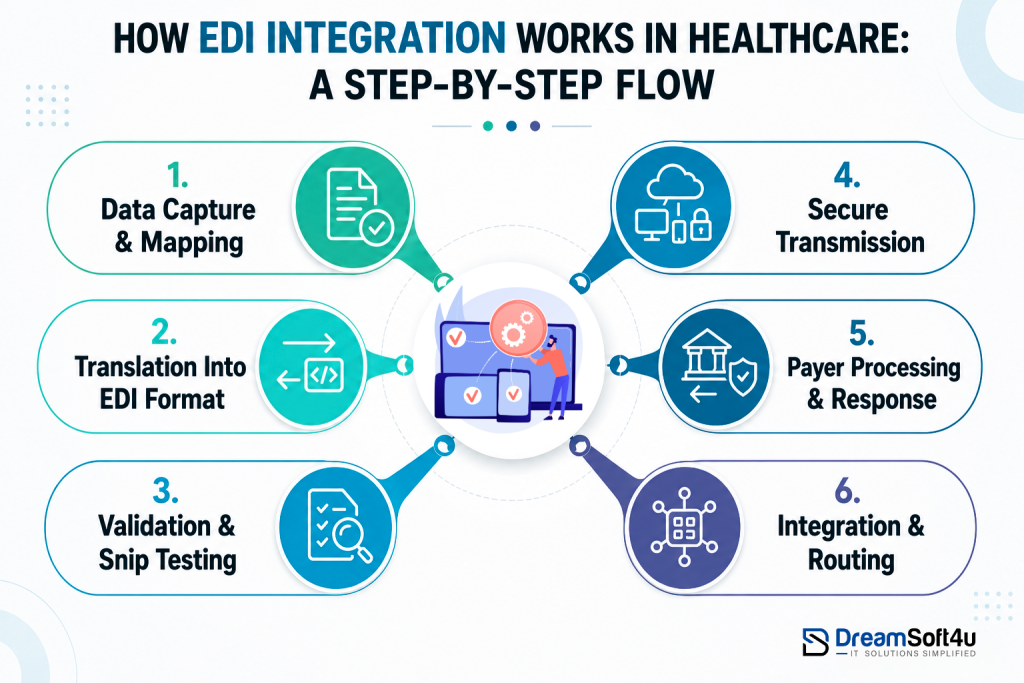
1. Data Capture and Mapping
First, your system gathers the raw data, such as patient details, diagnosis codes, procedures, and charges. Mapping then lines up each of those fields with the matching field in the EDI standard. Think of this as translating your everyday records into a form every partner can read. Get the mapping right once, and every future file follows the same clean structure.
2. Translation Into EDI Format
Next, translation software converts the mapped data into the standard file, usually an X12 document like the 837. The output is not human-friendly, and that is the point. It is a tightly structured message built for machines, not for the eye. This step is where our EDI development expertise saves teams hours of custom scripting.
3. Validation and Snip-Level Testing
Before anything goes out, the file gets checked for accuracy. Healthcare uses a method called Snip levels, which validates a document across several layers to confirm nothing is missing or mismatched. For example, one level checks that service-line totals add up to the claim total. Passing these checks up front is what keeps denials low later.
4. Secure Transmission Through Clearinghouses
Now the file travels, often through a clearinghouse that sits between you and the payer. The clearinghouse validates the claim again, flags any errors for correction, and routes it to the right payer. Transmission happens over secure protocols like AS2 or SFTP, so the data stays protected the entire way.
5. Payer Processing and Response
The payer receives the claim, processes it, and decides on payment. It then sends back a response, typically an 835 with payment and remittance details. That response travels through the same secure channel, so your team gets a clear answer without chasing anyone.
6. Integration and Routing Into Core Systems
Finally, the incoming data gets translated back into a format your systems understand. It routes automatically into your billing platform, accounting tools, and records. This last step is what makes EDI integration in healthcare feel effortless, because the answer simply appears where your team already works.
Top 10 Benefits of EDI Integration in Healthcare
The case for EDI is strong once you see the payoffs stacked together. These are the benefits that keep providers and payers investing in EDI integration in healthcare.
1. Lower Administrative Costs
Manual claims, faxes, and paper trails quietly drain your budget every day. Automating these exchanges cuts the cost of postage, printing, and rework across the board. Your team then spends less time keying data and more time on work that helps patients.
2. Higher Data Accuracy
Every manual touchpoint is a chance for a typo, a missed field, or a wrong code. EDI removes most of those touchpoints by validating data before it leaves your system. You get cleaner records and information your partners can actually trust.
3. Faster Claims and Payments
Paper claims can sit for weeks before anyone acts on them. With EDI, a claim reaches the payer in seconds and remittance returns the same way. That speed shortens your billing cycle and steadies your cash flow.
4. Stronger HIPAA Compliance
Handling patient data by hand makes compliance a constant worry. EDI keeps exchanges inside standardized, auditable formats that align with HIPAA rules. You get a clear electronic record of who sent what, and when.
5. Improved Data Security
Sensitive health data needs more than a locked cabinet. EDI moves information over secure protocols like AS2 and SFTP, encrypted end-to-end. Only authorized parties can open it, even if someone intercepts the file.
6. Fewer Claim Denials
Denied claims mean lost revenue and wasted hours. EDI validates eligibility and claim details up front, so errors get caught before submission. Cleaner claims lead to higher acceptance rates and far fewer resubmissions.
7. Better Interoperability and Care Coordination
Care suffers when systems cannot talk to each other. EDI gives providers, payers, and labs one shared language for critical data. That connection helps every team see the same accurate picture of a patient.
8. Scalable and Flexible Operations
Growth should never break your data exchange. A well-built EDI setup lets you add new payers, partners, and locations without a rebuild. You scale on your terms, not on your software’s limits.
9. Real-Time Visibility and Tracking
Chasing a claim by phone wastes everyone’s time. EDI lets you track a transaction’s status the moment it changes. You spot issues early and act before they slow down payment.
10. Improved Patient Care and Safety
Every hour your staff saves on paperwork is an hour returned to patients. Faster, accurate data means quicker approvals and safer clinical decisions. Better data flow leads directly to better care.
EDI Integration and HIPAA Compliance
In healthcare, compliance is not a feature you add later. It is the ground every exchange stands on. This is where HIPAA EDI compliance shapes how you build and run integration.
1. The HIPAA Transactions and Code Set Standard
HIPAA requires covered entities to use standardized formats for electronic healthcare transactions. That means specific code sets and the ASC X12 standard for claims, eligibility, and payments. Following it keeps your exchanges legal, consistent, and readable by every partner.
2. National Provider Identifier and Standard Identifiers
HIPAA also introduced the National Provider Identifier, a unique number for each healthcare entity. It removes confusion over who is sending and receiving a document. Only with a valid identifier can providers submit transactions to payers and agencies.
3. The Privacy, Security and Enforcement Rules
Three rules work together to protect patient data. The Privacy Rule governs how information is used, the Security Rule sets protection standards, and the Enforcement Rule defines the consequences of a breach. Together they raise the bar for anyone handling health data.
4. Secure Protocols and Data Protection
Compliance shows up in how files actually move. Secure protocols like AS2, SFTP, and MLLP encrypt data in transit, while access controls limit who can see it. Add role-based access and audit trails, and sensitive information stays protected from end to end.
Direct EDI vs VAN vs iPaaS vs Custom Build: Choosing Your Approach
There is no single right way to connect. The best approach depends on your volume, budget, systems, and how unusual your workflows are. Here is how the four main options compare.
| Approach | Best For | Main Trade-Off |
|---|---|---|
| Direct point-to-point EDI | High-volume, security-focused connections | Setup and ongoing maintenance effort |
| Value-added network (VAN) | Reaching many payers quickly | Per-transaction fees that grow with volume |
| iPaaS and cloud EDI | Scalable, multi-format modern integration | Subscription cost and vendor reliance |
| Custom EDI integration | Unique workflows and deep system fit | Higher upfront build investment |
Not Sure Which EDI Approach Fits Your Systems?
DreamSoft4U has delivered 1,600+ healthcare software projects across providers, payers, and pharmacies. Let’s find the right EDI integration path for your organization — direct, VAN, iPaaS, or custom.
Talk to Our EDI Team5 Common EDI Integration Challenges and How to Solve Them
Every integration hits a few bumps, and knowing them early saves months of pain. Here are the challenges teams face most, along with the way through each one.
1. Integrating With Legacy Systems
Older hospital and billing systems rarely support modern EDI out of the box. The fix is a flexible integration layer that maps legacy data into standard formats. A partner who has done this before can connect old and new without a full rebuild.
2. Onboarding Trading Partners
Adding each payer or supplier can be slow when everyone has different rules. The solution is a repeatable onboarding process with templates and testing built in. Programmatic onboarding turns weeks of setup into hours.
3. Meeting Compliance and Security Demands
Health data raises the bar on privacy, encryption, and access control. The answer is to design for HIPAA from day one, not to bolt it on later. Secure protocols, role-based access, and audit trails keep you covered.
4. Handling Data Mapping and Format Variability
Every partner seems to want data in a slightly different shape. Strong mapping tools and clear field rules keep translations accurate across all of them. Thorough testing before go-live confirms the data flows correctly.
5. Managing Errors and Rejections
Even good systems produce the occasional rejected file. Real-time validation and clear error alerts let you catch and fix issues fast. Proactive monitoring turns a silent failure into a quick, managed correction.
How to Implement EDI Integration in Healthcare: A Step-by-Step Roadmap
A smooth EDI implementation in healthcare comes down to planning, not luck. Follow these steps in order, and you avoid the common traps that stall projects. Let me guide you through each one simply.
Step 1. Assess Requirements and Workflows
Start by looking closely at how your current processes work. Identify where manual data entry slows you down and which transactions cause the most pain. This honest audit tells you exactly what your integration needs to solve before any building begins.
Step 2. Define Standards, Transactions, and Partners
Next, decide which standards and transaction sets apply to your work. List the claims, eligibility, and payment exchanges you need, then map out your trading partners. Clarity here keeps the whole project focused and prevents scope creep later.
Step 3. Choose Your Integration Approach
Now pick the approach that fits your volume, budget, and systems. Weigh direct EDI, a VAN, a cloud platform, or a custom build against your real needs. There is no universal winner, so choose the path that matches how your organization actually operates.
Step 4. Build a Secure, Compliant Architecture
With a plan set, design the system to be secure from the ground up. Add role-based access, encryption, and backup and recovery so nothing breaks under pressure. Building compliance early is far easier than retrofitting it after go-live.
Step 5. Map, Translate and Configure Data
Here you align each internal field with its place in the EDI standard. Configure the translation rules and test them carefully with sample files. Getting the mapping right now prevents a wave of rejected transactions down the road.
Step 6. Test With Trading Partners
Before going live, exchange sample messages with your partners end to end. Confirm the formats translate correctly and that acknowledgments come back as expected. This testing phase is where you iron out problems safely, away from real claims.
Step 7. Train Staff and Go Live
Once testing passes, teach your team the new workflows and how to handle exceptions. Then move to production, ideally running old and new processes side by side at first. Once transactions stabilize, you can retire the manual steps with confidence.
8. Monitor, Optimize and Scale
After launch, keep a close eye on transaction status and error rates. Real-time monitoring lets you catch issues early and fix them fast. As your volume grows, a well-built setup lets you add partners and locations without starting over.
Why Healthcare Brands Choose DreamSoft4U for EDI Integration
DreamSoft4u is a healthcare software development company that engineers compliance-grade EDI integration for providers, payers, and health-tech teams worldwide. We connect claims, clinical data, and partner networks into one secure, interoperable flow. Our focus is outcomes over output.
Here is what sets our EDI work apart:
- Deep domain experience:More than 23 years delivering healthcare software, with over 1,600 projects completed.
- Compliance-first engineering: HIPAA-aligned, secure-by-design builds with FHIR, HL7, X12, and DICOM interoperability.
- End-to-end capability:EDI mapping, translation, clearinghouse connectivity, and medical billing integration in one place.
- Proven healthcare delivery: A team of 100+ engineers and real case studies across EHR, EMR, and claims platforms.
- Global reach: Delivery teams that support healthcare brands across the US, India, the UK, Europe, the Middle East, and Australia.
Ready to Modernize Your Healthcare Data Exchange?
DreamSoft4U has delivered 1,600+ projects across healthcare providers, payers, and health-tech teams. Let’s build a secure, HIPAA-compliant EDI integration — from planning to go-live.
Connect With Our ExpertsConclusion
EDI integration in healthcare is what keeps claims, compliance, and partner data moving without the drag of paper and manual work. Get the standards, transactions, and security right, and you unlock faster payments, fewer denials, and cleaner data.
Choose the approach that fits your systems, and build compliance in from the start.
We hope this guide gave you a clear picture of how EDI integration in healthcare works and where it delivers the most value. Now it is your turn to put it into action and modernize the way your data flows.
If you are ready to plan or improve your integration, connect with our experts to get a secure, scalable roadmap built around your goals.
FAQs
EDI integration in healthcare is the automated exchange of standardized data, like claims and eligibility files, connected directly into your systems. It links providers, payers, and pharmacies so information moves instantly instead of through paper or manual entry.
The most common sets are the 837 for claims and the 835 for payment. Others include the 270 and 271 for eligibility, the 276 and 277 for claim status, and the 278 for authorization. Each carries a specific type of information between partners.
Yes, when built correctly. HIPAA requires standardized formats and the ASC X12 standard for electronic transactions, along with secure protocols and access controls. A well-designed integration keeps patient data protected and audit-ready.
The 837 is used by providers to submit a claim to a payer. The 835 comes back from the payer with payment and remittance advice for that claim. One sends the bill; the other explains the payment.
It depends on your scope, systems, and number of partners. A focused setup can take a few weeks, while complex, multi-partner integrations may run several months. Clear planning and testing keep the timeline predictable.