
A patient’s medical history should be available in one complete picture, not scattered across the EHR, lab, pharmacy, imaging, billing, and other systems.
Yet in many healthcare organisations, the data exists but does not move where it needs to go.
That is where healthcare software integration comes in. It connects the systems behind modern healthcare so lab results reach clinicians, prescriptions reach pharmacies, claims reach payers, and patient data moves securely without endless manual entry.
But it is not just about connecting APIs. HL7, FHIR, DICOM, EDI, terminology mapping, patient identity, security, and consent all have to work together.
One weak link can turn a seemingly simple integration into a costly project.
In this guide, you will learn how healthcare software integration works, which standards and architecture patterns to use, the 10 key integration types, the implementation process, realistic costs and timelines, common challenges, and how to choose between building, buying, or partnering.
By the end, you will have a practical roadmap to plan, budget, and execute your healthcare integration project with fewer surprises.
What Is Healthcare Software Integration?
Healthcare software integration connects different healthcare systems so patient data can move between them automatically and accurately.
It helps EHRs, labs, pharmacies, billing systems, imaging platforms, and other tools share information without repeated manual entry. It also includes data mapping, security, and monitoring to keep these connections working properly.
The goal is simple: lab results reach clinicians quickly, prescriptions reach pharmacies without retyping, and billing data moves directly from clinical records to the right systems.
What Healthcare Software Integration Delivers: 7 Measurable Outcomes
- Complete Patient Records: Brings lab, imaging, pharmacy, and clinical data into one place so clinicians can see the full patient history.
- Fewer Clinical Errors: Gives clinicians the right information at the right time, helping reduce missed allergies, drug interactions, and duplicate tests.
- Less Manual Work: Moves data automatically between systems, reducing repeated data entry, copying, and paperwork.
- Faster Billing and Fewer Claim Denials: Connects clinical, coding, billing, and payer systems to help submit accurate claims faster.
- Faster Access to Results: Sends lab results, radiology reports, and device data to clinicians quickly, helping them make faster decisions.
- Better Compliance: Supports required security, consent, API access, and audit records, making it easier to meet healthcare regulations.
- Better Data for AI and Analytics: Converts data into consistent, structured formats so AI tools and analytics systems can use it more effectively.
Regulatory Rules Driving Healthcare Integration Worldwide
Healthcare integration is no longer just a technology or budget decision. Many countries now have rules that require healthcare organisations to share health data securely and use approved standards.
1. United States: 21st Century Cures Act
The Cures Act requires certified EHR systems to support standard FHIR APIs and prevents organisations from blocking legal access to health information.
For healthcare providers and technology companies in the US, supporting these APIs is now an important part of meeting regulatory requirements.
2. United States: CMS Interoperability and Prior Authorization
CMS rules require many health plans to support FHIR-based APIs for patient access, provider information, payer-to-payer data sharing, and prior authorization.
Connecting to these APIs can reduce manual work and make authorization and data exchange faster.
3. India: ABDM
India’s Ayushman Bharat Digital Mission (ABDM) supports digital health data exchange through FHIR-based standards, ABHA IDs, consent systems, and registered healthcare organisations.
Healthcare facilities and professionals can also register through the Health Facility Registry (HFR) and Healthcare Professional Registry (HPR).
4. UAE: NABIDH, Malaffi, and Riayati
The UAE has different health information exchange programmes, including NABIDH in Dubai, Malaffi in Abu Dhabi, and Riayati at the federal level.
They use FHIR-based data exchange, but each has its own requirements for data formats, identity, security, and compliance. A standard FHIR integration may need additional changes to meet each programme’s rules.
5. UK, Europe, and Australia
Different regions have their own healthcare data requirements.
- Europe: GDPR and the European Health Data Space (EHDS) influence how health data is shared, stored, and protected.
- UK: NHS standards guide healthcare data exchange and interoperability.
- Australia: My Health Record has its own integration and conformance requirements.
The common idea is simple: use recognised standards, follow local rules, and make patient data exchange secure and controlled.
📖Key Laws for Medical Software Development
10 Types of Healthcare Software Integration
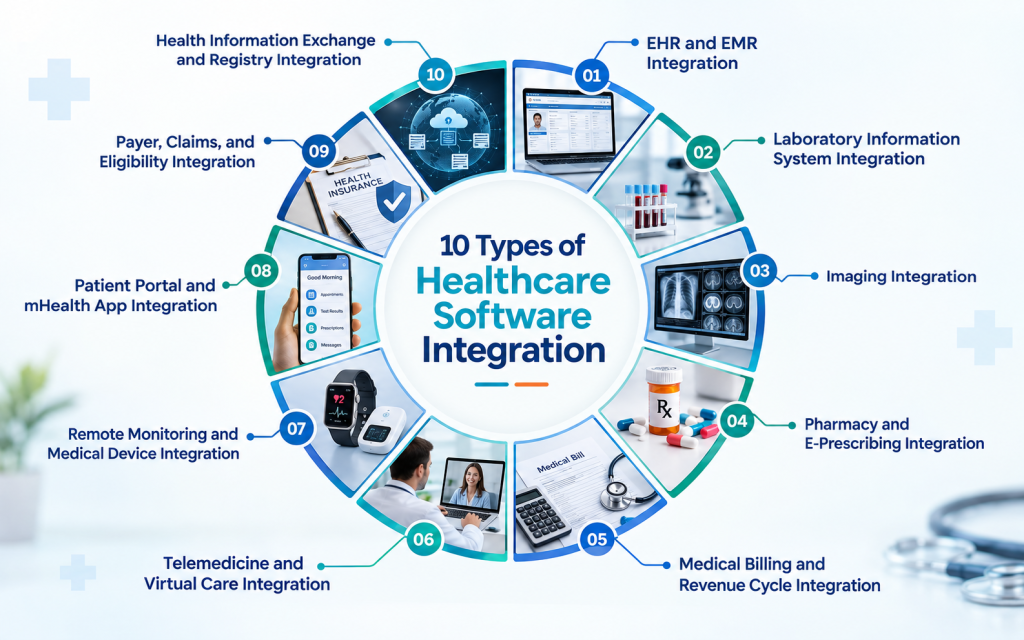
Healthcare systems rarely work alone. These integrations connect the tools that keep patient care, operations, and payments moving.
- EHR and EMR Integration: Connects patient records, medications, allergies, encounters, notes, and other clinical data across healthcare systems.
- Laboratory Information System Integration: Sends test orders to the lab and brings results back to the clinician without manual data entry.
- Imaging Integration: Connects PACS, RIS, and imaging tools so clinicians can view medical images and reports directly from the patient record.
- Pharmacy and E-Prescribing Integration: Sends prescriptions to pharmacies and supports refills, medication history, and formulary checks.
- Medical Billing and Revenue Cycle Integration: Moves charges, claims, payments, and remittance data between clinical and financial systems.
- Telemedicine and Virtual Care Integration: Connects virtual visits with scheduling, EHRs, documentation, prescriptions, and billing for a smoother care workflow.
- Remote Monitoring and Medical Device Integration: Brings data from wearables and medical devices into healthcare systems for real-time monitoring and alerts.
- Patient Portal and mHealth App Integration: Gives patients easy access to health records, results, appointments, prescriptions, and care-team messages.
- Payer, Claims, and Eligibility Integration: Connects providers with payers for eligibility checks, claims, benefits, prior authorization, and claim updates.
- Health Information Exchange and Registry Integration: Connects providers with health networks and registries such as ABDM, NABIDH, and Malaffi for secure health data exchange.
Now that you have seen every connection type worth planning for, let us look at the architecture patterns that decide how well they scale together.
5 Integration Architecture Patterns and When Each One Fits
The pattern you choose early determines what your integration costs to run for the next decade. Here is how the five realistic options compare.
| Pattern | Build complexity | Scales to | Maintenance load | Best fit |
|---|---|---|---|---|
| Point-to-point | Low | 2 to 3 connections | High and rising | One narrow, temporary link |
| Hub-and-spoke | Medium | Dozens | Moderate and predictable | Hospitals with heavy HL7 traffic |
| API-first FHIR facade | Medium to high | Many consumers | Low once stable | Patient apps, payer and registry work |
| iPaaS or managed platform | Low to medium | Vendor-defined | Shifted to vendor | Small teams without integration staff |
| Event-driven streaming | High | Very high volume | Requires platform skills | Device data, analytics, real-time alerting |
Not Sure Which Integration Approach Fits Your Project?
Our architects will review your systems and recommend the right approach — before a single line of code is written.
No commitment required · Response within 24 hours · Free gap assessment included
Get a Free Architecture ReviewHealthcare Software Integration Process: 9 Simple Steps
A successful integration starts with the right team. Once experienced integration experts are on board, they can assess your systems, choose the right approach, and help avoid costly mistakes before development begins.
Step 1. Hire Experienced Healthcare Integration Experts
Start with an experienced healthcare integration partner like DreamSoft4u that understands healthcare standards, EHR systems, APIs, security, compliance, and data exchange.
Look for expertise in HL7, FHIR, DICOM, EDI, healthcare terminology, and platforms such as Epic and Oracle Health. Your integration partner should also understand regional requirements such as HIPAA, ABDM, NABIDH, and GDPR.
With the right experts involved from the beginning, you can choose the right integration approach, avoid common mistakes, and build a more reliable project from the start.
Step 2. System Inventory and Discovery
Now let your integration team map every system that stores or uses patient data, including systems that may not have a clear owner.
For each system, document the vendor, version, available APIs, supported standards, data formats, and internal owner.
Also check whether the system needs vendor approval before integration and whether it is likely to be replaced soon.
This gives your team a clear picture of what needs to be connected and what challenges may appear later.
Step 3. Data Mapping and Gap Assessment
Next, define what data needs to move, where it needs to go, and how quickly it should arrive.
Instead of saying “lab results,” define the requirement clearly, such as “verified lab results delivered to the ordering clinician within five minutes.”
Your integration experts can then compare the data available from each source with what the destination system requires.
Identify missing fields, format differences, terminology gaps, and other issues. Rank these gaps by risk and effort so the project has a realistic scope and timeline.
Step 4. Standard Selection and Architecture Design
Choose the right standard for each connection. You may use HL7 v2 for existing lab and ADT feeds while using FHIR for a patient app or external API.
Then decide how the integration will work, including the interface engine, FHIR server, hosting environment, integration pattern, and data residency requirements.
Document the architecture and get approval before development begins. Changes are much cheaper to make at this stage.
Step 5. Security, Consent, and Compliance Design
Build security and compliance into the integration from the start.
Plan encryption, authentication, authorization, access controls, network security, audit logging, and consent management before writing interface code.
Your team should also define how patient consent, opt-outs, restricted records, and data access will be handled.
Designing these controls early helps prevent expensive compliance problems later.
Step 6. Interface Development and Terminology Mapping
Start building the interfaces in short development cycles and test working connections early.
Map local healthcare codes and terminology to standards such as SNOMED CT, ICD-10, LOINC, and RxNorm as each data type is integrated.
At the same time, build error handling, retry logic, error queues, and message resubmission into the interfaces.
Finding problems early is far easier and cheaper than discovering them during final testing.
Step 7. Data Quality Remediation
Integration can expose problems in your existing data, such as duplicate patient records, missing information, or free-text values where structured data is required.
Do not rely on the integration layer to fix everything. Correct poor data at the source whenever possible.
Clean historical data that needs to be transferred and improve the way new data is captured.
This step often takes more time than expected, so include it in the project plan from the beginning.
Step 8. Sandbox Testing, Validation, and Certification
Test the integration using realistic data volumes and difficult scenarios, not just clean sample records.
Include cases such as amended results, cancelled orders, duplicate or merged patients, missing identifiers, and system failures.
If a regulator, EHR vendor, or health information exchange requires certification, complete the required testing and validation in the sandbox before going live.
The goal is to identify and fix issues before they affect real patients or clinical workflows.
Step 9. Go-Live, Hypercare, and Ongoing Monitoring
Go live only after monitoring, alerting, and a rollback plan are ready.
Track key metrics such as successful transactions, rejected messages, processing time, system errors, and queue depth from day one.
Keep the integration team closely involved during the first few weeks to quickly resolve issues and support users.
After stabilisation, document the integration, assign clear ownership, maintain runbooks, and continue monitoring standards, vendor changes, and system performance.
A healthcare integration is not finished at go-live. It needs ongoing management to remain secure, reliable, and compliant.
📖A Complete Guide To Integration Of Wearable Devices With EHR
6 Healthcare Software Integration Challenges and How to Solve Them
Healthcare integration projects often face the same problems. Knowing them early helps you plan better and avoid costly delays.
Challenge 1: Legacy Systems With No API
Many older healthcare systems were built before modern APIs existed. They may only support files, databases, or older HL7 connections.
Solution: Use middleware or an interface engine to connect these systems with modern applications. This lets you work with legacy software without waiting for the vendor to replace it.
Challenge 2: Different Data Meanings and Mapping Changes
Two systems may use different names or codes for the same information. These mappings can also change when a system is updated.
Solution: Create clear, version-controlled data mappings and review them whenever systems change. Treat mappings as something that needs regular maintenance.
Challenge 3: Patient Identity Matching and Duplicate Records
The same patient may appear under different names, IDs, or records across different systems. A wrong match can connect medical information to the wrong person.
Solution: Use a Master Patient Index (MPI) to match records across systems. Combine automated matching with a manual review process for uncertain matches.
Challenge 4: Vendor API Limits and Approval Delays
Some healthcare vendors limit API access, require approval, charge connection fees, or do not provide all the data you need.
Solution: Check API access, pricing, limitations, and approval requirements before development starts. If a vendor cannot support your timeline, explore another integration approach.
Challenge 5: Poor Source Data Quality
Bad or incomplete data can cause integration problems. For example, free-text information may be used where a standard code is required.
Solution: Check data quality during discovery and fix problems at the source. Clean important historical data before moving it between systems.
Challenge 6: HIPAA, GDPR, and Data Residency Requirements
Healthcare data is highly sensitive. Different countries and regions have different rules for storing, sharing, protecting, and auditing patient information.
Solution: Identify all applicable regulations early. Use strong security controls, access management, encryption, audit logs, and the right agreements with vendors handling patient data.
Healthcare Software Integration Cost and Timeline
Costs vary widely because scope varies widely. These ranges reflect what comparable projects run in the market, and they give you a defensible starting point for budget conversations.
1. What Actually Drives the Cost
Five variables move the number most. They are the count of connected systems, the state of your source data, the standards involved, compliance obligations, and identity reconciliation. Two hospitals connecting the same three systems can differ threefold on data quality alone. Scope the data first.
2. Cost Ranges by Integration Tier
| Tier | Typical scope | Indicative cost | Typical timeline |
|---|---|---|---|
| Single interface | One point-to-point connection, for example, EHR to lab | $15,000 to $50,000 | 6 to 8 weeks |
| SMART on FHIR application | Patient or provider app embedded in the EHR | $40,000 to $120,000 | 6 to 12 weeks |
| Multi-system programme | 3 to 6 platforms across clinical and administrative | $50,000 to $150,000 | 3 to 6 months |
| HL7 to FHIR modernisation | Legacy estate bridged to a FHIR facade | $80,000 to $300,000 | 5 to 9 months |
| Enterprise interoperability | 8 or more platforms, MPI, terminology, governance | $150,000 to $500,000 and above | 6 to 18 months |
3. Timeline Benchmarks by Project Type
- Lab and radiology integration: 8 to 12 weeks
- Practice management and billing integration: 12 to 16 weeks
- Patient portal integration: 10 to 14 weeks
- Multi-system integration: 20 to 30 weeks
- Registry integration and certification: Depends on the required assessment and approval process
4. Costs Teams Often Underestimate
- Data quality cleanup: Fixing incomplete, duplicate, or inconsistent patient data
- Network and infrastructure: Upgrading servers, networks, security, or cloud infrastructure
- Vendor connection fees: Some vendors charge separate fees for API or interface access
- Change management: Training staff and adapting workflows
- Discovery and planning: A detailed discovery phase can help prevent expensive rework later
5. Total Cost of Ownership After Go-Live
- Annual maintenance: Plan for around 15% to 20% of the original development cost
- Monitoring: Keep track of system performance, errors, and failed transactions
- Version updates: Update integrations when connected systems change
- Mapping maintenance: Update data mappings when formats or standards change
- Vendor changes: Adjust integrations when vendors update their APIs or systems
- Compliance support: Maintain audit records and adapt to new regulatory requirements
- Long-term management: Treat integration as an ongoing system, not a one-time project
How to Achieve Successful Telemedicine EMR Integration
Build In-House, Buy a Platform, or Partner With an Integration Team
There is no universally right answer here, only a right answer for your team size, timeline, and risk tolerance. Weigh the three honestly against your actual capacity.
| Option | Time to first interface | Ongoing ownership | Best when |
|---|---|---|---|
| Build in-house | Slowest | Fully yours | Integration is core to your product, and you can hire for it |
| Buy a platform | Fastest | Shared with vendor | Standard connections, small team, predictable needs |
| Partner with a team | Fast | Transferable to you | Regulated deadlines, mixed legacy estate, no interface staff |
Why DreamSoft4U for Healthcare Software Integration
Healthcare software integration is what we have been engineering since our first hospital client, and it sits at the centre of everything we build. We work daily across HL7, FHIR, DICOM, EDI and Mirth Connect pipelines for providers and digital health products worldwide.
- 23+ years in healthcare IT: Domain-deep delivery across EMR, EHR, PHR, telemedicine, HMS and regulated health information exchange
- 1,600+ projects delivered: From single-clinic interfaces to multi-hospital interoperability platforms, engineered at every scale
- 100+ engineers across the US and India: Serving healthcare clients in the USA, UK, UAE, India, Canada and Australia
- Proven regulated delivery: Our NABIDH work built an HL7 converter and Mirth Connect channels producing compliant ADT messages with field-level validation
- Secure-by-design engineering: HIPAA-compliant architecture shaped around consent, encryption, residency and audit readiness
- EMR-agnostic and vendor-independent: We connect commercial, regional, and in-house systems, and build outside the EHR when a vendor roadmap will not meet your date
- Accountable past go-live: Managed compliance covering version upgrades, submission monitoring, rejection analysis, and annual audit support
Ready to Connect Your Healthcare Systems?
Book a free consultation and we will scope your integration gap first — no commitment required.
23+ years in healthcare IT · 1,600+ projects delivered · Serving USA, UAE, India, UK & Australia
Book a Free ConsultationConclusion
Healthcare software integration helps different healthcare systems work together and share patient data securely. When EHRs, labs, pharmacies, billing systems, devices, and patient apps are connected, teams spend less time on manual work and can access the right information faster.
A successful integration starts with good planning. Choose the right standard, check your data quality, plan security and compliance early, and test everything before going live.
Whether you build the integration yourself, use a platform, or work with experienced experts, the right approach can save time, reduce errors, and make your healthcare systems easier to manage.
If you are planning a healthcare integration project, our experts can help you understand your requirements, choose the right approach, and build a clear integration roadmap.
Frequently Asked Questions
It is the engineering work that connects your clinical, administrative, and financial systems. Patient data then moves between them automatically, in a format each system understands. It covers interfaces, data mapping, terminology, security, and monitoring.
HL7 v2 pushes event-driven messages between systems inside a hospital, while FHIR exposes health data as resources over REST APIs that applications request on demand. Both are HL7 standards, and most organisations run them side by side rather than replacing one with the other.
Usually yes, because almost every estate still carries HL7 v2 lab, radiology, and ADT traffic alongside its FHIR endpoints. The engine handles routing, transformation, persistence, and replay. Pure FHIR environments are rare outside greenfield digital health products.
Yes, and replacement is rarely necessary. Where an EHR cannot be modified directly, the integration layer is built outside it using middleware, database views, or available APIs. This keeps your compliance date independent of your vendor’s release schedule.
A single interface typically runs 6 to 8 weeks, a multi-system programme 3 to 6 months, and an enterprise interoperability build 6 to 18 months. Registry certification adds its own assessment cycle, and poor source data quality extends every one of these ranges.