

Hospital Management Information System (HMIS) Software for Hospitals and Clinics
A Hospital Management Information System runs the whole hospital as one operation. It ties clinical care to admissions, revenue cycle, pharmacy, inventory, staffing, and reporting on a single record.
We engineer HMIS platforms that speak HL7 v2, FHIR R4, ICD-10, SNOMED CT, and DICOM. HIPAA, NABH, GDPR, and ABDM obligations are built in, so you stay audit ready as rules change.
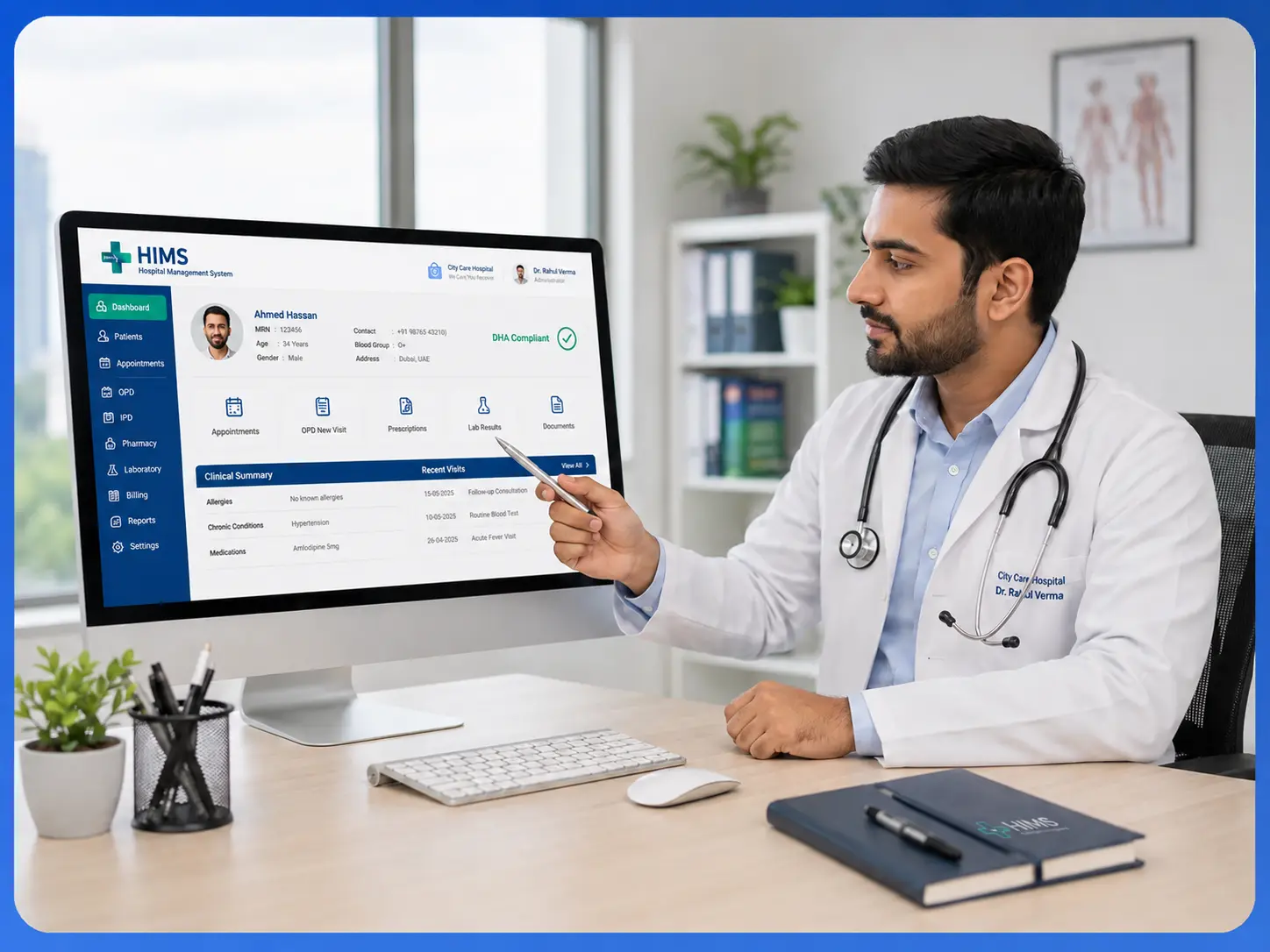
Hospital Management Information System Designed For YOUR Needs
- Patient Management and Care
- Clinical Operations and Support
- Administrative and Financial
- Support and Infrastructure
Patient Management and Care
Patient Registration and UHID
Single registration flow with duplicate checks, ABHA linking, and photo capture.
Outpatient (OPD) Management
Token queues, consultation notes, order entry, and same-visit billing.
Inpatient (IPD) Management
Admission notes, care plans, daily rounds, and structured discharge summaries.
Nursing Care Management
Vitals charting, medication administration records, and shift handover notes.
Ward and Bed Management
Live bed maps, transfers, occupancy alerts, and housekeeping status.
Electronic Medical Records
Longitudinal clinical records containing notes, orders, results, and images.
Ambulance and GPS Tracking
Dispatch, live vehicle tracking, and pre-arrival alerts to the emergency desk.
Clinical Operations and Support
Laboratory Information System
Sample tracking, analyser interfaces, and controlled result release.
Pathology Module
Specimen workflow, template reporting, and critical value alerts.
Radiology Information System
Order routing, modality worklists, and structured radiology reporting.
PACS and DICOM Viewer
Image storage, study retrieval, and diagnostic viewing inside the clinical record.
Operation Theatre Management
OT scheduling, surgical checklists, consumable capture, and post-op notes.
Blood Bank Management
Donor records, cross-matching, stock levels, and traceable issue logs.
CSSD and Sterilisation Tracking
Instrument sets, cycle logs, and reprocessing audit trails.
Administrative and Financial
Admission, Transfer, Discharge
Bed allocation, transfer approvals, and discharge clearance in one queue.
Billing and Revenue Cycle
Package pricing, tariff plans, split billing, and live outstanding views.
Insurance, Claims and TPA
Pre-authorisation, claim files, denial tracking, and NHCX ready claim exchange.
Pharmacy Information System
Dispensing, batch and expiry control, and automatic reorder triggers.
Inventory and Procurement
Indents, purchase orders, goods receipt, and consumption by department.
HR, Payroll and Duty Rosters
Attendance, shift planning, and payroll integration for clinical and support staff.
MIS Reporting and Analytics
Configurable management dashboards for occupancy, revenue, turnaround time, and quality.
Support and Infrastructure
Appointment and Queue Management
Online booking, doctor calendars, reminders, and waiting-area queue display.
Patient Portal and Mobile Access
Reports, prescriptions, payments, and follow-up booking on any device.
Telemedicine and Video Visits
Scheduled and on-demand consultations written back to the same record.
Facilities and Housekeeping
Room readiness, cleaning cycles, and service request tracking.
Equipment and Asset Tracking
Asset registers, maintenance schedules, calibration, and downtime logs.
Dietary and Catering
Diet orders by consultant, kitchen indents, and tray tracking to the bedside.
Helpdesk, Complaints and Feedback
Ticket routing, resolution timelines, and patient experience capture.
Features of Our Hospital Management Information Systemr
Our HMIS centralises clinical, administrative, and financial activity on one platform. Ten capabilities carry most of the day-to-day load.
- 01.ABHA and smart card patient identity
- 02.Appointment and queue management
- 03.E-prescription with safety checks
- 04.Online lab and radiology reporting
- 05.ICD-10 and SNOMED CT coded records
- 06.Multi-payment and multi-currency billing
- 07.Accounting and ERP integration
- 08.NABIDH and HIPAA aligned audit trails
- 09.Management dashboards and MIS reports
- 10.Predictable total cost of ownership
One verified identity per patient, with duplicate merge and family linking.
Online booking, doctor calendars, reminders, and live token displays.
Structured prescribing with drug interaction, allergy, and dose alerts.
Results published to clinicians and patients the moment they are verified.
Coded diagnoses and procedures that hold up in claims and audits.
Cash, card, UPI, wallet, insurance, and corporate accounts on one invoice.
Two-way posting to Tally, QuickBooks, SAP, or an existing finance stack.
Immutable access logs, consent records, and role-based visibility.
Occupancy, revenue leakage, turnaround time, and clinical quality in one view.
Transparent licensing, staged rollout, and no per-module surprises.
Compliance and Interoperability Built Into the HMIS
A hospital management information system fails an audit at the data layer, not the interface. We engineer conformance into the record model, the terminology, and the exchange APIs.
India
ABDM identity and record sharing through ABHA, HFR, and HPR, milestone M1, M2, and M3 workflows,NHCX claim exchange, NABIDH Digital Health Standards, and DPDP Act controls.
Explore ABDM IntegrationUnited States
HIPAA privacy and security rules,HL7 v2 and FHIR R4 APIs, USCDI aligned data classes, and exchange patterns that fit TEFCA participation.
Explore HIPPA IntegrationUAE
NABIDH submission for DHA-licensed Dubai facilities and Malaffi readiness for Abu Dhabi.
Explore NABIDH IntegrationTechnology Expertise for Modern HMIS
A secure, interoperable technology stack built for scalable healthcare platforms, long-term support, and seamless upgrades.
Frontend
- React
- Angular
- Vue
- Next.js
- Flutter
- React Native
Backend
- .NET / C#
- Java
- Spring Boot
- Node.js
- Python
Data
- SQL Server
- PostgreSQL
- MongoDB
- Redis
- Data Warehousing
Interoperability
- HL7 v2
- FHIR R4
- CDA
- C-CDA
- DICOM
- Mirth Connect
- HAPI FHIR
Terminology
- ICD-10
- SNOMED CT
- LOINC
- CPT
- RxNorm
Cloud & DevOps
- AWS
- Azure
- Google Cloud
- Docker
- Kubernetes
- CI/CD
Security
- OAuth 2.0
- SMART on FHIR
- RBAC
- AES-256
- TLS
- Audit Logs
AI & Analytics
- Clinical Decision Support
- AI Documentation
- Coding Assistance
- Bed Forecasting
- Demand Forecasting
Build a secure and scalable HMIS platform with us.
From requirement mapping to go-live, we handle every phase – so your team focuses on patient care.
Choose the Deployment Model That Fits Your Hospital
The same hospital management information system runs in three configurations. We help you pick based on data residency rules, in-house IT capacity, and rollout speed.
Cloud HMIS
Best fit: clinic groups, new facilities, and multi-site networks
Faster rollout, lower upfront spend, managed updates, remote access, and elastic capacity during peak load.
On-premise HMIS
Best fit: large hospitals with in-house IT and strict residency rules.
Full control of servers, data location, and security policy, with scheduled release cycles you approve.
Hybrid HMIS
Best fit: hospitals modernising in stages.
Clinical core stays on site while portals, telemedicine, and management analytics run in the cloud.
Why Choose Us for Your Hospital Management Information System?
Selecting the right healthcare IT partner is the hardest part of an HMIS programme. Here is what changes inside your hospital when we deliver it.
Connected departments, one record
Registration, wards, lab, radiology, pharmacy, and billing read and write the same patient file.
Lower administrative workload
Repeat data entry, manual registers, and reconciliation calls drop away from front-desk teams.
Fewer documentation errors
Structured capture, coded fields, and validation rules catch mistakes before they reach a claim.
A smoother patient journey
Shorter queues, faster discharge, and reports delivered to the patient portal automatically.
Automated pharmacy and stock control
Batch and expiry tracking, reorder triggers, and department-level consumption visibility.
Integrated back office
Procurement, HR, payroll, and finance posting sit inside the same platform as clinical operations.
Predictable cost of ownership
Staged rollout, transparent licensing, and a support model priced before you sign.
Management decisions on live data
Occupancy, revenue leakage, turnaround time, and clinical quality reported daily, not monthly.
What Our Customers Say

DreamSoft4u delivered an excellent quality of work at pocket-friendly pricing. They agreed to develop an EMR-EHR-PHR solution with our frequent change requests and bug reports during the development phase. But the team stayed polite during the communication and asked for frequent feedback. Working with them was a pleasure, and their hard work is highly appreciated.
Nino Gorgia
(SmartDocs)

Considering DreamSoft4u’s
more than 15 years of experience in healthcare software development, I
outsourced my mHealth app’s dream project. Not only did they meet my
expectations, but they also handed me over a best-in-class mHealth solution
competent to combat other contenders in the market. That too at a
cost-effective pricing and faster
time to market.
Nitin Chooda
(Intouch EMR)

Great working experience with DreamSoft4u. Very responsive and very professional. Not only do they understand your needs, but they also suggest the best possible options to expand your project reach. Happy to work with them and will surely give them my next projects!!
Rick Tran
(EPIC EMR Integration)

I am completely satisfied with the work done by DreamSoft4u. They delivered me the same what I expected, a bespoke quality product at budget-friendly pricing. Great team, experienced and skilled developers, highly recommended
Kem Tolliver
(MRCS)

Choosing DreamSoft4u for my custom healthcare software solution was the right choice, and working with them was a pleasure. I strongly recommend DreamSoft4u for any healthcare software solution or mobile app development need as they possess vast experience and a team of experienced developers in the healthcare industry.
Michel.J. Kaldesh
(Cyomed)

The team of DreamSoft4u is very knowledgeable in Telemedicine app development. I hired them for my telemedicine app development project, and they delivered the same as I expected. I highly appreciate DreamSoft4u’s work and recommend them as the best telemedicine app development company.
Rich Blanton
(Sniffle)
Development Process DreamSoft4u Follows For Hospital Management Information System
Five phases take a hospital from requirement capture to a monitored go-live. Each phase closes with a sign-off before the next begins.
Requirement analysis and compliance mapping
Department workflow study, module scoping, integration inventory, and a compliance gap register.UX and UI design
Clinical and administrative workflow prototypes, tested with the staff who use them daily.Development and interoperability
Module build in short iterations, HL7 and FHIR interfaces, and terminology mapping.Quality analysis and security testing
Switch to production through our pre-certified credentials and perform your first live ABHA transaction on the ABDM network.Deployment, migration and go-live
Data migration, department-wise cutover, staff training, and staffed hypercare.Our Portfolio

HIPAA Compliance for Criticare Technologies
Explore CTI HIPAA-Compliant Innovations Improving Patient Monitoring to New Heights!
Read More
Nabidh DHA Compliant Healthcare Data Integration
A secure integration layer for hospitals to exchange patient data with NABIDH, ensuring full compliance with Dubai Health Authority (DHA) standards.
Read More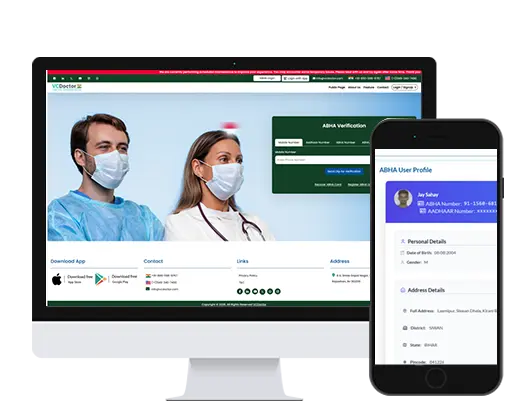
VCDoctor ABDM Integrated Telemedicine Platform
VCDoctor is a telemedicine platform integrated with ABDM that enables secure patient data exchange
Read More