






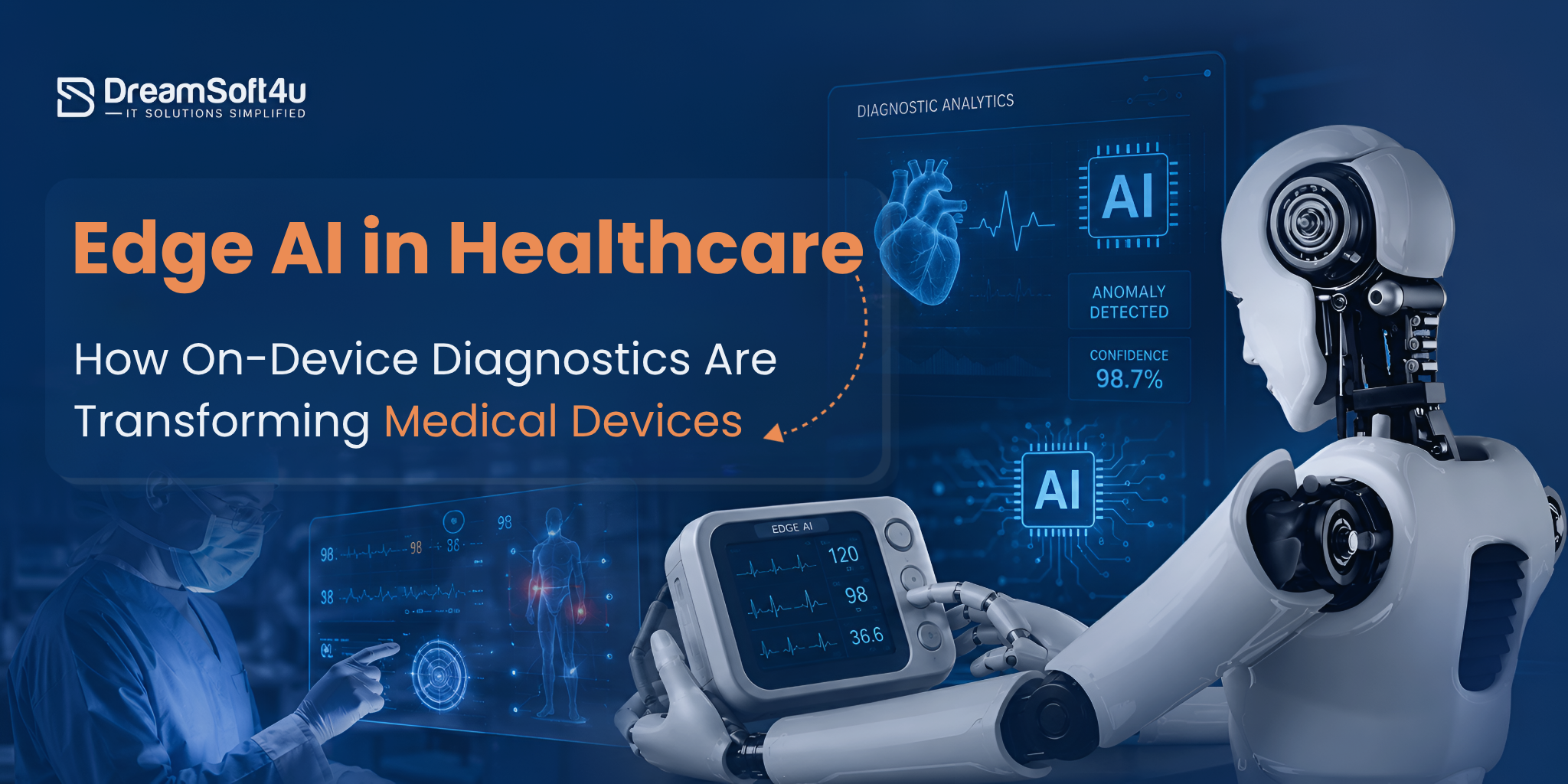
Every second counts in healthcare. Whether it’s detecting a stroke, monitoring a patient’s heart rhythm, or identifying abnormalities in a medical scan, delays in diagnosis can have serious consequences.
Edge AI in Healthcare helps eliminate those delays by bringing artificial intelligence directly to medical devices.
Instead of sending sensitive medical data to the cloud for analysis, Edge AI brings intelligence directly to the device itself. From portable ultrasound machines and wearable ECG monitors to insulin pumps and smart hospital equipment, medical devices are becoming faster, safer, and far more autonomous.
This shift is solving some of healthcare’s biggest challenges. It reduces diagnostic delays, protects patient privacy, lowers dependence on cloud connectivity, and enables high-quality care in ambulances, rural clinics, operating rooms, and even patients’ homes.
For teams investing in healthcare software development, Edge AI is no longer a futuristic concept. It is becoming a competitive advantage for building the next generation of intelligent medical devices.
In this guide, you’ll learn:
- What Edge AI in Healthcare really is
- How it differs from cloud-based AI
- Its biggest benefits and real-world applications
- The technologies powering modern Edge AI devices
- Common implementation challenges and how to overcome them
- A practical roadmap for building your own Edge AI medical device
By the end, you’ll understand how Edge AI is transforming healthcare and what it takes to build secure, compliant, and intelligent medical devices.
What Is Edge AI in Healthcare?
Edge AI in Healthcare means a medical device can analyze patient data on its own instead of relying on a cloud server. This allows it to make faster decisions right where the data is generated.
For example, a wearable heart monitor can detect an irregular heartbeat and send an alert within seconds. Since the data is processed on the device itself, there is no waiting for cloud processing, resulting in quicker diagnoses, better privacy, and reliable performance even in areas with poor internet connectivity.
Edge AI vs Cloud AI in Healthcare
Both approaches have a place in modern care. The real question is where each one belongs. The table below sums up the trade-offs, and the points after it explain them in plain terms.
| Factor | Edge AI | Cloud AI |
|---|---|---|
| Processing location | On the device, near the patient | Remote data centre |
| Response time | Milliseconds, real time | Depends on network speed |
| Connectivity | Works offline | Needs steady internet |
| Data privacy | Data stays local | Data travels over networks |
| Best suited for | Urgent, on-site decisions | Large-scale analysis and training |
1. Latency and Real-Time Response
Edge AI processes data directly on the medical device, so results are available almost instantly. For example, a portable ultrasound can detect a potential issue while the scan is still being performed. Cloud AI takes longer because the data must first be sent to a remote server for analysis.
2. Data Privacy and Compliance
Since Edge AI processes patient data on the device, sensitive information doesn’t need to be sent over the internet. This improves patient privacy and makes it easier to meet regulations like HIPAA and GDPR. Cloud AI requires data to be transferred and stored remotely, which increases security and compliance requirements.
3. Connectivity and Offline Reliability
Edge AI continues working even when there is no internet connection. This makes it ideal for ambulances, rural clinics, and other areas with limited connectivity. Cloud AI depends on a stable internet connection, so it may stop working if the network goes down.
4. Cost, Bandwidth, and Scalability
Because Edge AI processes data locally, it sends much less information to the cloud. This reduces bandwidth usage and cloud storage costs, especially when managing many devices. The cloud is still valuable for training AI models and storing large amounts of data, which is why many healthcare organizations use a combination of both Edge AI and Cloud AI.
Top 7 Benefits of Edge AI in Healthcare
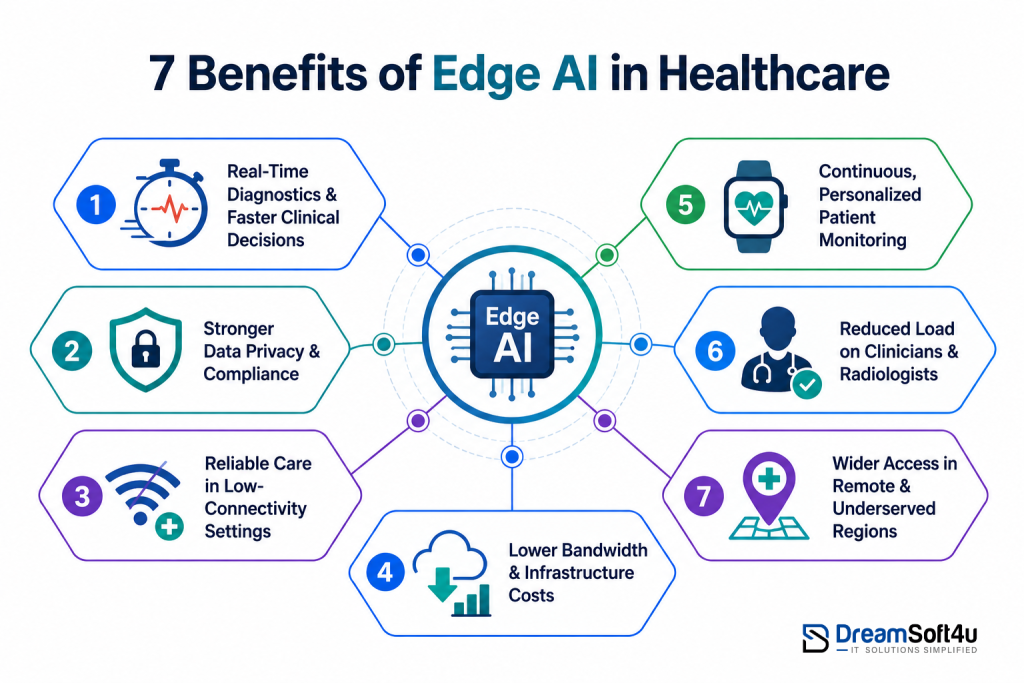
The benefits of Edge AI in Healthcare reach far beyond speed. The stakes are large too, since AI could deliver net savings of around $360 billion a year in healthcare spending. Here are the seven advantages that push providers and device makers to adopt it.
1. Real-Time Diagnostics and Faster Clinical Decisions
Processing data on the device removes cloud delays, so results arrive in real time. An edge-enabled ECG can catch an arrhythmia the instant it appears. That gives clinicians the head start critical moments demand.
2. Stronger Data Privacy and Compliance
Because analysis happens locally, sensitive records stay on the device instead of crossing public networks. This lowers breach risk and makes it far easier to satisfy HIPAA, GDPR, and similar rules that patients and regulators expect.
3. Reliable Care in Low-Connectivity Settings
Edge devices keep working when the internet does not, which matters in remote clinics and during outages. Care no longer stalls because a signal dropped. That dependability builds trust with staff and patients alike.
4. Lower Bandwidth and Infrastructure Costs
Sending only insights instead of raw data cuts bandwidth use and cloud storage bills. As device fleets grow, that saves compounds. It gives teams a more cost-effective path to scale without heavy backend spend.
5. Continuous, Personalized Patient Monitoring
Wearables and patches track vitals nonstop and adapt to each person’s baseline. This steady stream of on-device insight supports tailored care. It also flags subtle changes long before a scheduled visit would.
6. Reduced Load on Clinicians and Radiologists
Edge models handle first-pass screening and triage, so specialists focus on the complex cases that truly need them. That easing of routine workload helps overstretched teams do more without burning out.
7. Wider Access in Remote and Underserved Regions
By putting diagnostic power into portable, affordable devices, Edge AI reaches places that lack specialists and infrastructure. It widens access to quality care and shortens the distance between a symptom and a sound answer.
Also Read: AI in Healthcare: Benefits, Importance and Future Trends
How Edge AI Is Transforming Medical Devices: Key Applications
Edge AI in Healthcare already shows up across the devices clinicians use every day. These seven applications are where it makes the biggest difference.
1. AI-Powered Medical Imaging and Diagnostics
On-device models analyse X-rays, CT, MRI, PET, and ultrasound scans and highlight anomalies like tumours or fractures in seconds. This speeds triage and gives radiologists a reliable second read right where the image is captured.
2. Wearables and Remote Patient Monitoring
ECG patches, glucose monitors, and smartwatches read vitals continuously and catch issues such as arrhythmias or low blood sugar. They alert care teams the moment something looks wrong, which turns remote patient monitoring into true early warning.
3. Point-of-Care and Portable Diagnostic Devices
Handheld ultrasounds and portable X-ray units bring imaging to ambulances, rural camps, and bedsides. With intelligence built in, a nurse or technician can capture and read results without a specialist standing by.
4. Digital Therapeutics and Adaptive Treatment
Software-based treatments use live patient data to adjust interventions on the fly. Edge processing keeps these therapies running even offline, which supports steady care for chronic conditions like diabetes and heart disease.
5. Implantable and Smart Therapeutic Devices
Pacemakers, defibrillators, and insulin pumps now make local decisions from the signals they read. An insulin pump can sense glucose and dose accordingly on its own, delivering precise care without waiting on a server.
6. Predictive Analytics and Early Warning Systems
By learning a patient’s normal patterns, edge models spot small deviations before they escalate. This shift toward prediction helps teams intervene early and prevent avoidable admissions.
7. Smart Hospital and In-Room Patient Safety
Edge-enabled cameras and sensors watch for falls, bed exits, and unusual movement, then alert staff at once. In busy wards, that constant local vigilance adds a quiet layer of safety around every patient.
| Planning an Edge AI medical device? Talk to our healthcare software experts and get a clear, practical build plan. Contact us. |
Now that you have seen where Edge AI reshapes care, let’s look at what it takes to build these devices.
Inside the Technology: How Edge AI Medical Devices Are Built
Building Edge AI in Healthcare devices is an engineering discipline. It balances compute power, energy use, and strict safety needs. Four elements decide whether a device performs in the real world.
1. Edge Hardware: SoCs, NPUs, and AI Accelerators
Real-time inference needs chips that pack strong compute into a small, low-power footprint. Systems-on-chip with built-in neural processing units and accelerators run model workloads while sparing the battery. That keeps portable devices practical.
2. Optimizing AI Models for the Edge
A model built for the cloud is usually too heavy for a device, so engineers shrink it. Techniques like quantization, pruning, and lightweight architectures cut size and speed up inference while holding on to accuracy.
3. System-Level Design: Sensors, Connectivity, and OTA
A dependable device is far more than its model. It needs clean sensor input, secure connectivity, and over-the-air updates so models improve safely after launch. All of it rides on solid IoT app development that ties the pieces together.
4. The Edge-to-Cloud Hybrid Architecture
The strongest designs blend both worlds. The device runs urgent inference and triage. Meanwhile, the cloud aggregates data, retrains models, and enables federated learning that sharpens accuracy without sharing raw records.
Data Privacy, Compliance, and Security at the Edge
Trust is the foundation of any healthcare software product. So compliance for Edge AI in Healthcare cannot be an afterthought. It has to be engineered from the first design decision.
1. Meeting HIPAA, GDPR, and Global Data Rules
Keeping data on the device already reduces exposure, but formal compliance goes further. Aligning with HIPAA, GDPR, and regional rules, backed by strong HIPAA compliance practices, protects patients and keeps products market-ready.
2. Interoperability With HL7, FHIR, and DICOM
An edge device rarely works alone, so it must speak the shared languages of healthcare. Support for HL7, FHIR, and DICOM lets it exchange data cleanly with EHRs, imaging systems, and hospital networks.
3. Securing Distributed Edge Devices
Every device is a possible entry point, so each one needs strong protection. Encryption, secure boot, authentication, and safe update channels defend distributed fleets without slowing the real-time performance that makes edge valuable.
Also Read: How AI Is Enhancing DICOM Medical Imaging Solutions
7 Common Challenges of Adopting Edge AI in Healthcare (and How to Solve Them)
Adopting Edge AI in Healthcare comes with several technical and operational challenges. The good news is that each challenge has a practical solution. Here are the most common ones.
Challenge 1: Interoperability Across Devices and Systems
Many healthcare devices still use proprietary systems and data formats, making it difficult to exchange information with EHRs, medical imaging systems, and other healthcare platforms.
Solution: Build devices using industry standards like HL7, FHIR, and DICOM. This ensures seamless communication with existing healthcare systems and makes future integrations much easier.
Challenge 2: Hardware, Thermal, and Durability Limits
Edge AI devices must process complex AI models while remaining compact, energy efficient, and durable enough for healthcare environments.
Solution: Choose AI-optimized processors and design efficient cooling systems. Lightweight AI models and purpose-built hardware help maintain performance without overheating or reducing battery life.
Challenge 3: Cybersecurity Across Distributed Devices
Each connected medical device can become a potential entry point for cyberattacks, increasing security risks across healthcare networks.
Solution: Protect every device with strong encryption, secure boot, authentication, and regular over-the-air (OTA) security updates to reduce vulnerabilities.
Challenge 4: Upfront Investment and Integration Complexity
Building Edge AI solutions requires investment in hardware, software, AI development, and integration with existing healthcare infrastructure.
Solution: Start with a phased implementation strategy. Using modular architectures and partnering with an experienced healthcare software development company can reduce costs and implementation risks.
Challenge 5: Data Quality and Model Reliability
AI models are only as accurate as the data used to train them. Incomplete or inconsistent healthcare data can reduce diagnostic accuracy.
Solution: Invest in high-quality data collection, thorough validation, continuous testing, and regular model monitoring to maintain reliable performance.
Challenge 6: Regulatory Approval and Algorithm Transparency
Medical AI solutions must meet strict regulatory requirements, and healthcare providers need to understand how AI reaches its decisions.
Solution: Design products with compliance in mind from the beginning. Document AI decisions, maintain explainability, and work with regulatory authorities early to simplify the approval process.
Challenge 7: Ongoing Model Maintenance and Drift
AI models can become less accurate over time as patient populations, diseases, and clinical practices evolve.
Solution: Continuously monitor model performance, retrain models with updated data, and deploy secure OTA updates to keep devices accurate, reliable, and compliant throughout their lifecycle.
How to Build an Edge AI Medical Device: A Practical Roadmap
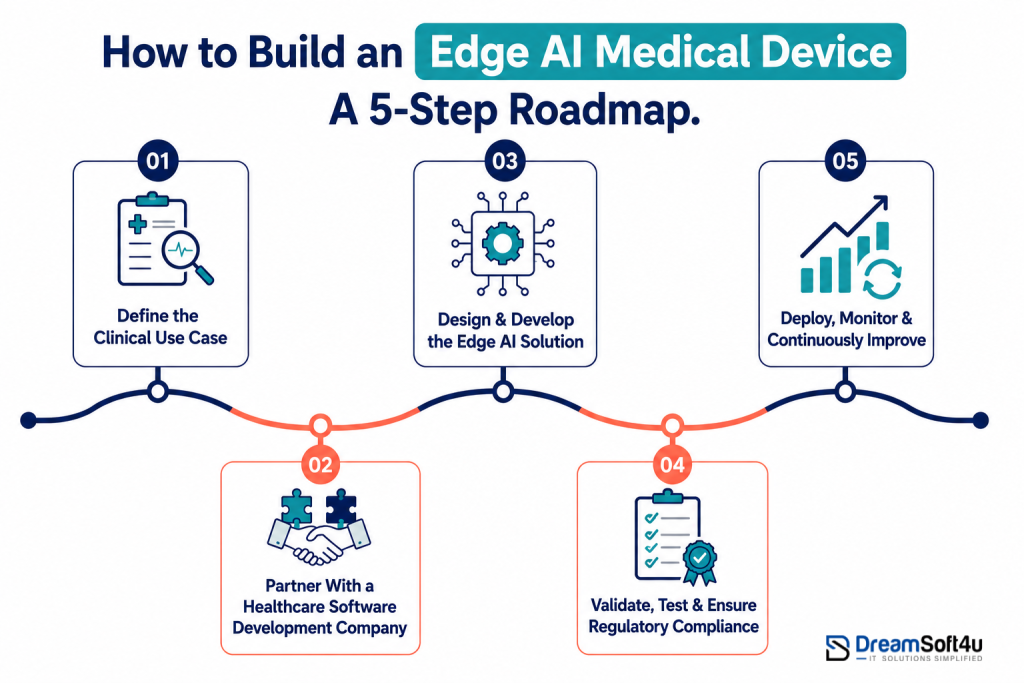
Building an Edge AI medical device involves much more than developing an AI model. You need the right strategy, healthcare expertise, regulatory knowledge, and engineering team to turn an idea into a compliant product. Here’s a practical roadmap to guide the process.
Step 1. Define the Clinical Use Case and Requirements
Every successful Edge AI project starts with a clearly defined healthcare problem. Identify exactly what your device should do, whether it’s detecting strokes, monitoring heart rhythms, or assisting with medical imaging.
Next, define your users, operating environment, performance expectations, and technical constraints such as power consumption, response time, and connectivity. These requirements become the foundation for the entire project.
Step 2. Partner With an Experienced Healthcare Software Development Company
Building an Edge AI medical device requires expertise in AI, embedded systems, healthcare regulations, cybersecurity, and medical interoperability. Instead of managing multiple vendors, partnering with an experienced healthcare software development company can significantly reduce development risks.
An experienced partner like DreamSoft4u helps you validate your idea, choose the right technology stack, build AI-powered medical software, ensure HIPAA and GDPR compliance, integrate standards like HL7, FHIR, and DICOM, and guide your product through testing and regulatory requirements. This allows your team to focus on the product vision while experienced engineers handle the technical execution.
Step 3. Design and Develop the Edge AI Solution
Once your development partner understands your requirements, they begin designing the complete solution. This includes selecting suitable hardware, optimizing AI models for edge devices, integrating sensors, and developing secure software that delivers real-time performance.
The solution is also designed to scale, making future enhancements and integrations easier as your product evolves.
Step 4. Validate, Test, and Ensure Regulatory Compliance
Before deployment, the solution undergoes extensive testing to verify its accuracy, performance, reliability, and security under real-world conditions.
Your development partner also prepares the documentation needed for regulatory approvals while ensuring the product meets standards such as HIPAA, GDPR, FDA, MDR, HL7, FHIR, and DICOM, depending on your target market.
Step 5. Deploy, Monitor, and Continuously Improve
After launch, the work doesn’t stop. Monitor device performance, collect operational insights, and continuously improve AI models through secure over-the-air (OTA) updates.
A long-term development partner can also provide ongoing maintenance, security updates, feature enhancements, and technical support to keep your Edge AI medical device secure, compliant, and ready for future healthcare needs.
Also Read: FDA Regulations for PACS and Medical Imaging Software
Why DreamSoft4U for Edge AI Healthcare Development
DreamSoft4u engineers compliance-grade, production-ready healthcare platforms for a global client base. We pair deep medical-domain knowledge with hands-on skill in AI, IoT, and secure device software.
What sets our Edge AI in Healthcare work apart:
- Healthcare depth: We bring 22+ years of building HIPAA-compliant systems, EMR/EHR, telemedicine, and medical device software.
- Proven delivery: We have shipped 1,600+ projects with a team of 100+ engineers across the US, India, and beyond.
- Interoperability first: Native HL7, FHIR, and DICOM expertise that connects devices to real clinical systems.
- End-to-end build: From model optimisation and edge hardware to compliance, testing, and OTA updates.
- See how we deliver in our healthcare portfolio, then book a free consultation with our software experts today. Contact us.
Conclusion
Edge AI in Healthcare is changing how medical devices sense, decide, and act. It moves intelligence to the point of care, where speed and privacy matter most.
From imaging and wearables to implants and smart wards, on-device diagnostics are making care faster, safer, and more accessible for people everywhere. The path to building one runs through clear use cases, the right hardware, strict compliance, and steady improvement after launch.
We hope this guide helped you understand what Edge AI in Healthcare is and how it works. You now also know what it takes to build a device clinicians can trust.
Now it is your turn to turn these ideas into a real product. When you are ready, connect with our experts to get a clear, practical roadmap for your Edge AI build. Reach our team here.
Ready to Build a Trustworthy Edge AI Medical Device?
You now understand what it takes to build a trustworthy Edge AI medical device. The next step is a conversation — one that turns these ideas into a clear, practical roadmap for your team.
Frequently Asked Questions
Edge AI in Healthcare refers to running AI models directly on medical devices or nearby gateways, so data is analysed locally. This enables real-time, secure diagnostics without depending on a remote cloud.
Edge AI processes data on the device for instant results and stronger privacy, while cloud AI sends data to remote servers. Cloud suits large-scale training, and edge suits urgent, on-site decisions.
It can be, and local processing helps by keeping sensitive data on the device. Full compliance still needs deliberate design, including encryption, access controls, and secure update channels.
Common examples include ECG patches, glucose monitors, handheld ultrasounds, portable X-ray units, pacemakers, and smart in-room safety sensors. Each analyses data on the device for faster action.
Yes, and that is one of its biggest strengths. An edge device can capture, analyse, and act on data offline, which keeps care running in remote areas and during network outages.