
Dubai is becoming a major market for digital healthcare, creating strong opportunities for telehealth startups. But launching a virtual care platform is not just about building a good app. You also need to meet DHA requirements and connect with NABIDH before your platform can operate as part of Dubai’s regulated healthcare system. This is where DHA Integration for Telehealth becomes important.
It affects how you store patient data, manage consent, secure clinical records, exchange health information, and prepare your platform for regulatory testing. Many startups build the platform first and think about compliance later. That can lead to expensive changes, delayed testing, and missed launch dates.
The better approach is to plan compliance from the start.
In this guide, you will learn how DHA Integration for Telehealth works, what your platform needs before launch, the key NABIDH standards, the integration process, expected costs and timelines, and the common mistakes that can delay approval.
By the end, you will have a clear roadmap for taking your telehealth platform from development to a compliant Dubai launch.
DHA Integration for Telehealth: Quick Answer
Here is the short version of what DHA Integration for Telehealth demands, before we open each area in detail.
| Requirement | What it means | Who owns it | Planning duration |
|---|---|---|---|
| Facility licence with registered telehealth service | Your operating entity holds a DHA licence and registers virtual care under it | Founder and clinical lead | 8 to 12 weeks |
| NABIDH onboarding and production credentials | Your platform exchanges live clinical messages with Dubai’s health information exchange | Engineering and compliance officer | 6 to 10 weeks |
| UAE data residency | Databases, backups, logs, and failover servers all sit inside the country | CTO and infrastructure lead | Design stage |
| Security certification and encryption | Recognised certification plus encryption in transit and at rest | Security lead | 10 to 16 weeks |
| Bilingual interface | Arabic and English parity across patient and clinician journeys | Product lead | Design stage |
What DHA Integration for Telehealth Actually Covers
Three separate rulebooks apply at once, and treating them as one blurred requirement is the fastest route to a rejected submission.
1. NABIDH, Dubai’s Unified Health Information Exchange
NABIDH links public and private providers across Dubai so a clinician can pull a patient’s history from any connected facility. Your platform sends structured clinical messages into that network and reads records back, with patient consent controlling visibility.
2. The DHA Telehealth Standard That Governs Virtual Care
The Standards for Telehealth Services define virtual care as a regulated service with its own registration, approved care pathways, and documentation duties. It also sets the technical bar for platforms, covering hosting, encryption, certification, and consent capture.
3. The Health Data Law Sitting Above Both
The federal ICT health law keeps health information tied to UAE services inside the country unless a regulator approves the transfer. Breaching it carries a fine between AED 500,000 and AED 700,000, which is imposed independently of any licensing action.
Who Carries the DHA Integration for Telehealth Obligation
Founders often assume their software vendor owns compliance. The regulator does not see it that way, and the distinction changes how you structure the company.
1. Licensed Facilities Versus Platform Vendors
In DHA Integration for Telehealth, the licensed health facility carries the legal obligation, not the software company behind it. Your vendor executes the technical work and may hold a certified product, but certification is granted per facility. Each entity completes its own onboarding, testing, and production sign-off.
2. Startups Launching Through a Partner Clinic
A software-only startup can launch faster by partnering with a facility that already holds a licence and a live NABIDH connection. You supply the platform, the clinic supplies the regulatory cover, and clinical records flow through its credentials. Contracts must state clearly who owns data governance duties.
3. NABIDH, Malaffi, and Riayati Compared
Dubai is one node in a wider national network, so know which exchange applies before you scope the interface work.
| Exchange | Coverage | Regulator | Effect on your launch |
|---|---|---|---|
| NABIDH | Dubai, mainland and most free zones | DHA | Mandatory connection for every Dubai-licensed facility |
| Malaffi | Abu Dhabi | DOH | Separate onboarding if you license an entity in Abu Dhabi |
| Riayati | Northern Emirates and the federal baseline | MOHAP | Applies to facilities licensed outside Dubai and Abu Dhabi |
These platforms interconnect under the national unified medical record programme, so a Dubai facility reaches cross-emirate records via its NABIDH link.
DHA Integration for Telehealth Requirements Your Platform Must Meet Before Launch
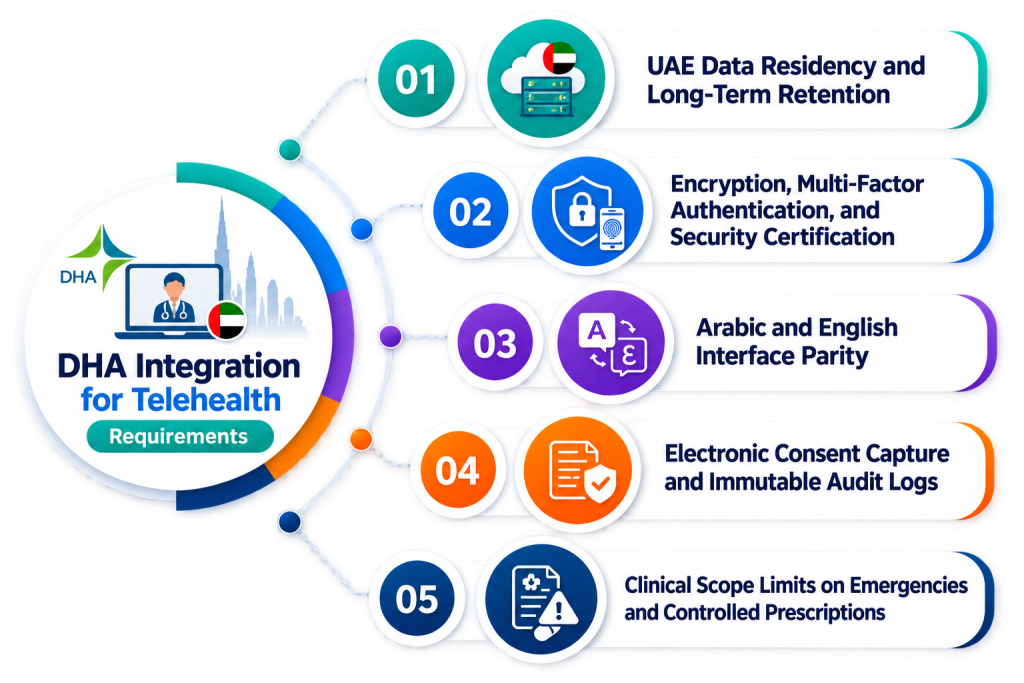
These five requirements decide whether your submission moves forward or sits in a correction loop for months.
1. UAE Data Residency and Long-Term Retention
Every database, backup, log file, and failover server holding patient data stays inside the country. Records must survive a retention window measured in decades, so plan storage lifecycle and archival costs early rather than treating them as an afterthought.
2. Encryption, Multi-Factor Authentication, and Security Certification
Encrypt data in transit and at rest, enforce multi-factor authentication for clinicians and patients, and hold recognised security certification. Communication tools used for consultations need approval too, so a generic video widget rarely clears review on its own.
3. Arabic and English Interface Parity
Bilingual support is a regulatory condition, not a growth-stage nicety. Both languages need equal coverage across registration, consultation, prescriptions, and consent screens. English-only products face approval friction and lose reach across a large share of the patient base.
4. Electronic Consent Capture and Immutable Audit Logs
Consent is captured electronically and securely before the consultation begins, with the status and date recorded against the patient. Every read, edit, and export of a record produces a timestamped log entry that auditors can inspect without touching production data.
5. Clinical Scope Limits on Emergencies and Controlled Prescriptions
Virtual care excludes emergencies needing immediate physical intervention, and remote prescribing of narcotic, controlled, and semi-controlled medication is off limits. Build triage logic that routes these cases out of your platform instead of relying on clinician judgement alone.
NABIDH Data Standards Your Build Must Support
DHA Integration for Telehealth is mostly a data engineering exercise. These five standards carry the highest rejection risk when they are handled late.
1. HL7 v2.5.1, CDA R2, and FHIR R4 Messaging
NABIDH runs on HL7 and FHIR messaging, with HL7 v2.5.1 still carrying most live facility traffic and FHIR R4 shaping newer work. Design your resources around both, since a single-standard build usually needs rework mid-project.
2. The NABIDH Minimum Data Set
The Minimum Data Set fixes which fields each message type must carry, including Emirates ID, demographics, encounter details, and insurance data. Missing or optional-looking fields are the most common reason a test submission comes back rejected.
3. Clinical Code Systems: ICD-10, LOINC, SNOMED CT, and Dubai Drug Code
Diagnoses map to ICD-10, laboratory results to LOINC, clinical terminology to SNOMED CT, and medications to the Dubai Drug Code. Free-text clinical entry feels faster during development, then blocks submission until every value is mapped.
4. Sheryan ID Mapping for Facility and Clinician
Each message carries the facility identifier and the treating clinician’s Sheryan ID. Stale or unmapped clinician records trigger avoidable test failures, so audit your practitioner table against the licensing register before you submit anything.
5. API Security With OAuth 2.0, JWT, and Tokenised Access
Message exchange runs over authenticated, encrypted channels using OAuth 2.0 authorisation and token-based session validation. Treat token lifecycle, rotation, and revocation as first-class features rather than configuration handled during the final sprint.
Now that you have seen what the regulator asks for in DHA Integration for Telehealth, let us walk through the delivery order that actually works.
The DHA Integration for Telehealth Process: 7 Phases
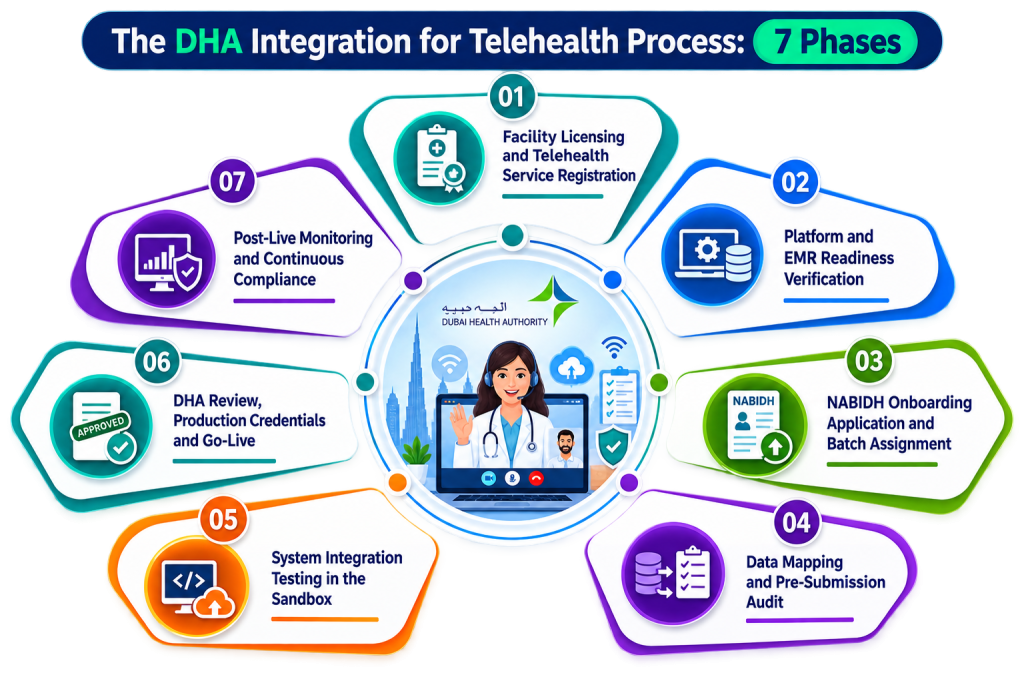
Think of this as a sequence rather than a checklist. Each phase produces something the next phase depends on, and skipping ahead almost always costs more time than it saves.
Phase 1. Facility Licensing and Telehealth Service Registration
Start with the entity, not the code. You apply for a health facility licence, then register the telehealth service under it. That submission describes your care pathways, clinical scope, and the technology you intend to run.
Prepare this documentation carefully, because reviewers use it as the reference point during later inspection. If your submitted scope says follow-up consultations only, your product cannot quietly launch acute triage six months later.
Phase 2. Platform and EMR Readiness Verification
Next, confirm the system carrying clinical records can genuinely produce compliant messages. If you are buying an off-the-shelf platform, check that it appears on the regulator’s certified register rather than trusting marketing language about readiness.
Ask direct questions here. How many facility go-lives has this vendor completed, how long did testing take, and who maintains the interface when message specifications change? Vague answers usually predict a slow project.
Phase 3. NABIDH Onboarding Application and Batch Assignment
With the licence and platform settled, you submit the onboarding application through the official portal using your licence details and system information. The authority then assigns your facility to an integration batch.
You cannot skip this queue, so build it into the plan. Facilities going through initial licence approval tend to move sooner, which is one practical reason to run licensing and integration preparation in parallel.
Phase 4. Data Mapping and Pre-Submission Audit
This is the phase teams underestimate most. You map every clinical field in your system to the required code systems. Then you run a dry audit against the Minimum Data Set, finding gaps before a reviewer does.
Pull a sample of real encounter records and trace each field end to end. Check clinician identifiers, timestamp formats, and code values. Fixing this now costs days, while fixing it during testing costs weeks.
Phase 5. System Integration Testing in the Sandbox
Your platform then connects to the sandbox and transmits test messages covering registration, encounters, prescriptions, laboratory results, and imaging reports. Reviewers validate structure and completeness against the standard.
Expect more than one round. Plan the calendar around two or three testing cycles and keep one named person accountable for the correction log. Resist the urge to fix issues in bulk without retesting each one.
Phase 6. DHA Review, Production Credentials, and Go-Live
Once testing passes, the authority reviews your security architecture, data flows, access controls, and documentation, then issues production credentials. Network addresses are whitelisted, and your facility record is updated.
Treat go-live as a supervised event rather than a release. Run a limited clinical pilot, watch acknowledgement messages closely, and confirm records land correctly before opening the platform to full patient volume.
Phase 7. Post-Live Monitoring and Continuous Compliance
Compliance continues after launch. Message errors accumulate silently, so review transmission success dashboards weekly for the first quarter and assign one owner to clear the failure queue.
Beyond messaging, keep documentation current, run penetration testing on a fixed schedule, and track specification updates. A platform that stops maintaining evidence quietly drifts out of compliance well before anyone notices.
DHA Integration for Telehealth Cost and Timeline Benchmarks
Use these as planning bands for budgeting conversations, not as quotations. Scope, integrations, and clinical complexity move every number here.
| Workstream | Planning range | Duration |
|---|---|---|
| Regulatory documentation and readiness mapping | $8,000 to $12,000 | 3 to 4 weeks |
| Compliance-led architecture and data modelling | $10,000 to $18,000 | 4 to 6 weeks |
| Core platform build with records, consultations, and prescriptions | $25,000 to $60,000 | 8 to 14 weeks |
| NABIDH interface layer and message mapping | $6,000 to $15,000 | 3 to 5 weeks |
| Sandbox testing, review support, and go-live | $5,000 to $10,000 | 2 to 4 weeks |
Most early-stage platforms land between $54,000 and $115,000 across four to seven months.
What Pushes the Budget Up
Several factors can increase the overall development cost:
- Legacy systems may require additional middleware.
- Multi-site rollouts need more development and testing.
- Insurance claim integrations add extra complexity.
- Large amounts of historical data take more time to migrate.
- Custom clinical modules require additional mapping and testing.
- More integrations usually mean higher development costs.
What Stretches the Timeline
Some parts of the process can take longer than expected:
- NABIDH batch assignment can cause delays and is outside your control.
- Missing or incorrect clinical data can lead to testing failures.
- Failed tests may require multiple correction rounds.
- Late data mapping can push the launch back by several weeks.
- Starting data mapping early can help avoid major delays.
Not Sure What NABIDH Integration Will Cost for Your Platform?
Share your requirements with our healthcare IT team and get a clear scope, timeline, and cost estimate — no obligation.
Get a Free Cost EstimateWhere Telehealth Startups Fail DHA and NABIDH Approval
Rejections in DHA Integration for Telehealth rarely come from exotic technical problems. They come from the same three clusters, and each one is preventable.
1. Hosting and Data Residency Failures
Offshore cloud regions, overseas backup buckets, and third-party analytics tools quietly shipping records abroad are the leading cause of enforcement action. Audit every outbound data path, including monitoring and support tooling, before you submit anything.
2. Data Quality and Clinical Coding Failures
Free-text diagnoses, internal medication codes, and inconsistent timestamp formats all trigger message rejection. Solving EHR interoperability problems starts at the schema, not the interface. Teams often discover this during testing, when remapping a live schema is far harder than designing it correctly at the start.
3. Identity, Consent, and Documentation Failures
Mismatched clinician identifiers, missing consent workflows, and incomplete audit logs stall submissions repeatedly. Retrofitting consent capture onto an existing patient base is painful, so build it into registration from your first release.
Why Trust DreamSoft4U for DHA Integration for Telehealth
Launching a telehealth platform in Dubai requires the right technology, compliance planning, and NABIDH integration from the start.
DreamSoft4u brings these pieces together to help you move from planning to a compliant, launch-ready platform with fewer delays.
Why choose us:
- Proven NABIDH delivery: Our NABIDH integration project built an HL7 converter and Mirth Connect channels producing compliant ADT messages with field-level validation.
- Interoperability depth: We work daily across HL7, FHIR, DICOM, and Mirth Connect pipelines for hospitals and digital health products.
- Healthcare specialisation: 22+ years in software engineering, 1,600+ projects delivered, and 100+ engineers focused on regulated industries.
- Secure-by-design build: Healthcare software development shaped around data residency, consent, encryption, and audit readiness.
- White-label acceleration: Production-ready telemedicine platforms that shorten your path from licence approval to live consultations.
Conclusion
Launching a telehealth platform in Dubai takes more than building a good app. You also need to meet DHA requirements, connect with NABIDH, protect patient data, and follow the right healthcare standards.
The best approach is to plan these requirements from the start. This helps you avoid costly changes, reduce testing delays, and move toward launch faster.
With the right technology partner, you can build a secure, compliant, and reliable telehealth platform ready for the Dubai healthcare market.
Ready to Launch a DHA-Compliant Telehealth Platform in Dubai?
DreamSoft4u’s healthcare IT team handles NABIDH integration, DHA compliance, and full platform development — so you can focus on care delivery.
Book a Free ConsultationFrequently Asked Questions
Yes, without exception in practice. Any platform delivering regulated clinical services in Dubai operates through a licensed facility, and that facility connects to NABIDH. No soft launch route avoids the requirement.
No separate practitioner licence exists for virtual care. A clinician’s existing professional licence covers remote consultations, provided the health facility they practise through holds registered telehealth authorisation.
Most single-site facilities complete DHA Integration for Telehealth from testing submission to production in roughly six to ten weeks. Add licensing, platform selection, and clinical mapping, and the end-to-end journey usually lands between four and seven months.
Yes, by operating through a licensed partner clinic that already holds telehealth authorisation and a live exchange connection. Your commercial agreement should define data governance responsibilities in writing.
Message exchange uses HL7 v2.x, CDA R2, and FHIR R4, with HL7 v2.5.1 carrying most active facility traffic. Clinical values map to ICD-10, LOINC, SNOMED CT, and the Dubai Drug Code.
In almost all cases, it cannot. Health data tied to services delivered in the country stays inside it unless a regulator approves a specific exemption. That covers live databases, backups, logs, and failover infrastructure.
Unmapped clinical codes, missing Minimum Data Set fields, mismatched clinician identifiers, and incorrect timestamp formats. Nearly all of them are caught by a pre-submission audit of sample encounter records.
Planning bands typically fall between $54,000 and $115,000 depending on scope, existing systems, and integration depth. Interface work alone usually sits in the lower five-figure range.