






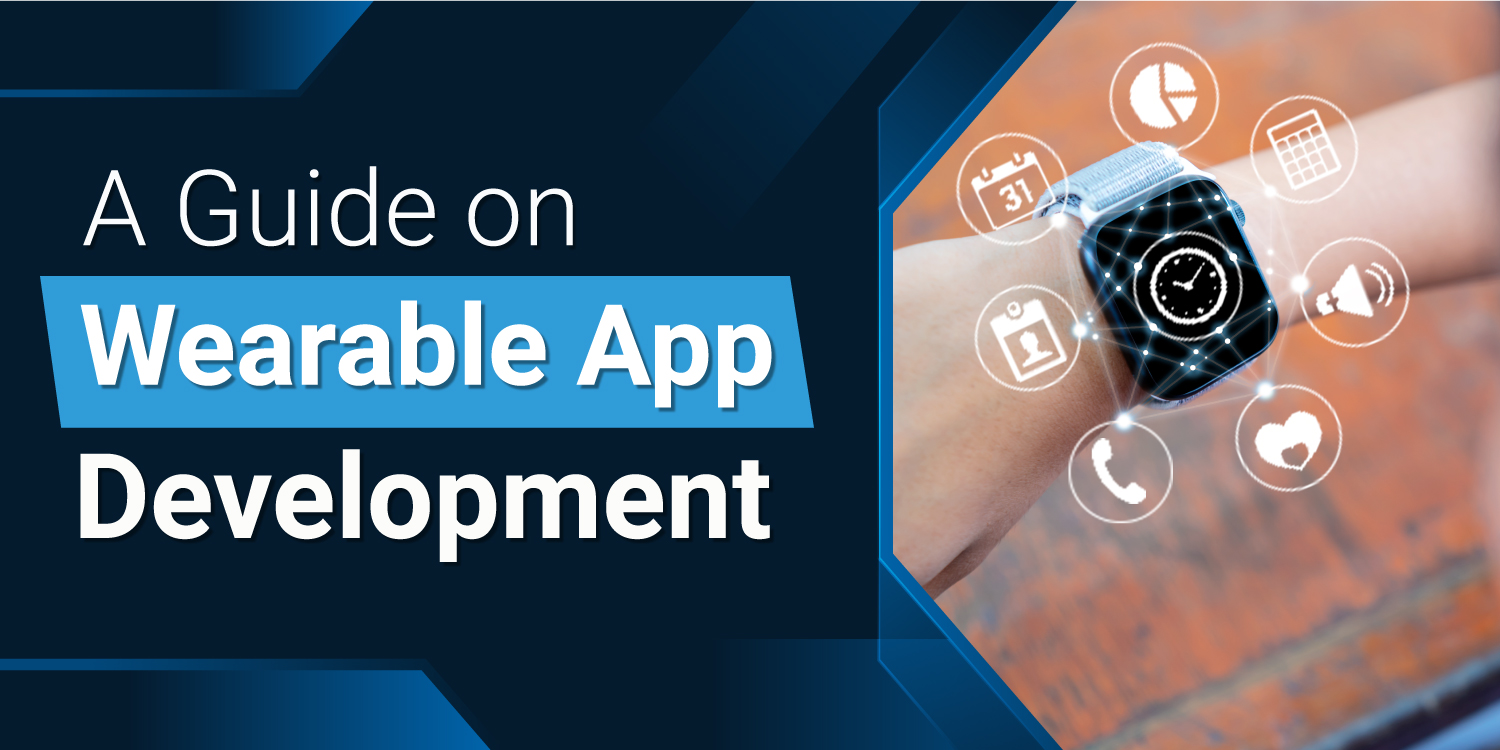
Wearable app development is the process of building software for devices worn on the body- smartwatches, fitness bands, smart glasses, and health biosensors – that collects sensor data and delivers it through small, glanceable screens. The global wearable technology market is projected to keep growing sharply through 2030, and businesses across fitness, healthcare, and enterprise are racing to build for it.
At DreamSoft4u, our wearable app development services have shipped apps for smartwatches, fitness bands, and healthcare-grade biosensors for clients across the US, UAE, and India – this guide covers what it actually takes to plan, build, and launch one in 2026: the process, must-have features, real cost ranges, and the tech stack decisions that matter.
What is Wearable App Development?
Wearable application development is a comprehensive process of designing and developing applications which run smoothly on wearable devices. Some most common wearable devices are smartwatches, activity trackers, fitness bands and smart glasses. These applications collect information from wearable devices. Further, they access the hardware and operating system of the device and make use of sensors for data collection and transfer to the application.
They’re designed differently than regular apps, with a screen size of their own and different hardware that offers its own set of benefits. One way to develop a new product is by developing an app that can work with wearable devices. For example, if you have a weight loss app, it could sync your exercise information from the watch and show you how close you’re getting to your target weight.
Standalone vs. Companion Wearable Apps: Which Should You Build?
Every wearable app falls into one of two categories, and the choice shapes your entire development approach:
Companion apps run alongside a mobile app and sync data between the phone and the wearable. They’re faster and cheaper to build since most logic, storage, and processing stay on the phone. Most fitness and notification apps start here.
Standalone apps run independently on the device itself – no phone required for core functionality. They’re essential for use cases like emergency health alerts or GPS tracking during workouts, but they cost more to build because they need their own data handling, battery optimization, and often offline capability.
Our recommendation: Start with a companion app if you’re validating a new wearable product idea. Move to standalone only once you have a specific use case – like continuous health monitoring – that genuinely requires the device to work without a paired phone.
Difference Between Wearable and Mobile Apps
Wearable and mobile applications are designed and developed for different purposes despite they share common ground in their functions. Generally, mobile apps are meant for tablets and smartphones, offering different functions like entertainment, communication and productivity. The mobile app development majorly relies on touch or gesture-based inputs and promotes the device screen for interaction.
Whereas, wearable applications are meant for wearable devices only. Some common wearable devices are smartwatches and augmented reality glasses. These applications focus on delivering quick information and are optimized for smaller screens only. These also offer glanceable information and promote lightweight interactions. The primary aim of wearable apps is to offer improved user experience and prioritize simplicity and efficiency.
Current Market Overview of Wearable App Development
- According to the Grand View research, the worldwide market size of wearable technology is expected to rise at a CAGR of 14.6% by 2030.
- A report by Markets and Markets says that the market for headwear wearables is expected to see a massive growth of CAGR of 30% by 2026.
- According to a report by Deloitte Technology, the worldwide market of wearable devices for the medical industry is expected to reach nearly 440 million in 2024.
Types of On-Demand Wearable Apps
1. Smartwatches
According to Statista, smartwatches are known to be the most popular kind of wearable device. Smartwatch wearable applications include different features like activity trackers, heart rate monitors, calorie trackers, notifications, and deep health-data sync via Apple HealthKit integration.
2. Smart eyewear
Smart eyewear, also known as smart glass, is the next most popular technological advancement, which includes data related to the objects which users visualize. as Smart glasses include data from external and internal sensors while providing adequate support to wireless technologies like GPS, WiFi and Bluetooth. Some key features of smart eyewear are data storage and communication, visual tracking and information assessment.
This kind of sensor-to-cloud data flow is a classic IoT app development use case – the wearable is really just a smart, connected IoT endpoint.
3. Fitness bands
Famously called Fitbits, fitness bands are a great wearable device for all fitness freaks who want to track their everyday movements. The wearable device application collects all important data and transforms it into steps, daily routines, sleep quality and more. This platform also helps you monitor your health and set future goals. Key features include breathing rate, health metrics and others.
Most fitness bands also sync seamlessly with platforms like Google Fit for a unified view of daily activity.
4. Head-mounted display
The most obvious examples of head-mounted displays based on wearable app development technologies are AR/VR glasses. They can be employed to keep an eye on users of the virtual ecosystem and to inform them. Numerous diagnostic trackers are used to detect chronic illnesses, muscle activity, body temperature, and a host of other things. Custom wearable app development has applications and use cases outside the healthcare industry.
5. Messaging and communication
With these, users can use their wearable devices to make calls, send and receive messages, and maintain social connections. They provide:
- Voice commands.
- Speech-to-text functionality for hands-free communication.
- Simplified user interfaces designed for speedy interactions.
Wearable messaging apps improve accessibility and convenience, especially when exercising or travelling.
Tech Stack for Wearable App Development
The right stack depends on the platform and how much native performance you need:
- Apple Watch (watchOS): Swift, SwiftUI — best choice when you need deep integration with Apple Health and HealthKit.
- Wear OS (Android): Kotlin, Jetpack Compose — the standard for Android-based smartwatches and Samsung Galaxy Watch.
- Cross-platform: Flutter or React Native, when you need one codebase across phone and wearable and can trade some native performance for faster, cheaper delivery.
- Backend/sensor integration: REST or GraphQL APIs, cloud storage (AWS/GCP/Azure), and HealthKit/Google Fit SDKs for syncing biometric data.
At DreamSoft4u, we pick native (Swift/Kotlin) when hardware-level sensor access or battery efficiency is critical – like continuous heart-rate monitoring – and cross-platform when speed to market matters more than squeezing out the last bit of native performance.
Benefits of Wearable App Development
Wearable technology is continuously on the rise for good reason. Wearable devices are capable of making the daily routine of life easy. There are many benefits of wearable app development. Some most significant advantages of wearable app development are discussed below:
1. Fashion
Wearable apps are easy to handle in the fashion industry. Popular brands like Levis are adding functional products, like suits, skirts, and other accessories to clothes. Unique fabric clothes will be launched in the coming days which will enhance blood flow as required. Big brands produce wearable jewellery such as necklaces, rings, and bracelets, in addition to clothing.
2. Entertainment
The largest entertainment app has made the product compliant with wearable devices. For instance, different apps allow you to play different media on your phone, like music, videos, and pictures, or other devices like Spotify.
3. Improvement in task accuracy
Any person can make mistakes but you can provide error-free operations using the wearable device. Anyone may concentrate on their entire mission minimizing numerous obstacles of daily life.
4. Increases productivity
Wearable devices can deliver speedy production that increases production because the wearable device has so many features and functions. This enhances user experience and promotes great productivity.
5. Improved accessibility and convenience
Wearable applications offer users piles of data and services directly from their bodies and different parts. This easy accessibility eliminates the requirement to constantly look for your phone, promoting better interactions and great convenience, especially when using a smartphone is not possible.
Thinking About Wearable App Development for Your Business?
Whether it’s a companion app or a full standalone build, DreamSoft4u’s wearable app development team can scope your idea in a free 30-minute consult.
Best features to include in a wearable fitness app (In Table Only)
| Feature | Description |
| Activity Tracking | Monitor steps, distance, calories burned, and active minutes. |
| Heart Rate Monitoring | Measure heart rate in real-time and track trends over time. |
| Workout Logging | Log various types of workouts, including running, cycling, and strength training. |
| Goal Setting | Set personalized fitness goals and track progress towards achieving them. |
| GPS Tracking | Record routes, map activities, and track outdoor workouts using GPS technology. |
| Sleep Tracking | Monitor sleep patterns, duration, and quality to optimize rest and recovery. |
| Custom Workouts | Create and follow customized workout plans tailored to individual preferences and goals. |
| Challenges | Participate in challenges and compete with friends for motivation. |
| Nutrition Tracking | Log food intake, track macros, and monitor nutritional intake to support fitness goals. |
| Water Intake Monitoring | Remind users to stay hydrated and track daily water intake for overall well-being. |
Wearable App Development Challenges
While these wearable devices offer certain good features, still there are many challenges which developers have to face while building wearable applications. Some major challenges of wearable app development are discussed below:
1. Privacy and Data Security
In today’s scenario data security and privacy is a big concern. Every wearable technology demands data transfer from one device to another. However, there are a couple of benefits to data transfer. However, the data being robbed by a third party is a security concern. It is a major problem that keeps people from using wearable devices.
2. Battery Friendly
If the wearable app utilizes too much power then it will not work in the market. Due to its portable nature, most wearable devices on the market have battery life. The wearable device will discharge sooner if you use a large battery.
3. Speed
The design of applications for all these devices has become necessary efficiently and rapidly as competition increases. The sooner the product is launched into the market, the higher the wearable app development experts can react to it.
4. Regular Updates
To stay on the top in the market and to ensure long-term success, wearable app development required updates to keep the latest technology and trends and fix the bugs.
5. Limited Screen Size and Interaction
In most cases, wearable devices have small screens as compared to other devices like smartphones and tablets. As a result, it becomes a major challenge to display data and design user interfaces. It is the responsibility of developers to optimize application layouts to accommodate limited screens while maintaining great readability and usability.
How to Develop a Wearable Application: Step-by-Step
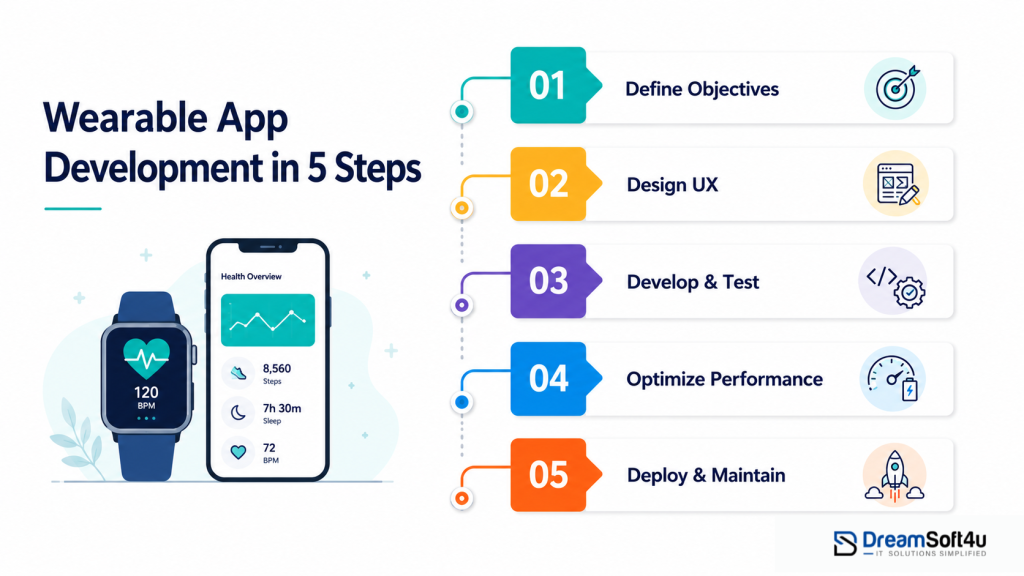
1. Define Your Objectives and Target Audience
The first step of the wearable app development process is cleaning and defining the wearable app objective. You must also determine your target audience to understand their individual preferences and needs. This will help the wearable app developer to tailor the application accordingly. An in-depth market research is conducted to determine potential gaps and solutions.
2. Design User-Centric Interfaces and Experiences
Design user-friendly, intuitive interfaces that are tailored to the specific form factor and interaction capabilities of wearable technology. To increase user happiness and engagement, give priority to readability, simplicity, and ease of navigation.
3. Develop and Test the Application
Using the right development tools and frameworks, you must start the wearable app development process. Add features, Wearable Devices Integration and overall functionalities. Once the application is built, conduct a comprehensive and frequent test.
4. Optimize for Performance and Efficiency
Pay special attention to performance and efficiency application optimization to reduce power consumption and increase responsiveness. Use background processing, caching, and lightweight interactions to make sure everything runs well without using up all of the device’s resources.
5. Deploy and Maintain the Application
Once the application is built and tested, you must prepare the app for deployment on different distribution channels and app stores. Make sure you monitor user feedback and gather insights to determine gaps. Based on the customer expectations, make further updates and enhancements.
Tips for Wearable App Development
Here are certain tips for Wearable App Development services that wearable app developers must follow:
1. Start with a use case
Developers have to build the app which is valuable to do this developers should start with the relevant set of questions from the wearable context. It can help you to find the best solutions and the roadmap will help to achieve advancement.
2. Right platform selection and API
In the market, certain platforms and APIs are available so it is important to select the best APIs and platforms as per the requirement.
3. Focus on the user
While developing the wearable app the developer should focus on the experience of the end-user with the restricted physical visible space available. The functions of the app should be developed to solve issues of customers or make a easier life or more fun.
4. Consumption and memory space
This is the key factor in every smart device. Users always want apps that should consume low power and memory space. So while developing the wearable app the developer should design it in that way it will take less memory and memory space.
5. Test continuously
Use an iterative development process to improve app features and fix usability concerns by testing and prototyping features and getting user input. To guarantee interoperability, dependability, and performance, thoroughly test a variety of wearables and use cases.
How Much Does It Cost to Develop a Wearable App?
Wearable app development cost depends heavily on complexity:
- Basic app (simple companion app, notifications, basic tracking): $8,000–$25,000
- Mid-complexity app (custom UI, health data sync, cloud backend): $25,000–$70,000
- Advanced app (AI/ML features, AR, standalone functionality, full HIPAA-compliant healthcare integration): $80,000–$150,000+
Key factors that move you up or down this range:
- Wearable app features and standalone vs. companion architecture
- Tech stack (native vs. cross-platform)
- Regulatory compliance needs (HIPAA, GDPR — common for healthcare wearables)
- Whether you’re outsourcing to a full-service partner or hiring individually
For comparison, see our full breakdown of the cost to build a mobile app, which covers many of the same factors in more detail.
Get a free, itemized quote for your wearable app idea →
Why Choose DreamSoft4U for your Wearable App Development?
DreamSoft4u is a US-based globally renowned software development company which builds highly compelling and feature-rich applications. At DreamSoft4u, there are more than 100 skilled professionals offering touch-notch, wearable app development solutions. So, if you are looking for the best wearable app development company, your search ends here! Get in touch with professionals at DreamSoft4u now to get the best developing mobile solutions for IoT devices!
Future of Wearable Devices in Healthcare
Wearable devices like fitness trackers, pulsometers, smart health watches and wearables that monitor your blood pressure are excellent advancements in the field of healthcare. They have multiple uses from tracking your ECG data to checking your heart rate.
If you’re building the companion platform alongside the wearable, our guide to telehealth app development cost breaks down that side of the budget separately.
This is where specialized healthcare app development comes in – turning raw biosensor data into clinically useful insights for both patients and providers.
Patients can receive precise medical information from wearable devices thanks to their improved performance, compact equipment, and the most recent advancements in biosensor technology. It improves healthcare by enabling patients to monitor, identify, and prevent any condition. In the future, healthcare is going to be greater from technology by building a world-class healthcare system. In most Western countries, this has already happened.
For a deeper look at building the provider-facing side of these systems, check out our full healthcare app development guide.
Wrapping Up!
The use of wearable devices is expected to grow immensely in the future! In recent years, we all have witnessed how fitness bands and devices have changed everyone’s exercise routines. The wearable applications are designed carefully by experts to offer personalized suggestions with the use of ML and AI technologies. Developing a wearable application includes planning, designing and developing functions of an app. You can choose DreamSoft4u to get the best solutions!
Ready to Build Your Wearable App?
DreamSoft4u has shipped wearable apps for smartwatches, fitness bands, and healthcare biosensors across the US, UAE, and India.
FAQs
Some major factors that you should consider when developing wearable apps are telehealth application complexity, user base, security, data integration, prototyping and others.
When developing a wearable application, developers come across several challenges. These challenges are privacy and data security, battery consumption and customized notifications.
The user interface is the most important for smooth user accessibility on small screens. Crafting an easy-to-use and intuitive interface tailored for wearable devices improves customer satisfaction.
Wearable devices in the healthcare industry promote continuous monitoring of the patient’s health. These also provide personalized care and prevention tips to all patients.
Some common examples of biosensors are: Continuous Glucose Monitoring (CGM) devices, Smartwatches, Fitness trackers, Smart technology clothing.
A basic companion app typically takes 8–12 weeks. A standalone app with custom health features or AI integration can take 4–6 months, depending on platform and compliance requirements.
Choose native (Swift for watchOS, Kotlin for Wear OS) if you need deep sensor access or maximum battery efficiency. Choose cross-platform (Flutter/React Native) if speed to market and one shared codebase matter more.
Yes, if the app collects, stores, or transmits patient health data in the US. This affects architecture, data storage, and third-party integrations from day one — build compliance in early rather than retrofitting it.