
There are myriads of options when we speak of Software Development & Programming Tools. But, picking up one tool can be a daunting task.If you’d rather have this handled for you, our team offers custom software development services across the full stack covered below.
The list is prepared after extensive research on the attributes of features, compatibility, etc. Moreover, we have listed these tools into three main categories:
- Best Recommended Software Development Tools
- Integrated Development Environment
- Best Software Development Frameworks
- Cloud Tools for Software Development
- Data Science
- Source Control
- Prototyping
- Best DevOps Tools / Programs
- Notifications
- UML
How we evaluated these tools: Our team shortlisted these 25 tools based on hands-on use across our own development projects, checked each one’s pricing transparency and integration options, and grouped them by the stage of the development lifecycle they support – from IDEs and frameworks to cloud, DevOps, and source control.
| # | Tool | Category | Best For | Pricing |
|---|---|---|---|---|
| 1 | RAD Studio | IDE | Cross-platform native desktop/mobile apps | Paid, free Community Edition |
| 2 | FinanceLayer | API | Live financial news feeds for sites/apps | Freemium, paid tiers by volume |
| 3 | Collaborator | Code/Doc Review | Formal, audit-ready review workflows | Paid, per-user license |
| 4 | Studio 3T | IDE | MongoDB GUI for devs/DBAs | Freemium, paid Pro/Enterprise |
| 5 | Linx | IDE | Low-code backend process automation | Free Community, paid Enterprise |
| 6 | SQL Sentry | Monitoring | Proactive DB monitoring/alerting | Paid, quote-based |
| 7 | DbSchema | Database Design | Visual schema design across DB types | Free trial, then paid per-user |
| 8 | Apache NetBeans | IDE | Free Java/PHP development | Free, open source |
| 9 | AWS Cloud9 | IDE | Cloud-based multi-language dev on AWS | Free tool, pay for AWS usage |
| 10 | Zend Studio | IDE | Professional PHP dev, debugging, testing | Paid, per-seat license |
| 11 | Atom | Text Editor | Customizable free code editor | Free, open source (archived by GitHub) |
| 12 | CodeLobster | IDE | Lightweight PHP/HTML/CSS/JS editing | Free edition, paid Professional |
| 13 | CodeCharge Studio | RAD Tool | Fast database-driven web apps | Paid license |
| 14 | Bootstrap | Framework | Responsive front-end UI | Free, open source |
| 15 | HTML5 Builder | Framework | Cross-platform apps from one HTML5 codebase | Paid license |
| 16 | Visual Online | Dev Platform | Code quality, components, testing in one place | Paid, tiered |
| 17 | Azure | Cloud | Hosting, deployment, app management | Pay-as-you-go, free tier available |
| 18 | Kwatee | Deployment | Deployment automation for PHP/Java apps | Free/open-source core, paid support |
| 19 | Data Studio (Looker Studio) | Data Visualization | Turning data into shareable reports | Free |
| 20 | GitHub | Source Control | Code hosting, PRs, CI/CD | Free tier, paid Team/Enterprise |
| 21 | BitBucket | Source Control | Git hosting integrated with Jira | Free for small teams, paid tiers scale |
| 22 | Axure | Prototyping | Interactive wireframes/prototypes | Paid, per-user subscription |
| 23 | Red Hat CodeReady Workspaces | DevOps | Cloud-native containerized dev environments | Paid (OpenShift ecosystem) |
| 24 | SendBird | Messaging SDK/API | In-app chat, voice, video messaging | Freemium, usage-based paid tiers |
| 25 | Enterprise Architect | UML Modeling | UML/SysML/BPMN modeling with traceability | Paid, per-seat one-time license |
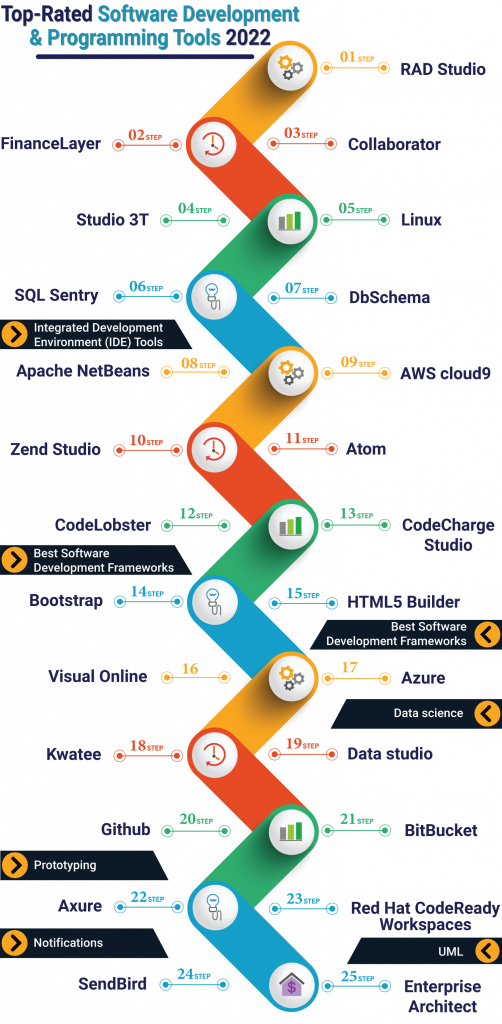
Top-Rated Software Development & Programming Tools
Here, the section represents all businesses’ 25 best software development tools. It will help you in heaps and leverage success in leaps & bounds.
1. RAD Studio
RAD Studio is among the magnificent software development IDE tools. It helps build native applications on Windows, iOS, Android, Linux, and macOS. With less coding effort, you can design awesome desktop and mobile application UIs. It has a complete set of tools that simplify the development life cycle.
These are the following RAD Studio Features:
- Single code base
- Connect to over 20 databases
- Faster coding
- High DPI & 4k
- Remote desktop
Best for: Teams building native cross-platform desktop and mobile apps from one Delphi/C++ codebase.
Pricing: Paid, with a free Community Edition for small teams/individuals.
Watch out for: Steeper learning curve if your team has no Delphi/Object Pascal background.
2. FinanceLayer
FinanceLayer is an application programming interface or software development methodologies for finance news. It offers the most dynamic financial data in handy JSON format. It delivers live finance news and article feeds on any website or application.
The followings are the features of FinanceLayer:
- Live financial news
- Keyword searches
- Tag searches
- Connect to 100+ financial sources through one integration
- Historical news feature
- The API supports any client and server-side programming language, making it accessible to all.
Best for: Sites and apps that need a live financial news feed instead of building their own aggregation pipeline.
Pricing: Freemium, with paid tiers for higher request volume and historical data.
Watch out for: You’re dependent on FinanceLayer’s uptime and source coverage rather than your own feed.
3. Collaborator
Collaborator is a premier document review tool. The development teams take software quality seriously and use this tool. It enhances mobile app development performance.
The followings are the feature of the Collaborator:
- Comprehensive review capabilities-all in one tool- Review source code, Microsoft Word, Excel, PowerPoint, Adobe PDF, Images, and Simulink models.
- Enhances the code review process
- Supports 11 version control tools
- To meet auditing and regulatory compliance standards, the Collaborator Ensures proof of review with electronic signatures & detailed reports.
Best for: Teams that need formal, audit-ready code and document review (not just quick PR comments).
Pricing: Paid, per-user licensing; free trial available.
Watch out for: Heavier setup than lightweight PR-review tools like GitHub’s built-in review flow.
4. Studio 3T
Studio 3T offers a graphical user interface and integrated development environment. It accesses and modifies MongoDB databases and their documents. It is a user-friendly tool that lets you take full advantage of MongoDB’s document management capabilities.
The followings are the feature of the Studio 3T:
- Generate instant code.
- Import and export in multiple formats
- Migration from MongoDB to SQL.
Best for: Developers and DBAs working daily inside MongoDB who want a GUI instead of the shell.
Pricing: Freemium (Free tier) with paid Pro/Enterprise tiers for team features.
Watch out for: Full feature set (query code generation, migration tools) sits behind the paid tiers.
5. Linx
Linx is a low code integrated development environment and sever. It supports high-volume & multithreading applications and is well-suited for all types of server applications. It enhances the software development company’s credibility.
The followings are the feature of the Linx:
- Easy to use, drag and drop interface
- Live debugging with step
- End-to-end encryption
- Frequent new updates
- Lightweight infrastructure
- Automate backend processes
Best for: Backend teams automating server-side processes without hand-coding every integration.
Pricing: Free Community Edition, paid Enterprise licensing for production/scale features.
Watch out for: Low-code tools like this can be harder to version-control and code-review than plain code.
6. SQL Sentry
SQL Sentry is a monitoring tool that boosts the software development process. Your entire database environment can effectively monitor, diagnose, and optimize.
The followings are the feature of the SQL Sentry:
- Proactive alerting and response system
- It finds and fixes high-impact queries
- Performance analysis dashboard
Best for: DBAs and platform teams who need proactive alerting across a large SQL Server/Azure estate.
Pricing: Paid, quote-based licensing.
Watch out for: Overkill if you’re only running one or two small databases.
7. DbSchema
DbSchema is a visual database designer and enables out-of-the-box schema management. It also facilitates schema documentation, design in a team, and deployment on multiple databases. The tool is the manager for any SQL, NoSQL, or Cloud database that streamlines the software development life cycle.
The followings are the feature of the DbSchema:
- Deploy on multiple databases
- Generate migration scripts
- SQL Editor with autocomplete
- Design offline
Best for: Teams that want visual schema design/documentation across SQL, NoSQL, and cloud databases.
Pricing: Free trial, then paid per-user license.
Watch out for: Best value shows up on larger, multi-database projects – light for a single small SQL DB.
Integrated Development Environment (IDE) Tools
8. Apache NetBeans
Apache NetBeans is an integrated development environment (IDE) for Java, PHP, and many other languages. It offers high-end web development & editors to help you create applications.
The followings are the feature of the Apache NetBeans:
- Support for fast code editing
- Rapid user interface development
- Helps to write bug-free code
- Easy & Efficient Project Management Process
Best for: Java and PHP developers who want a free, mature IDE with no licensing overhead.
Pricing: Free and open source.
Watch out for: Feels dated next to IntelliJ/VS Code for some newer language ecosystems.
9. AWS Cloud9
Aws Cloud9 is a cloud-based integrated development environment. It supports multiple programming languages like C, C++, PHP, Ruby, Perl, Python, JavaScript with Node.js, and Go.
The followings are the feature of AWS Cloud9:
- Easily drag any file.
- Terminal to create multiple split views.
- The Debugger helps developers to set breakpoints.
- It offers software developers to code faster and avoids typos.
- Built-In Terminal for the command-line wizard.
Best for: Teams already on AWS who want a browser-based IDE tied directly to their cloud environment.
Pricing: Free to use; you pay for the underlying AWS compute resources.
Watch out for: Ties you into the AWS ecosystem — less useful if you deploy elsewhere.
10. Zend Studio
Zend Studio is a professional-grade development environment. It includes debugging, profiling, unit testing, PHP code editing, etc. It scales according to the DPI settings. The tool sometimes helps in software development services.
The followings are the feature of Zend Studio:
- Code faster with up-to-performance improvements
- Offering debugging capabilities
- It supports development tools.
- Supports PHP 4 and PHP 5X
- It supports js Doc
- Severs view
Best for: Professional PHP teams needing integrated debugging, profiling, and unit testing in one IDE.
Pricing: Paid, per-seat license.
Watch out for: Free alternatives (VS Code + PHP extensions) now cover much of the same ground.
If your priority is a mobile-first product rather than desktop tooling, our mobile app development company can help you choose and implement the right IDE and framework combination
11. Atom
Atom is a free and open-source text editor. It is a desktop application built with HTML, JavaScript, CSS, and Node.js integration.
The followings are the feature of Atom:
- It is customizable.
- Atom works across many popular operating systems like OS X, Windows, and Linux
- Easily browse
- Find, preview, and replace text type in a file or across the entire project
Best for: Developers who want a free, highly customizable text editor.
Pricing: Free and open source.
Watch out for: GitHub archived Atom in December 2022 in favor of VS Code – confirm current maintenance status before recommending it for new setups.
12. CodeLobster
CodeLobster is a portable integrated development environment that simplifies the PHP development process. It also supports HTML, CSS, and JavaScript development.
The followings are the feature of the CodeLobster:
- PHP, HTML, JavaScript, CSS code highlighting
- Autocomplete of style property names and values
- It offers PHP Advanced autocomplete
Best for: Freelancers and small teams doing PHP/HTML/CSS/JS work who want a lightweight, portable IDE.
Pricing: Free edition available; paid Professional edition unlocks more plugins.
Watch out for: Smaller plugin ecosystem than VS Code or JetBrains products.
13. CodeCharge Studio
CodeCharge Studio is a rapid application development and integrated environment for creating database-driven web applications. It offers the fastest way to build applications.
The followings are the feature of the CodeCharge Studio:
- Visual query builder
- It supports multiple programming languages
- Avoid costly errors and misspellings by generating consistent
- It Helps to convert any database into a web application in less time.
Best for: Rapid-building database-driven web apps (admin panels, CRUD interfaces) without heavy manual coding.
Pricing: Paid, one-time or licensed purchase.
Watch out for: Generated code can be harder to customize deeply than a hand-built app.
Best Software Development Frameworks
14. Bootstrap
Bootstrap is a CSS framework and toolkit. It contains massive amounts of reusable code and website element templates. It can also easily drag and drop to assemble responsive web pages.
Best for: Front-end teams needing fast, responsive UI without writing CSS from scratch.
Pricing: Free and open source.
Watch out for: Sites can look “templated” if you don’t customize the default styling.
15. HTML5 Builder
HTML5 Builder is a rapid application development tool that builds dynamic web and mobile apps from a single HTML5, CSS3, JavaScript, and PHP codebase.
Best for: Teams building cross-platform web/mobile apps from a single HTML5/CSS3/JS/PHP codebase.
Pricing: Paid license.
Watch out for: Smaller community/support base than mainstream JS frameworks (React, Vue).
16. Visual Online
Visual Online is one of the best tools for software developers that allows organizations to create the perfect development environment.
Features:
- Improve code quality
- Build, manage, secure, and share software components
- Tools for manual, performance, and automated testing
Best for: Organizations wanting an integrated environment for code quality, component management, and testing in one place.
Pricing: Paid, tiered by team size/usage.
Watch out for: Confirm current product naming/availability with the vendor — this space has consolidated a lot under Azure DevOps in recent years.
Cloud Tools for Software Development
17. Azure
Azure is an online portal that allows you to access and manage cloud services. It is used by developers to build, deploy and manage web applications.
Best for: Teams needing a full cloud platform to build, deploy, and manage applications at scale.
Pricing: Pay-as-you-go, with a free tier for limited usage.
Watch out for: Costs can scale quickly without active monitoring/governance.
Looking to build rather than just host? Explore our cloud application development services alongside the platform tools above.
18. Kwatee
Kwatee is a software development tool. It is suitable for updating PHP sites, Java Web apps, and n-tier applications.
Best for: Teams needing straightforward deployment automation for PHP or Java web apps.
Pricing: Free/open-source core, with paid support options.
Watch out for: Less actively marketed than modern CI/CD tools (GitHub Actions, Jenkins) – check current maintenance activity.
Data Science
19. Data Studio
Data Studio is a visualization tool that turns your data into fully customizable informative reports. It makes data easy to read and share.
Best for: Turning raw data into shareable, customizable visual reports for stakeholders.
Pricing: Free (Google’s Looker Studio, the current name for Data Studio).
Watch out for: Best for reporting/dashboards, not a substitute for a full BI/data-science stack.
Source Control
20. GitHub
GitHub is a code hosting platform. It allows developers to review code, manage projects, and build software.
The followings are the feature of GitHub:
- Easy documentation
- It offers the right tool for different development jobs.
- Developers can host their documentation directly from repositories.
Best for: Hosting code, managing PRs/issues, and running CI/CD via Actions.
Pricing: Free for individuals and public repos; paid Team/Enterprise tiers for private-repo collaboration features.
Watch out for: Advanced security/compliance features are gated behind higher-cost plans.
21. BitBucket
BitBucket is a Git-based code hosting and collaboration tool. It integrates very well with JIRA, a famous project and issue-managing app.
The followings are the feature of BitBucket:
- IP whitelisting.
- Merge checks.
- Git large file storage
Best for: Teams already using Jira who want tightly integrated issue tracking and code review.
Pricing: Free for small teams; paid tiers scale by user count.
Watch out for: Smaller community/marketplace than GitHub’s.
Prototyping
22. Axure
Axure is a wireframing and interactive-prototyping tool used by business analysts, product managers, and IT consultants to design and test UX flows before development begins.
The followings are the feature of Azure:
- It helps to create and maintain widget libraries.
- It can run on Microsoft IIS with a MySQL or Microsoft SQL Server database.
Best for: Business analysts, PMs, and UX teams building interactive wireframes/prototypes before development starts.
Pricing: Paid, per-user subscription.
Watch out for: Steeper learning curve than simpler tools like Figma for teams that only need static mockups.
Best DevOps Tools / Programs
23. Red Hat CodeReady Workspaces
Red Hat CodeReady Workspaces is a developer tool that makes cloud-native development practical for teams. It fully automates deployments of text and binary files from any number of target servers.
The followings are the features of Red Hat CodeReady Workspaces:
- It eliminates the need for installation & configuration.
- Supports various operating systems, including Linux, Windows, Mac OS X, Solaris, etc.
- It takes out many operational risks in the software development process.
Best for: Teams standardizing cloud-native, containerized dev environments across distributed teams.
Pricing: Paid, part of Red Hat’s OpenShift ecosystem (open-source upstream project available as “Eclipse Che”).
Watch out for: Best value requires you’re already invested in Kubernetes/OpenShift infrastructure.
Need help standardizing your team’s DevOps workflow? Our DevOps consulting services can set up and manage a CodeReady-style environment for you.
Notifications
24. SendBird
SendBird is a customizable messaging SDK and chats API. It provides chat, voice, and video messaging for mobile applications and websites.
The following are the feature of the SendBird:
- It offers scalability for a massive audience.
- It also prevents spam from flooding chat rooms.
- Read and track the status of the messages sent to users
- It Offers Push Notifications & Callbacks.
Best for: Apps needing chat, voice, or video messaging without building the infrastructure in-house.
Pricing: Freemium, with usage-based paid tiers.
Watch out for: Costs scale with active users/message volume – model this before committing at scale.
UML
25. Enterprise Architect
Enterprise Architect is responsible for the upkeep and maintenance of an organization’s IT networks and services. It is a design tool for UML, SysML, BPMN, and many other technologies.
The following are the feature of the Enterprise Architect:
- It Supports Single click HTML and document generation.
- Code execution to visual diagrams
- It loads huge models in seconds.
- Offers complete traceability.
Best for: Architecture teams needing UML/SysML/BPMN modeling with full traceability across large systems.
Pricing: Paid, per-seat license (one-time purchase model, not subscription).
Watch out for: Steep learning curve for teams new to formal modeling notations.
Are You Looking for a Tailored Business Software Solution?
Our experts can fulfill your specific needs!
Conclusion
So, these were the top-rated 25 Best Software Development Tools. Users can directly download or can first check the reviews & ratings of these programming tools. We have also shared the download links of some tools. Visit and boost your business now!
FAQs
We offer a comprehensive suite of software development services, including: Web development ,Mobile app development ,Cloud computing ,IoT ,Salesforce and Healthcare software
The tool we use depends on your project needs. Our stack varies with native, hybrid, and cross-platform applications. However, we have expertise and experience across most if not all the tools mentioned in this blog.
We work with clients on an hourly, monthly, and project-based basis. You can hire dedicated developers on whichever basis fits your project.
You can switch between full-time, part-time, or project-based assistance as your needs change. We aim to be flexible and customize our services to fit your requirements during our collaboration.
Yes, we do have on-demand software solutions for e-commerce, food delivery chains, event management, telehealth, and more You can launch these solutions within weeks and they are 100% white label too.
For beginners, free and well-documented tools are the easiest starting point — Apache NetBeans or Atom for general coding, and Bootstrap if you’re starting with front-end work. They have large communities and tutorials, so you won’t get stuck without support while you’re still learning.
An IDE (like Apache NetBeans or Zend Studio) is the software you write, debug, and test your code in. A framework (like Bootstrap) is a set of pre-built code and templates you use inside that code to avoid building common features from scratch. In short: an IDE is where you work, a framework is what you build with.
For individuals and small teams, free tools like Apache NetBeans, Atom, GitHub’s free tier, and Bootstrap cover most core needs well. Paid tools tend to add value through team collaboration features, dedicated support, and compliance/audit capabilities — worth it once you’re scaling a team, not usually necessary to get started.
Most teams in 2026 center their workflow around an IDE (NetBeans, Zend Studio, or a cloud IDE like AWS Cloud9), a source control platform (GitHub or BitBucket), and at least one cloud platform (Azure) for hosting and deployment — with DevOps and monitoring tools layered on top as the team grows.