







A hospital can have the best doctors and advanced medical equipment, yet still lose time, money, and efficiency because of a poor supply chain.
Missing inventory, delayed deliveries, manual procurement, and disconnected systems can increase costs, disrupt patient care, and make day-to-day operations harder than they should be.
That is why medical supply chain management is now a key part of every hospital’s digital transformation strategy.
In this guide, you’ll learn the key challenges, essential features, implementation costs, and best practices for successful medical supply chain digital transformation.
By the end of this guide, you’ll know what it takes to build a modern, efficient, and future-ready hospital supply chain.
Medical Supply Chain Management at a Glance
Here is the short version before we go deeper.
| Question | Answer |
|---|---|
| What is it? | Coordinated sourcing, procurement, storage, distribution, and consumption of medical products across a health system |
| What does it cover? | Pharmaceuticals, implants, devices, consumables, and the data attached to each one |
| Why digitise it? | Supply spend is a top controllable cost line, and manual tracking creates clinical risk |
| Biggest blocker? | A dirty item master and disconnected systems, not the software |
| What to fix first? | Product data, integration readiness, and process standardisation |
| Typical build timeline | 4 to 12 months depending on scope and integration count |
What Is Medical Supply Chain Management? Key Components Explained
Before you can fix it, you need a clear picture of what sits inside it.
1. The journey from manufacturer to point of care
Every item follows the same path: sourcing, contracting, ordering, receiving, storage, clinical consumption, then returns or disposal. Medical supply chain management governs each handoff and records what happened at every step.
2. Why healthcare behaves differently from other industries
Retail can absorb a late delivery. A cardiac cath lab cannot. Products expire, implants carry lifetime traceability duties, and a single missing item can cancel a scheduled procedure and the revenue attached to it.
3. The stakeholders you have to coordinate
Manufacturers, distributors, group purchasing organisations, warehouses, clinical departments, and finance all touch the same items. Each holds part of the data, rarely in the same format.
That is why a hospital information management system needs supply chain visibility built in rather than bolted on later.
What Problems Do Hospitals Face Before Supply Chain Digital Transformation?
Before hospitals modernize their supply chain, they often face these common challenges.
1. Disconnected systems
Different systems store different information. For example, the ERP manages purchasing, the EHR records supply usage, and inventory systems track stock levels. Since these systems don’t communicate well, teams spend hours combining data manually.
2. No real-time inventory visibility
Many hospitals know what they ordered but don’t know exactly what’s available in storage. Without real-time inventory tracking, shortages and overstocking become common problems.
3. Too many manual purchasing processes
Many hospitals still rely on emails, phone calls, or paper-based purchasing. Buying outside approved suppliers can increase costs and make it harder to track spending.
4. Poor product data
Duplicate product records, missing information, and outdated prices create inaccurate reports and inventory errors. Even the best software cannot deliver reliable results if the data is incorrect.
5. Heavy dependence on suppliers
Many hospitals depend completely on distributors for inventory planning. When a supplier runs out of stock, hospitals often find out only after an order is delayed, leaving little time to find alternatives.
Also Read: How Hospital Information System (HIS) Manages Healthcare Agencies
Digital Transformation Readiness Checklist for Hospitals
Before investing in new software, make sure these five areas are ready. Otherwise, the new system will simply carry over your existing problems.
1. Clean and accurate product data
Review your product catalog for duplicate records, missing information, and outdated data. Clean, well-organized product data is the foundation of a successful implementation.
2. Integration readiness
Check whether your existing EHR, ERP, and other systems can integrate with the new platform. Understanding your current system capabilities helps avoid unexpected challenges later.
3. Standardized processes
If different hospitals or departments follow different purchasing or inventory processes, standardize them first. A common workflow makes implementation much smoother.
4. Clear ownership
Assign a team or project owner to manage product data, approve changes, and make key decisions. Without clear ownership, projects often face delays and confusion.
5. Budget and internal resources
Make sure you have enough budget, time, and people for tasks like data cleanup, testing, training, and implementation. These activities often take more effort than expected.
Essential Features of a Medical Supply Chain Management Platform
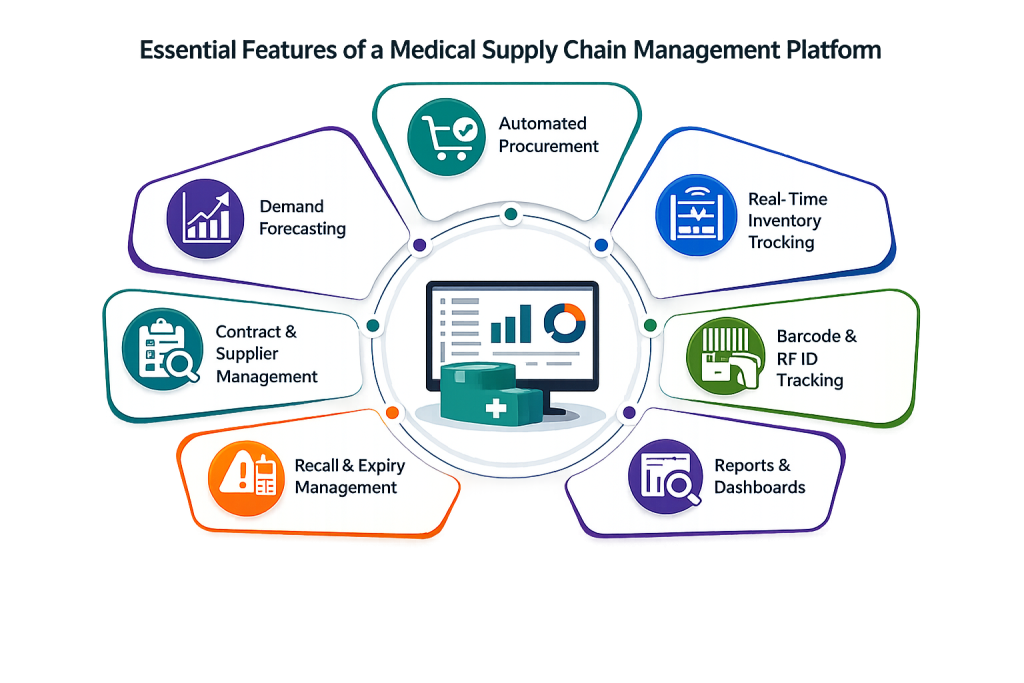
Once your hospital is ready, the next step is choosing the right software. A good medical supply chain management platform should include these essential features.
1. Automated procurement
Simplify the purchasing process by managing purchase requests, approvals, purchase orders, and receipts in one system.
2. Real-time inventory tracking
Track inventory across warehouses, departments, and storage rooms in real time. The system should also notify teams when stock needs to be replenished.
3. Contract and supplier management
Manage supplier contracts, pricing agreements, and GPO contracts in one place to ensure hospitals always purchase at the correct price.
4. Barcode and RFID tracking
Use barcode, RFID, or UDI scanning to track every item, including its lot number, serial number, and expiry date from receiving to patient use.
5. Demand forecasting
Analyze historical usage and upcoming procedures to predict future inventory needs and prevent shortages or excess stock.
6. Recall and expiry management
Quickly identify recalled or expired products, locate where they are stored, and remove them before they are used.
7. Reports and dashboards
Monitor inventory levels, purchasing costs, supplier performance, and product usage through real-time reports and dashboards.
Tip: AI-powered inventory management can further improve demand forecasting by analyzing usage patterns and helping hospitals maintain the right inventory levels.
Not sure which of these features your hospital actually needs first? [Get a free supply chain software assessment →]
Compliance Requirements Every Hospital Should Consider
Compliance should be part of your software planning from the beginning, not something you add after development.
1. HIPAA compliance
If your supply chain system stores or shares patient-related information, it must comply with HIPAA. This includes protecting sensitive data with secure access, encryption, and activity logs.
2. FDA UDI and DSCSA compliance
Medical devices and pharmaceuticals must be tracked using FDA regulations such as UDI and DSCSA. Your system should record product details, lot numbers, serial numbers, and expiry dates to support full traceability.
3. Secure records and audit trails
Every inventory update, purchase, and product movement should be recorded automatically. A complete audit trail helps hospitals meet regulatory requirements and simplifies compliance audits.
4. Regional compliance requirements
Hospitals operating in multiple countries must also comply with local healthcare and data privacy regulations. The platform should be flexible enough to support different compliance requirements without major redevelopment.
Also Read: How EDI Integration Can Improve Your Business Performance
ERP vs Purpose-Built Medical Supply Chain Management Software
Almost every hospital asks the same question: can our ERP just do this? Here is an honest comparison.
| Criterion | Hospital ERP module | Purpose-built platform |
|---|---|---|
| Functional coverage | Broad, finance-led | Deep, clinically-led |
| Point-of-use tracking | Limited or add-on | Native |
| UDI and lot-level capture | Basic | Full item-level |
| Recall response | Manual reporting | Automated lot lookup |
| Multi-site par management | Configurable, effortful | Built for it |
| Implementation effort | Long, enterprise-wide | Shorter, scoped |
| Best fit | Spend and financial control | Clinical inventory and traceability |
Still weighing ERP vs. a purpose-built platform? [Talk to a healthcare software architect →]
Medical Supply Chain Management Software Cost and Timeline
Medical supply chain management costs vary with scope, integration count, and data cleanup effort. These bands reflect typical custom and hybrid builds.
| Scope | Indicative range | Typical timeline |
|---|---|---|
| Single-facility module (inventory or procurement) | $40,000 to $90,000 | 3 to 5 months |
| Multi-department platform with EHR and ERP integration | $90,000 to $220,000 | 5 to 9 months |
| Enterprise multi-site platform with full traceability | $220,000 to $500,000+ | 9 to 15 months |
Integration count and compliance depth move these numbers most. Facility count, item master cleanup, and RFID hardware follow close behind, and change management is the line most budgets underestimate.
Also Read: Custom Healthcare Software Development: Cost, Benefits and Guide
A Step-by-Step Roadmap for Medical Supply Chain Digital Transformation
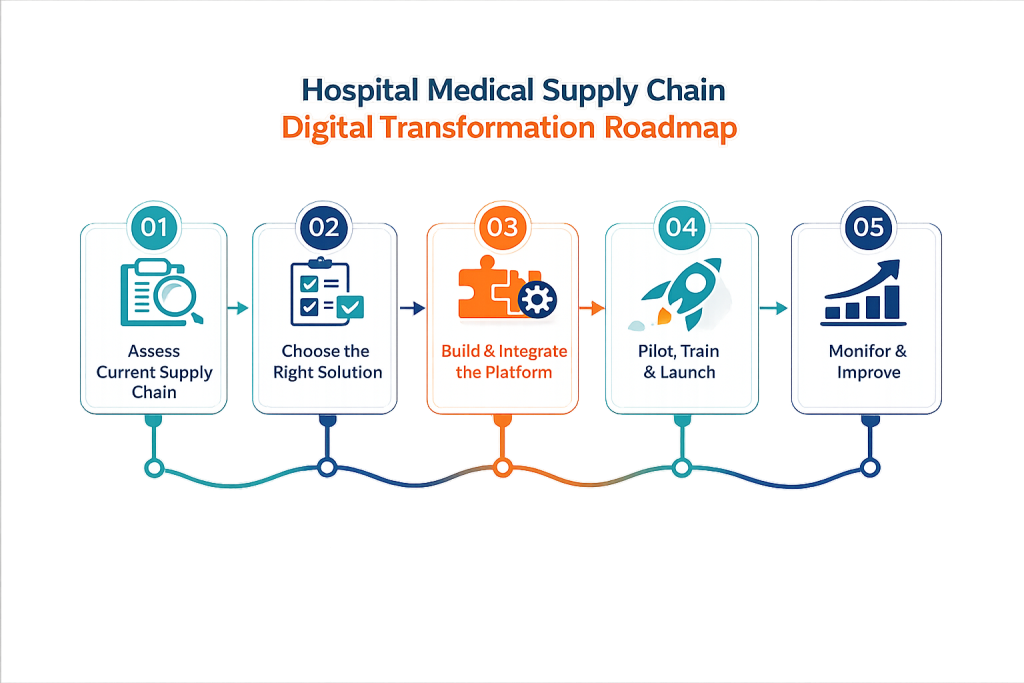
A successful medical supply chain implementation doesn’t happen overnight. Following these five steps can help reduce risks and ensure a smoother rollout.
1. Assess your current supply chain
Start by reviewing how your hospital currently purchases, stores, and uses medical supplies. Identify process gaps, remove duplicate product records, and clean up outdated inventory data before implementing new software.
2. Choose the right solution
Compare different platforms based on your hospital’s needs, budget, and existing systems. Make sure the software can integrate with your EHR, ERP, and other critical applications.
3. Build and integrate the platform
Configure the system and connect it with your existing healthcare software. Test all integrations carefully to ensure inventory, procurement, and clinical data flow accurately across systems.
4. Pilot, train, and launch
Begin with one department or facility before rolling the system out across the hospital. Train each team on the workflows they use every day and resolve any issues before full deployment.
5. Monitor and improve
After implementation, regularly track KPIs such as inventory levels, stockouts, expired products, purchasing costs, and order processing time. Use these insights to improve performance and optimize the system over time.
5 Common Mistakes in Medical Supply Chain Digital Transformation
Most failures repeat the same patterns, and all of them are avoidable.
- Buying before cleaning: Choosing a platform while the item master holds duplicates guarantees unreliable reporting from day one.
- No clinical sponsor: Projects run purely from finance lose the OR and nursing support that changes daily behaviour
- Underscoped integration: Teams budget for the platform and treat EHR, ERP, and EDI work as an afterthought
- No governance owner: Without a named owner, catalogue quality drifts back within months of go-live
- Ignoring change management: Staff who were never consulted keep the paper workaround alive beside the new system
Why Choose DreamSoft4u for Your Medical Supply Chain Software?
DreamSoft4u engineers compliance-grade healthcare platforms, and supply chain work sits on the interoperability skills we use daily. Our teams connect clinical, financial, and procurement systems for healthcare brands worldwide.
Why choose us?
- 23+ years in healthcare technology: Domain knowledge across hospital, telehealth, and health-tech product teams
- 1600+ projects delivered: A record spanning EMR / EHR / PHR, RCM, and enterprise integration work
- 100+ engineers: Capacity for architecture, integration, QA, and support across multiple time zones
- Interoperability depth: HL7, FHIR, DICOM, EDI, and GS1 handled by specialists, not generalists
- Secure-by-design engineering: HIPAA, GDPR, and ISO 27001 controls built in from the start
Conclusion
Medical supply chain management is no longer just about keeping shelves stocked. It plays a critical role in reducing costs, improving operational efficiency, ensuring regulatory compliance, and delivering better patient care.
Before investing in new software, focus on the fundamentals. Clean your product data, standardize processes, evaluate your existing systems, and choose a platform that integrates seamlessly with your healthcare ecosystem. Getting these basics right will make your digital transformation faster, smoother, and more successful.
If you’re planning to build or modernize a medical supply chain management system, DreamSoft4U can help. Our healthcare technology experts design secure, scalable, and compliant solutions tailored to your hospital’s unique workflows and long-term goals.
Ready to Modernize Your Hospital’s Supply Chain?
From item-master cleanup to full HL7/FHIR-integrated platforms, DreamSoft4U builds secure, compliant supply chain systems tailored to your hospital’s workflows — not a generic template.
Frequently Asked Questions
It is the coordinated management of sourcing, procurement, storage, distribution, and clinical consumption of medical products across a hospital. It also governs the data attached to every item.
Healthcare adds lifetime traceability duties, expiry and cold-chain handling, regulated documentation, and direct patient-safety consequences that commercial supply chains rarely face at the same intensity.
Clean the item master and confirm what your EHR and ERP can expose through integration. Then standardise receiving and par policies across sites, and name one owner for data governance.
In most cases, it does not. Hospitals keep the ERP for finance and spend control, then add a purpose-built layer for clinical inventory, point-of-use tracking, and traceability.
It captures item-level identifiers, lot, serial, and expiry data at receipt and consumption. That history is stored in auditable form and exchanged electronically with trading partners.
A single-facility module typically runs 3 to 5 months. A multi-department platform with EHR and ERP integration runs 5 to 9 months, and enterprise multi-site builds take longer.
Indicative bands run from around $40,000 for a single-facility module to $500,000 and above for enterprise multi-site platforms. Integration count drives most of the variation.
Track fill rate, stockout frequency, expired inventory value, inventory turns, and purchase order cycle time. Review them monthly against your pre-project baseline.