






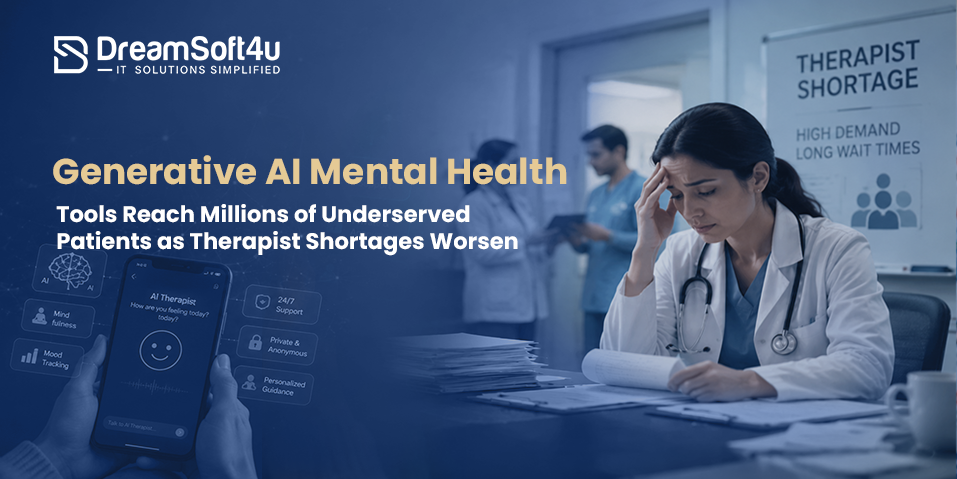
Millions of people struggle with stress, anxiety, depression, and other mental health challenges every day. Yet getting professional help is often difficult due to long wait times, high costs, or a shortage of therapists.
This is where generative AI mental health tools are making an impact. These AI-powered platforms provide instant conversations, coping support, and guidance anytime, helping people access support when traditional care is unavailable.
Their popularity is growing because they are available 24/7, easy to access, and affordable for people who may not have immediate access to a mental health professional.
While they cannot replace therapists, they can help people take the first step toward support and stay engaged between therapy sessions.
In this guide, you’ll learn what generative AI mental health tools are, how they work, their benefits and risks, what current research says, and how to build a safe and compliant platform.
By the end of this guide, you will understand where these tools genuinely help, where they fall short, and what it takes to engineer one that stays safe, compliant, and trusted by the people who lean on it.
Table of Contents
ToggleQuick Answer: Generative AI Mental Health Tools at a Glance
- What they are: Generative AI mental health tools are conversational apps and chatbots built on large language models that offer coping support, guided exercises, and round-the-clock listening.
- Who uses them: Millions of underserved patients, plus people who want private, low-cost support between sessions or while waiting for one.
- What they do well: Always-on access, reduced stigma, and early help for mild to moderate stress.
- Where they fall short: They cannot diagnose, manage a crisis, or stand in for a licensed clinician.
- The bottom line: Used as a supplement inside a wider plan of care, generative AI mental health tools widen access. Used as a replacement, they introduce real risk.
What Are Generative AI Mental Health Tools?
Generative AI mental health tools are software systems that hold natural, back-and-forth conversations to support emotional well-being. They read a person’s words, tone, and emotional context, then respond with tailored coping techniques, reflection prompts, or simple encouragement.
How Do They Differ From Rule-Based Mental Health Apps?
Older mental health apps follow scripts. They serve fixed meditations, mood logs, and pre-written replies, so the conversation feels stiff and repetitive once you step outside the menu. Generative AI mental health tools break that pattern by creating fresh responses in real time, which makes the exchange feel personal and far closer to a real dialogue.
4 Types of Generative AI Mental Health Tools
Here are four main types of generative AI mental health tools:
1. General-Purpose LLM Assistants
These are broad assistants people repurpose for emotional support, even though support was never their main design goal. They are easy to reach and surprisingly conversational, but they carry the least oversight of any option in this list.
2. Purpose-Built AI Therapy Chatbots
A purpose-built AI therapy chatbot is designed around clinical techniques like cognitive behavioral therapy, with guardrails baked in. These tools aim for structured, evidence-informed conversations rather than open-ended chat, which makes them safer for ongoing support.
3. AI Companions and Emotional-Support Agents
Companion agents focus on presence and connection, offering a steady, friendly voice for loneliness and everyday stress. They can ease isolation, yet they also raise the sharpest questions about emotional dependency, which we cover later.
4. Hybrid Telehealth and AI Platforms
The strongest model blends software with people, pairing AI mental health chatbots for between-visit support with live telehealth sessions. This hybrid setup keeps a human in the loop while still extending reach, which is why it suits serious clinical deployments best.
Also Read: The Complete Guide to Telemedicine
Why Generative AI Mental Health Tools Matter as Therapist Shortages Worsen?
The mental health workforce is stretched thin, and the gap keeps widening. Generative AI mental health tools matter because they reach people that the traditional system simply cannot serve fast enough.
1. The Widening Gap Between Demand and Available Clinicians
Need is rising while clinicians are scarce, and the math does not work in patients’ favor. Roughly 85% of people with a mental illness receive no treatment, often because there are too few providers to go around. That shortfall is the single biggest reason generative AI in mental healthcare is gaining ground so quickly.
2. Who Gets Left Behind Without Accessible Care
The people hit hardest are those in rural, low-income, and uninsured communities, where a nearby clinician may not exist at all. Willingness to try AI for support runs highest exactly where help is scarcest, with around 51% of people in India open to AI-led therapy compared to 24% in the US and France. Digital mental health tools step into that void.
3. Rising Adoption Among Young and Underserved Users
Younger users lead the shift, drawn by privacy, low cost, and the comfort of an anonymous listener. In one survey, 16% of US adults said they turned to AI chatbots for mental health in the past year, with much higher rates among people under 30. For many of them, generative AI mental health tools are the first door they ever knock on.
Want to Reach the Patients Traditional Care Can’t?
Millions of people are waiting for support that never comes in time. Build an AI-powered platform that meets them the moment they need it, without long waitlists or high costs standing in the way.
Talk to Our AI Healthcare ExpertsHow Generative AI Mental Health Tools Work?
Under the hood, these systems combine language understanding with clinical structure. Here is what actually happens when someone opens one and starts typing.
1. Understanding Language, Tone, and Emotional Context
The tool reads not just the words but the feeling behind them, picking up on distress, frustration, or relief. That context lets it shape a reply that fits the moment rather than serving a generic line, which is what makes generative AI mental health tools feel responsive.
2. Delivering Evidence-Based Techniques Like CBT and DBT
Good tools translate proven methods into plain conversation, walking a user through reframing a thought or grounding an anxious moment. They turn clinical exercises into something a person can actually follow at home, on their own schedule.
3. Early Detection and Risk Screening
By analyzing patterns in language and mood over time, these systems can flag early signs of worsening anxiety or depression. That early signal is one of the most valuable contributions of generative AI in mental healthcare, since it can prompt timely help before a small problem grows.
4. Personalization and Continuous Monitoring
The more someone engages, the better the tool tailors its support to their history and preferences. Continuous check-ins keep the experience consistent, which helps people stay with healthy habits between professional appointments.
Where Generative AI Mental Health Tools Fit in the Care Pathway?
The honest answer is that these tools belong inside a plan of care, not in place of one. Their value depends heavily on how severe a person’s needs are.
1. Self-Help and Mild Symptoms
For everyday stress, low mood, and mild worry, digital mental health tools shine as a first, low-pressure step. They give people coping skills and a place to vent, which can be enough to steady someone before things escalate.
2. Between-Session Support for Active Therapy
Between appointments, generative AI mental health tools reinforce what a therapist teaches, prompting practice and reflection so progress does not stall. This is where research finds them most useful, as a companion to human care rather than a substitute.
3. Triage and Waitlist Support
While people wait for a clinician, these tools offer a hand instead of silence. They can deliver basic coping support and gentle check-ins, easing the long, risky gap that waitlists create.
4. When to Escalate to a Human Clinician
The line is clear. Any sign of crisis, severe symptoms, or safety risk calls for a trained human, and a responsible tool should route the person to one fast. Knowing this boundary is the difference between a helpful product and a dangerous one.
Now that you know where these tools fit across the care pathway, let’s look at how they stack up against the alternatives people already rely on.
Generative AI Tools vs Human Therapists vs Specialized Apps
Each option solves a different part of the access problem, and a clear comparison makes the trade-offs obvious.
| Criterion | Generative AI Mental Health Tools | Specialized Apps | Human Therapist |
|---|---|---|---|
| Availability | 24/7, instant | On demand, fixed content | Limited by appointments |
| Cost | Low or free | Subscription | Highest |
| Reach | Global, very large | Moderate | Constrained by supply |
| Clinical depth | Limited, no diagnosis | Structured but rigid | Full assessment and treatment |
| Crisis handling | Unsafe on its own | Limited | Trained intervention |
| Personalization | High and conversational | Template based | Deeply individual |
| Oversight | Often minimal | Some curation | Licensed and accountable |
How to Build a Responsible Generative AI Mental Health Tool?
Building a generative AI mental health tool requires more than a powerful AI model. To create a platform that is safe, compliant, and trusted by users, you need the right strategy from the start.
Step 1. Define Clinical Scope and Guardrails
Start by clearly defining what your tool will do and what it will not do. For example, a tool designed for stress management should not present itself as a replacement for therapy. Set clear boundaries, identify situations that require human intervention, and make sure users always know they are interacting with AI.
Step 2. Choose the Right Healthcare Development Partner
Most teams underestimate how much domain depth this build demands. A general software shop can ship features, but engineering a safe, compliant generative AI mental health tool needs a partner who already lives in HIPAA, clinical workflows, and standards like FHIR and HL7.
This is where DreamSoft4u fits. With more than two decades of healthcare engineering, 1,600+ projects delivered, and a 100+ engineer team, you get a compliance-grade, clinically-aware foundation from day one, which keeps you from costly missteps and reaches production faster.
Step 3. Build a Secure and Compliant Platform
Mental health data is highly sensitive, so security must be a priority from day one. Implement encryption, secure access controls, and proper data management practices. Your platform should also comply with regulations such as HIPAA and GDPR to protect user information and maintain trust.
Step 4. Add Human Escalation and Crisis Support
AI can support users, but it cannot handle every situation. Your platform should be able to detect signs of crisis, severe distress, or self-harm risk and immediately direct users to appropriate human support, such as therapists, crisis hotlines, or emergency services.
Step 5. Keep Clinicians Involved
Mental health professionals should play an active role in designing and reviewing the platform. Their expertise helps ensure conversations remain accurate, helpful, and aligned with evidence-based mental health practices.
Step 6. Test, Monitor, and Improve
Launching the platform is only the beginning. Regularly review user feedback, monitor performance, and evaluate safety outcomes. Continuous improvements help keep your generative AI mental health tool effective, reliable, and aligned with evolving user needs.
Ready to Turn This Roadmap Into a Real Platform?
From clinical guardrails to crisis escalation and full HIPAA compliance, we handle every layer of the build so your platform is safe and production-ready from day one, not patched together later.
Book Your Free Platform ConsultationBenefits for Patients, Providers, and Health Systems
When designed responsibly, these tools deliver value on three fronts at once.
- Round-the-clock access: People can reach support at any hour, which matters most during the late-night spikes when no clinic is open.
- Lower stigma: Anonymity makes it easier for first-timers to open up, so hesitant users finally take that first step.
- Reduced clinician burden: AI that streamlines healthcare workflows handles notes and routine check-ins, freeing providers to focus on real care.
- Earlier intervention: Pattern detection can flag rising distress sooner, which helps people get help before a crisis hits.
- Wider system reach: Health systems extend services into rural and underserved regions without hiring at an impossible speed.
Now that you have seen the upside, let’s look honestly at where generative AI mental health tools fall short and what can go wrong.
Also Read: Everything You Should Know About Healthcare App Development
Risks, Limits, and Safety Concerns
The risks are real, and ignoring them is how good intentions turn into harm. Anyone building or deploying these tools has to design for these failure points from day one.
1. Why AI Cannot Replace Human Clinicians
An AI tool cannot truly assess risk or grasp the nuance of someone’s history, relationships, and environment. It can mimic empathy, but it cannot carry clinical responsibility, so it should support care and never replace the clinician at the center of it.
2. Hallucinations and Inaccurate Guidance
Generative systems sometimes state wrong information with complete confidence, which is dangerous in a mental health setting. A reassuring tone can mask bad advice, so accuracy controls and clear disclaimers are non-negotiable.
3. Dependency and Parasocial Attachment
Constant, always-agreeable support can pull vulnerable users into unhealthy reliance on a bot. That dependency can deepen isolation rather than ease it, which is why healthy usage limits and nudges toward real connection matter.
4. Handling Crisis and High-Risk Users
These tools are not built for emergencies, and treating them as crisis lines has led to serious harm in documented cases. A safety-first design detects red flags and hands the person to human help immediately, every time.
5. Data Privacy and Security Exposure
Mental health conversations are among the most sensitive data a person can share, and a breach here is devastating. Without strong protection, that information can be exposed or misused, so security has to be engineered in, not bolted on.
Why Trust DreamSoft4U for Generative AI Mental Health Platform Development?
DreamSoft4u engineers compliance-grade healthcare software for a global client base across the US, India, the UK, the Middle East, and Australia. With more than two decades of healthcare engineering experience, the team builds secure, scalable platforms that hold up in production. That depth is what responsible mental health app development demands.
- Healthcare-first engineering: 1,600+ projects delivered and 98% client retention across digital health builds.
- Compliance by design: HIPAA, GDPR, and ISO 27001 practices, with FHIR, HL7, and DICOM interoperability built in.
- AI depth: Generative AI development services and AI chatbot expertise tuned for sensitive, regulated use cases.
- Proven delivery:A 100+ engineer team and a portfolio of telehealth and EMR products shipped worldwide.
Not Sure What Your Platform Needs to Get Compliant and Safe?
Every healthcare AI product has its own compliance gaps, risk points, and clinical requirements. Let’s map out exactly what a HIPAA-ready, trustworthy AI mental health platform looks like for your specific use case.
Schedule a Free ConsultationConclusion
Generative AI mental health tools are doing something the old system could not. They are reaching millions of underserved people with instant, private, low-cost support at the exact moment they need it. As therapist shortages deepen, that reach is no longer optional; it is essential.
Still, the lesson from every credible source is the same. These tools work best as a supplement to human care, not a replacement for it, and the products that earn trust are the ones engineered with compliance, safety, and clinical oversight at the core.
We hope this guide helped you understand where generative AI mental health tools deliver real value and where the hard limits sit. Now it is your turn to act on it.
FAQs
They are conversational apps and chatbots built on large language models that offer coping support, guided exercises, and round-the-clock listening. They read tone and context to respond personally, and they work best as a supplement to professional care.
No, they cannot stand in for a clinician. These tools cannot assess risk, diagnose, or carry clinical responsibility the way a licensed professional can, so they work best as a first step or a between-session companion inside a wider plan of care.
They can be safe for mild, everyday stress when they include strong guardrails and crisis routing. They become risky when used for emergencies or severe conditions, which always call for a trained human instead.
Research shows they can reduce anxiety, depression, and stress, especially for milder issues and when paired with human support. The evidence is still early, so results should be read with healthy caution.
Responsible platforms use encryption, strict access controls, and audit trails, and they meet standards like HIPAA and GDPR. Security has to be engineered into the system from the start, not added later.