







The global digital health market is projected to reach $275 billion by 2028 (CAGR: 9.16%), and one technology at the center of this shift is AWS HealthLake – Amazon’s HIPAA-eligible, FHIR R4-native healthcare data platform.
Healthcare organizations – from hospital systems to insurance payers – use AWS HealthLake to store, transform, and analyze massive volumes of unstructured health data: EHR records, clinical notes, lab reports, imaging metadata, and insurance claims. Unlike traditional storage, AWS HealthLake automatically converts raw data into FHIR R4 format, making it instantly queryable and analytics-ready.
In this guide, you’ll learn exactly how AWS HealthLake works, its latest 2025–2026 features, FHIR R4 capabilities, pricing, real-world use cases, and how it compares to Azure Health Data Services and Google Cloud Healthcare API.
Quick Summary:
AWS HealthLake is a HIPAA-eligible, FHIR R4-based cloud service that lets healthcare organizations store, transform, and analyze EHRs, lab reports, and clinical notes. It uses built-in medical NLP (Amazon Comprehend Medical) and connects with SageMaker and QuickSight for analytics – without you managing infrastructure.
AWS HealthLake: Overview
AWS (Amazon Web Services) HealthLake is a HIPAA-compliant software that allows healthcare organizations to securely store, transform, organize, and analyze their healthcare data in one place. It’s a powerful tool that can analyze electronic health records in a few minutes and gives valuable insights that can help organizations make data-driven decisions.
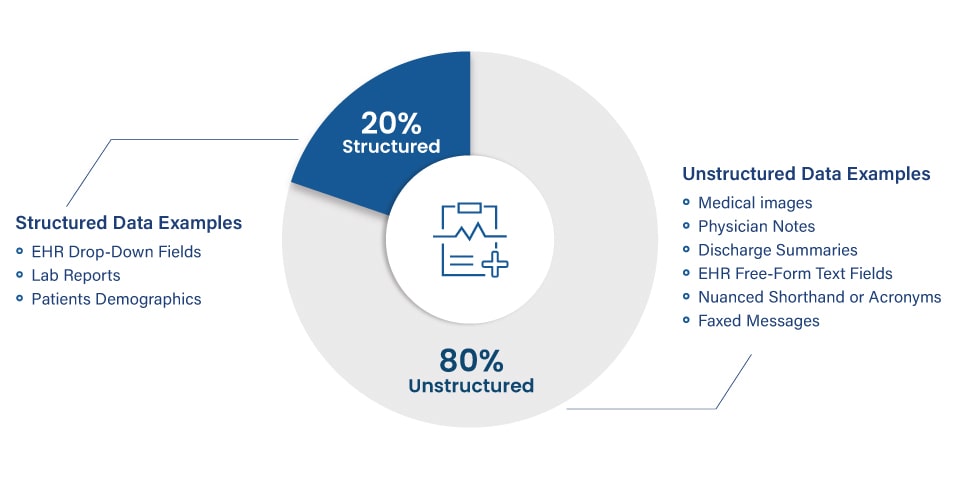
Mostly, the health data is in an unstructured and incomplete format, but it has valuable information, such as patient records, prescriptions, medical images, physician notes, etc, that is essential.
AWS HealthLake can transform the given raw data into FHIR APIs (Fast Healthcare Interoperability Resources), which makes it easier to understand and analyze. These FHIR-based APIs make it easier for organizations to import large amounts of health records to cloud storage.
It has built-in NLP (Natural Language Processing) models, which help users understand customers’ data and extract valuable insights after analysis for making data-driven decisions, identifying trends, and making predictions.
What’s New in AWS HealthLake (2025–2026 Updates)
AWS shipped a major set of FHIR operation updates to AWS HealthLake in 2025 – here’s what changed:
August 2025 – New FHIR Operations:
- $patch — Modify specific elements of a FHIR resource using JSON Patch, without rewriting the entire resource
- $validate — Validate a FHIR resource against the spec/profile before storing it, catching errors early
- $purge — Permanently delete all resources within a patient’s compartment (useful for right-to-erasure requests)
- $lookup — Retrieve details about a specific concept in a CodeSystem
- $expand — Expand a ValueSet to retrieve its full list of codes
- $erase — Permanently delete a specific resource and all its historical versions
- $document — Bundle a Composition resource with all referenced resources into a single clinical document
July 2025:
- Conditional Delete — delete resources based on search criteria instead of just by FHIR ID
These updates make AWS HealthLake noticeably more production-ready for high-volume clinical and payer workflows that need fine-grained, auditable data changes.
Why Use AWS HealthLake for Healthcare Data?
There are various reasons why healthcare organizations should consider the AWS HealthLake tool for health data:
1. Fast Ingest Health Data
By using the AWS HealthLake tool, healthcare organizations can quickly import their bulk health data, such as clinical notes, lab reports, insurance details, patient records, etc, to AWS storage in FHIR R4 format, which can be used later in downstream applications.
2. Time and Cost savings
It helps to save an organization’s precious time and money with AWS HealthLake because it will handle the cost of infrastructure to store healthcare data and analyze raw data in minutes.
3. Secured Cloud Storage
One of the key reasons why healthcare organizations need to switch to healthcare solutions is cloud storage. You can easily store raw data in AWS cloud storage with security in a HIPAA-compliant manner.
4. Data Interoperability
AWS HealthLake supports Fast Healthcare Interoperability Resources (FHIR), which can be used to transform raw data into FHIR-based data format for 360-view accessibility and analysis.
5. Data Analysis
AWS HealthLake has built-in various analyzing tools, such as Amazon QuickSight and ML Models, which can be used to analyze the raw data and extract the most valuable information that helps organizations make data-driven decisions, identify trends, and make predictions.
6. Security and Compliance
AWS HealthLake has HIPAA-compliant high-end cloud security and encryption support, which allows organizations to safely store their data on the cloud andprovides authorized access control to ensure privacy and safety.
7. Scalability
The AWS Cloud HealthLake tool can store large amounts of raw health data. It gives scalability to organizations to grow without the need for data storage infrastructure investment.
AWS HealthLake Pricing Overview (2026)
One of the most-searched questions is: how much does AWS HealthLake cost? AWS HealthLake uses a pay-as-you-go model with no upfront commitment.
- Data Store — $0.27 per Data Store hour (includes your first 10 GB of storage)
- Additional storage — $0.37 per GB/month beyond the included 10 GB (HealthLake Advanced tier)
- Data import — Free
- FHIR queries — First 3,500 queries/hour included; $0.048 per additional 10,000 queries
- Data export/transform for analytics — $0.19 per GB
- NLP processing — Billed separately via Amazon Comprehend Medical, per unit analyzed
💡 Cost tip: Because AWS HealthLake pricing is consumption-based with no infrastructure to provision, both small clinics and large hospital systems can adopt it without a large upfront investment.
For live, exact rates, always check the official AWS HealthLake pricing page.
Some Key Features of AWS HealthLake
Here are some key features of the AWS HealthLake tool:

1. Import Data
You can easily import healthcare data such as clinical notes, medical history, lab reports, insurance claims, and more into the AWS HealthLake data store by using APIs. First, it will transform the data into FHIR R4 format for easy import.
2. Store
One of the key challenges is that raw data is in an unstructured format. When you import data in AWS HealthLake, then, it will first structure the given data for easy accessibility and ensure the data is encrypted and HIPAA compliant.
3. Transform
AWS HealthLake has built-in Natural Language Processing (NLP) models, which can be used to transform the unstructured raw data into organized data and store it in the FHIR resources.
4. Query
Also, if any query arises or you want to make some changes in the healthcare data, then you can perform read, update, and delete operations by searching for particular data and making changes.
5. Analyze
AWS for Healthcare has built-in analysis tools, including Amazon QuickSights and Amazon SageMaker, which can help you create, train, and use your own ML models for fast data analysis.
6. Imaging
AWS HealthLake imaging allows users to reduce the cost of medical imaging storage by up to 40%, enhance scale, and lower infrastructure expenses.
Working on a Healthcare Data Project?
Our team has implemented AWS HealthLake for US-based healthcare clients — get a free 30-minute consultation on FHIR integration, HIPAA compliance, and cost optimization.
Book Free Technical Call →AWS HealthLake vs Azure Health Data Services vs Google Cloud Healthcare API (2026)
| Feature | AWS HealthLake | Azure Health Data Services | Google Cloud Healthcare API |
|---|---|---|---|
| FHIR Version | R4 | R4 | R4 + R3 |
| HIPAA BAA | Yes (200+ eligible services) | Yes | Yes |
| Native HL7 v2 | Limited | Yes, via MedTech service | Yes, native |
| DICOM / Imaging | Yes, via AWS HealthImaging | Yes, built-in | Yes, built-in |
| Medical NLP | Amazon Comprehend Medical | Azure AI Language | Vertex AI / Healthcare NL API |
| Analytics ecosystem | SageMaker, QuickSight, Athena | Power BI, Synapse | BigQuery |
| Best fit | AWS-native orgs, payer analytics | Microsoft/Epic-heavy environments | Research teams already on BigQuery |
Bottom line:
- Pick AWS HealthLake if you’re already on AWS and want managed FHIR R4 with deep ML/analytics options.
- Pick Azure if your organization runs Epic EHR and Microsoft tooling.
- Pick Google Cloud if BigQuery-based research analytics is your priority.
Challenges that Amazon HealthLake Faces During FHIR Data Conversion
When it comes to storing healthcare data in the AWS HealthLake tool then some challenges come during FHIR Data conversion:
1. Healthcare Data Complexity
Most of the healthcare data is unstructured and complex with different formats and standards that make it complex for AWS HealthLake to identify, store, and organize the data.
2. Data Quality
Another challenge is healthcare data quality because health data contains inconsistent errors, missing information, and complications that can affect the accuracy of FHIR data.
3. Data Mapping and Transformation
When you import health data into AWS HealthLake then, first convert the raw data into FHIR format for mapping this data format conversion is time-consuming and complex, especially in unstructured data.
4. Resource Modeling and Mapping
Once the data is transformed into FHIR resources then it uses a resource-oriented model for mapping and understanding different data types.
5. Technical Expertise and Resources
Also, it requires technical expertise and various resources to convert raw data into FHIR format as per the AWS healthcare solutions, as well as accessing the tools and resources to perform the conversion process.
Struggling with FHIR data conversion or unstructured healthcare data? DreamSoft4U’s AWS-certified team handles the technical heavy lifting – from data mapping to full HealthLake implementation. Schedule your free consultation today and skip the trial-and-error.
How Does Amazon HealthLake Work?
AWS HealthLake follows a complete process that organizations need to follow to securely store, transform, and analyze their health data. Here are the key steps to follow:
Step 1. First, you need to import the health data in AWS HealthLake, which is in multiple formats and unstructured, such as medical records, patient details, lab reports, prescriptions, etc. When you import the data, then, AWS HealthLake will transform the unstructured data into FHIR (Fast Healthcare Interoperability Resources) format.
Step 2. Now, Amazon HealthLake will use ML models to identify trends and make predictions.
Step 3. It has a built-in NLP (Natural Language Processing) model to extract valuable insights from the data.
Step 4. Now, the data is structured and indexed so that it can be easily searched.
Step 5. There are various tools available for data analysis, such as AmazonSageMaker, AmazonQuickSight, and Third-party apps to analyze data as per the organization’s demand.
That’s the complete process of AWS HealthLake to securely store, transform, transact, and analyze health data in minutes during the web application development.
AWS HealthLake Architecture
AWS HealthLake’s architecture connects four core layers: data ingestion (FHIR REST APIs), the FHIR R4 datastore (indexed, encrypted storage), the transformation layer (built-in NLP via Amazon Comprehend Medical), and the analytics layer (SageMaker, QuickSight, Athena).
- Data flows from raw import
- FHIR normalization
- NLP-based entity extraction
- structured, queryable storage
all within a HIPAA-eligible AWS environment.
Some Popular Use Cases of AWS HealthLake
There are various areas where the AWS for Healthcare tool can be used across the healthcare domains:
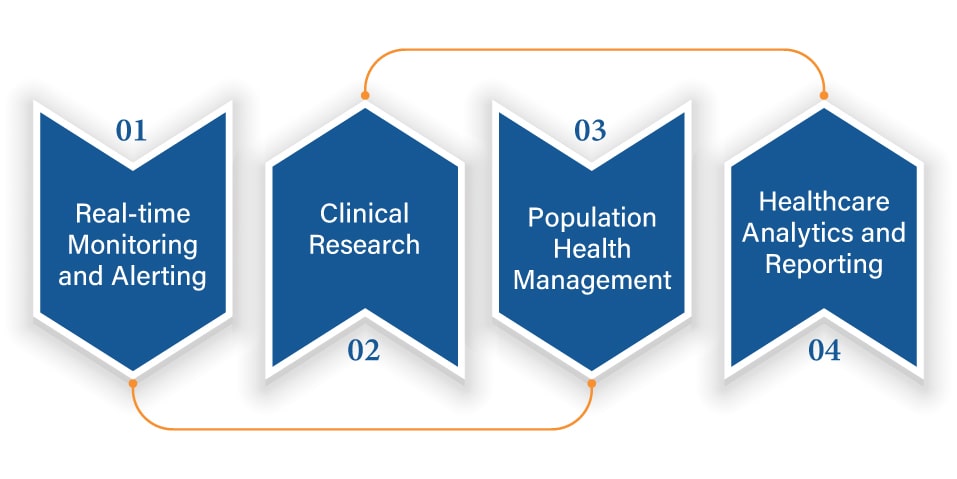
1. Real-time Monitoring and Alerting
By using the AWS HealthLake tool, organizations can import and analyze health data from medical devices and sensors. It can help to identify critical events for efficient patient management.
2. Clinical Research
AWS HealthLake can be used to analyze large amounts of raw health data, and that especially helps organizations in the research part to analyze and extract some valuable information, which helps organizations to identify trends and patterns, make predictions, and help in data-driven decisions.
3. Population Health Management
AWS HealthLake is also useful in population health management, where it has analytical tools and ML models to forecast outcomes, analyze health patterns, and control costs for population health management.
4. Healthcare Analytics and Reporting
You can use AWS HealthLake to securely store data and analyze it for meaningful insights and detailed reports with cloud computing security.
Wrapping Up!
AWS HealthLake is playing a crucial role in the healthcare industry. Organizations can use this tool to securely store, transform, and analyze the raw data and get meaningful insights within a few minutes for better decisions, identify trends, and make predictions. We hope this guide helps you be aware of how AWS HealthLake can be used for health data and what benefits it provides to organizations.
If you’re planning for healthcare app development for your organization, then hiring a custom healthcare software development company is a one-stop solution to let the professional build the software for your business as per your requirements. DreamSoft4U is a trusted name for healthcare software development, and our team of experts can understand your requirements and deliver the expected results. Get in touch with us today.
Ready to Build on AWS HealthLake?
Talk to our AWS Healthcare Specialists — HIPAA-compliant architecture, FHIR R4 integration, US & global clients. Free 30-min consultation.
Book Free Consultation →Frequently Asked Questions About AWS HealthLake
AWS HealthLake is a HIPAA-eligible cloud service that lets healthcare organizations store, transform, query, and analyze health data in FHIR R4 format — used for EHR management, payer analytics, clinical research, and population health management.
AWS HealthLake is HIPAA-eligible and covered under AWS’s Business Associate Addendum (BAA), which you accept through AWS Artifact. As with any AWS service, you’re still responsible for configuring access controls and encryption correctly on your side.
AWS HealthLake uses pay-as-you-go pricing: $0.27 per Data Store hour (10 GB storage included), $0.37/GB/month for additional storage, and $0.048 per 10,000 queries beyond the free 3,500/hour. There’s no upfront commitment.
AWS HealthLake supports FHIR R4 (Release 4), the current stable standard, along with newer operations like $patch, $validate, $purge, and $document added in 2025.
AWS HealthLake is the FHIR data store and query layer. Comprehend Medical is the NLP engine that extracts medical entities (diagnoses, medications, procedures) from unstructured text — AWS HealthLake uses it internally for NLP analysis.
Yes. AWS HealthLake can ingest FHIR-formatted data exported from EHR systems like Epic and Cerner, and supports bulk FHIR export/import workflows.
Medical imaging (DICOM) is handled by the related AWS HealthImaging service, which integrates with AWS HealthLake for a combined structured-data + imaging pipeline.
Yes — because it’s consumption-based with no infrastructure to provision, small clinics and startups can use AWS HealthLake without large upfront capital investment.
A healthcare data lake is a centralized repository that stores structured and unstructured health data — from EHRs to imaging to claims — in its raw or near-raw form, so it can later be transformed and queried. AWS HealthLake is a managed healthcare data lake that adds automatic FHIR R4 normalization on top of raw storage.
AWS HealthLake is FHIR R4-native. HL7 v2 and CCD data typically need to be converted to FHIR before ingestion — AWS provides integration tooling for this transformation, though native HL7 v2 support is more limited than on Azure Health Data Services.