






A patient walks into your hospital with years of medical records on their phone. But your staff still asks them to fill out the same paper form and search for old reports. This is the gap the Ayushman Bharat Digital Mission (ABDM) is designed to close.
For hospitals, ABDM is no longer just about creating an ABHA number. A truly ABDM-compliant HIMS should help you connect patient identities, share health records with consent, support digital claims, and keep everyday hospital operations running smoothly.
The challenge is that not every platform marketed as “ABDM ready” offers the same level of integration. Some support basic ABHA creation, while others support M1, M2, M3, consent-based record sharing, FHIR, and NHCX workflows.
So a wrong pick can leave you with stalled scheme claims, repeat integration work, and a painful migration later.
In this guide, you will learn:
- What is ABDM Compliant HIMS Platform
- ABDM milestones M1, M2 and M3 explained
- The top 15 ABDM compliant HIMS platforms compared
- Buy, build or retrofit: choosing your path
By the end of this guide, you’ll know which ABDM-compliant HIMS platforms are worth considering and how to choose the right one for your hospital.
Quick Answer: Top 15 ABDM Compliant HIMS Platforms at a Glance
Short on time and need a quick shortlist? Scan this snapshot of every ABDM compliant HIMS platform on our list and pick two or three that match your facility. Then jump to their detailed reviews further down.
| Platform | Best For | Deployment | ABDM Coverage | Standout Strength |
|---|---|---|---|---|
| DreamSoft4u | Hospitals, HIS vendors and healthtech platforms needing a custom or retrofitted HIMS | Cloud, on-premise or hybrid | M1 to M3, HFR, HPR, UHI and NHCX connector | Pre-certified ABDM Connector live in as little as one week |
| VCDoctor | Hospitals and groups wanting a branded HIMS | Cloud, private cloud or on-premise | M1 to M3, HFR, HPR, UHI and consent manager | White-label HIMS and telehealth under your own brand |
| KareXpert | Large hospital groups | Managed cloud | M1, M2 and M3 certified | Zero-footprint, plug-and-play cloud HIS |
| Insta by Practo | Multi-branch and multi-country groups | Cloud SaaS | ABDM workflows supported | Per-centre configuration with group reporting |
| Healthray | Mid to large hospitals | Cloud | NHA approved and ABDM compliant | AI-assisted operations and live bed view |
| MocDoc | Growing hospitals with their own lab and pharmacy | Cloud | ABDM compliant | Integrated LIMS and pharmacy |
| Healthixio | Clinics to mid-size hospitals | Cloud only | Officially integrated | ABHA workflow built into registration |
| Aarogya by Dataman | Teaching, government and legacy hospitals | On-premise or cloud | ABDM certified | Locally hosted deployment option |
| MediXcel | Large hospitals and diagnostic chains | Cloud or on-premise | All three milestones approved | NABH digital health certified at Advanced level |
| SoftCure Pro | Hospitals with heavy TPA and insurance volume | Web-based HIS | ABHA and ABDM integrated | Broad departmental coverage, including MRD |
| Doctors App | Clinics and small hospitals | Cloud with mobile apps | M1, M2 and M3 | Voice and stylus documentation |
| CureNearMe | Small and scheme-heavy hospitals | Cloud, mobile-first | ABHA, FHIR records and HIE-CM | Per-bed pricing with an AI scribe in Indian languages |
| Chikitsa | New builds wanting ABDM from day one | Cloud | HIP, HIU, HIE-CM and FHIR R4 | ABDM empanelled with NHCX claims built in |
| Eka Care | Clinics focused on patient engagement | Cloud | ABHA, PHR and ABDM Connect | Patient-first health record ecosystem |
| Bahmni | Public, NGO and low-resource facilities | On-premise or self-hosted | Community-built connectors | Open source with no licence fee |
What Is an ABDM Compliant HIMS Platform?
An ABDM compliant HIMS platform is hospital software that has cleared the National Health Authority’s integration and certification process.
It runs your daily operations, from OPD and IPD to lab, pharmacy, and billing, and connects each patient encounter to India’s national digital health network.
The word “compliant” carries real weight here. A compliant system creates and verifies ABHA numbers, links records to them, and shares data only when the patient consents.
If you want a refresher on how a hospital information management system works across departments, that primer covers the basics.
ABDM Milestones M1, M2 and M3 Explained
The NHA does not certify software in a single step. It tests integrations milestone by milestone, so a vendor can honestly say “ABDM integrated” after clearing only the first one. Knowing what each stage enables is the quickest way to cut through a sales pitch.
| Stage | What It Certifies | What Your Hospital Can Do |
|---|---|---|
| M1 | ABHA creation, verification and linking | Register patients against a verified national health ID |
| M2 | Health Information Provider (HIP) | Link care contexts and share records when patients consent |
| M3 | Health Information User (HIU) | Request and view a patient’s records from other facilities |
| NHCX | Claims exchange with insurers and TPAs | Send pre-authorisations and claims in a standard digital format |
| Security audit and approval | Safe-to-Host review and NHA production sign-off | Move from sandbox testing to live ABDM transactions |
Already Have a HIMS? Add ABDM Without Replacing It
Our pre-certified ABDM Connector can take your existing platform live with M1 to M3 compliance in as little as one week. No migration, no workflow changes.
Get a Free ABDM Gap AssessmentWhy an ABDM Compliant HIMS Platform Matters for Indian Hospitals
ABDM has moved well past the pilot stage. India has created more than 90 crore ABHA accounts, and over 100 crore health recordsare now linked to them. More than 450 public and private health technology solutions have integrated with the network, so your referral partners are likely already on it.
Here is what that shift changes inside your hospital.
1. PMJAY and Government Scheme Readiness
ABDM-enabled software can help hospitals manage PMJAY and other government scheme workflows more smoothly. It also helps medical colleges meet NMC requirements for ABDM integration.
2. One Verified Identity for Every Patient
ABHA gives each patient a single digital health identity. This reduces duplicate records and makes it easier to access the right patient information across facilities.
3. Faster OPD Registration With Scan and Share
With Scan and Share, patients can scan your hospital’s QR code using the ABHA app. Their details are shared instantly, reducing manual entry and waiting time at the registration desk.
4. Consent-Based Access to Patient History
With patient consent, doctors can access health records from other connected facilities. This makes it easier to review past reports and make informed decisions.
5. Fewer Repeat Tests and Lower Costs
Doctors can check previous test reports before ordering new ones. This can reduce unnecessary tests, save patients money, and make better use of hospital resources.
6. Simpler Insurance Claims With NHCX
NHCX helps hospitals send pre-authorisations and claims digitally to insurers and TPAs. Structured records can reduce manual work, errors, and claim delays.
7. DHIS Incentives for ABHA-Linked Records
Eligible hospitals and software providers may receive incentives for creating ABHA-linked health records under the Digital Health Incentive Scheme. These incentives can help offset part of the digitisation cost.
8. Audit-Ready Data Under the DPDP Act
An ABDM-ready HIMS can track who accessed patient data, when, and under what consent. This creates a clear audit trail and supports better data protection practices.
Top 15 ABDM Compliant HIMS Platforms for Hospitals
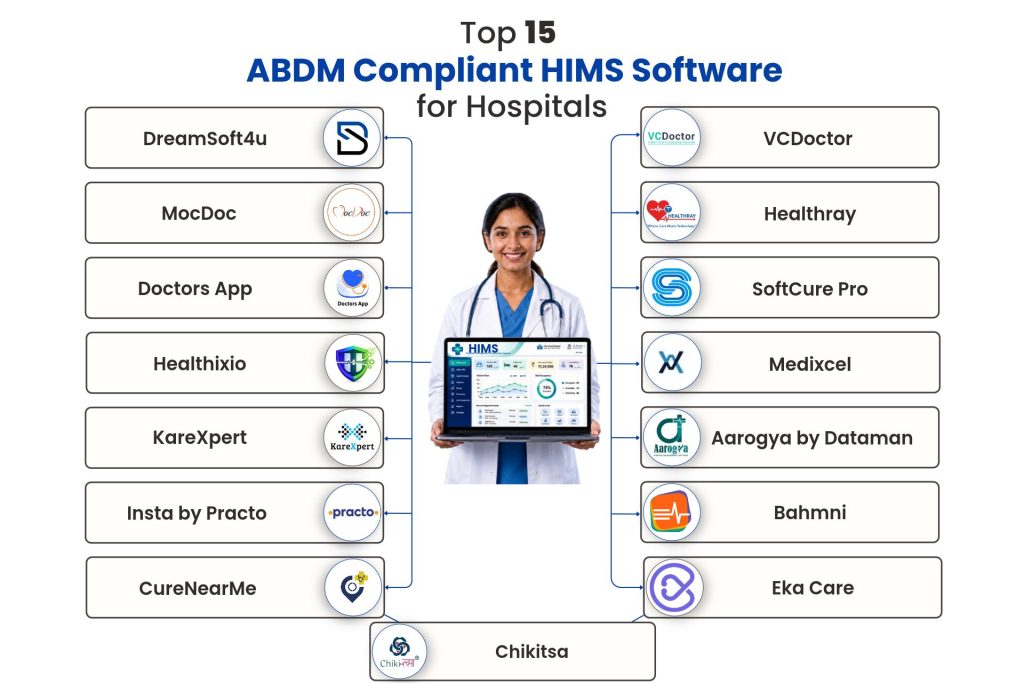
Below is the detailed breakdown of each platform. Every review covers what the product does best, its ABDM scope, deployment options, and where it falls short, so you can compare them fairly.
1. DreamSoft4u: Custom ABDM Compliant HIMS Development and ABDM Connector
DreamSoft4u takes the top spot because it solves the problem most hospitals actually face. You either need an ABDM compliant HIMS platform shaped around your own workflows, or you need ABDM added to the system you already run. DreamSoft4u engineers both routes under one delivery team.
For new builds, its engineers create a custom hospital management information system with clinical, administrative, and financial modules on one record. For existing platforms, the ABDM Connector replaces 40+ native APIs with 9 simplified ones. Your platform inherits M1 to M3 compliance and can go live in as little as one week.
Its ABDM scope starts with ABHA creation through Aadhaar, mobile, or driving licence. It then extends to PHR app integration, HIP and HIU modules, UHI connectivity, and HFR and HPR linkage.
A separate NHCX connector handles digital claims. The i-medicus ABDM integration shows this approach in production, from sandbox validation to live HIP workflows.
- Best for: Hospitals, hospital groups, EMR and HIS vendors, and healthtech platforms that want a custom HIMS or a fast ABDM retrofit.
- ABDM coverage: M1 to M3, HFR, HPR, UHI, consent management, FHIR record conversion, and NHCX claims exchange.
- Deployment: Cloud, on-premises, or hybrid, with data residency configured to your own policy.
- Standout strength: Two delivery paths, a pre-certified connector for speed and a custom integration (typically 8 to 12 weeks) for full control.
- Beyond India: The same team delivers HIPAA, HL7 FHIR, and NABIDH projects for healthcare clients worldwide.
- Watch out for: A fully custom HIMS takes months to scope and build, so a clinic needing an instant install may prefer a ready product.
2. VCDoctor: White-Label HIMS and Telehealth Platform
VCDoctor is a white-label hospital management and telehealth platform built by DreamSoft4u‘s healthcare engineering team. It suits facilities that want a ready HIMS but prefer their own brand, domain, and patient app over a vendor’s logo.
Its modules cover patient access, clinical care, diagnostics, revenue cycle, and administration on one shared record, with video consultations built in. VCDoctor can also layer ABDM onto an existing EHR without rebuilding clinical workflows.
The VCDoctor ABDM integration covers ABHA identity, consent-based sharing, HL7 FHIR APIs, and UHI telemedicine.
- Best for: Multi-specialty hospitals, hospital groups, diagnostic chains, and telehealth startups that want a branded platform.
- ABDM coverage: M1 to M3, HFR and HPR registration, UHI connectivity, and consent manager integration.
- Deployment: Cloud, private cloud, or on-premises.
- Standout strength: One white-label stack that also supports HIPAA, NABIDH, and GDPR for international operations.
- Watch out for: Branding and configuration add a short setup phase, so it is not a same-day install.
3. KareXpert: Zero-Footprint Cloud HIS for Hospital Groups
KareXpert targets large hospitals and groups with a zero-footprint cloud HIS, so you run clinical and revenue cycle workflows without maintaining servers. Everything arrives pre-integrated on a fully managed cloud. The vendor publicly states M1, M2, and M3 certification, which removes guesswork during shortlisting.
- Best for: Large hospital chains planning a phased, multi-site rollout.
- ABDM coverage: M1, M2, and M3 certified, with ABHA generation at registration.
- Deployment: Fully managed cloud, with no servers on site.
- Standout strength: Plug-and-play architecture with strong revenue cycle depth.
- Watch out for: Implementation effort and cost can feel heavy for a single nursing home.
4. Insta by Practo: Multi-Branch Cloud Hospital Management
Insta is Practo’s hospital platform for groups running many centres, sometimes across India, the UAE, and Saudi Arabia. Its real strength is configuration, since EMR forms, report templates, and workflows can differ by branch. Leadership still sees consolidated numbers, and ABDM workflows sit on top of a mature SaaS base.
- Best for: Multi-branch and multi-country hospital groups.
- ABDM coverage: ABDM workflows supported for Indian centres.
- Deployment: Cloud SaaS across all branches and countries.
- Standout strength: Per-centre flexibility with group-level reporting.
- Watch out for: Pricing tied to users and locations can stretch smaller single-site budgets.
5. Healthray: AI-Assisted HIMS for Mid to Large Hospitals
Healthray pairs standard hospital modules with operational intelligence. Administrators get live occupancy, billing audits, and predictive analytics instead of month-end reports. The vendor lists itself as NHA-approved and ABDM compliant, with ABHA verification at the front desk and FHIR, SNOMED CT, and ICD coding support.
- Best for: Mid to large hospitals where management wants operational data every day.
- ABDM coverage: NHA-approved ABDM integration with front-desk ABHA verification.
- Deployment: Cloud, accessible from desktop and mobile devices.
- Standout strength: AI-assisted analytics and real-time bed management.
- Watch out for: The analytics depth pays back mainly at higher patient volumes.
6. MocDoc: HMS With Integrated Lab and Pharmacy
MocDoc fits hospitals where diagnostics and dispensing matter as much as consultations. Its lab and pharmacy modules share one patient record, with barcode-driven sample tracking and batch-level stock control. Lab reports and prescriptions link to ABHA as part of routine work, not as an extra step for staff.
- Best for: Growing hospitals and clinic chains that run their own lab and pharmacy.
- ABDM coverage: ABDM compliant, with ABHA creation and record linking.
- Deployment: Cloud, with mobile apps for staff and patients.
- Standout strength: Integrated LIMS and pharmacy on the same platform.
- Watch out for: Enterprise-grade analytics are lighter than the large hospital suites offer.
7. Healthixio: Front-Desk-First Cloud HMIS
Healthixio builds its ABDM workflow around the registration desk, where ABHA creation sits inside the normal intake flow. The platform covers OPD, IPD, EMR, pharmacy, pathology, billing, and TPA in one cloud system. It is also refreshingly open about the situations where it does not fit.
- Best for: Clinics through to mid-size multi-specialty hospitals that want one cloud system.
- ABDM coverage: Officially integrated, with ABHA creation and record linking.
- Deployment: Cloud only, with no on-premises version.
- Standout strength: A front-desk ABHA workflow built for high OPD volume.
- Watch out for: No radiology PACS or blood bank module, and no on-premises option.
8. Aarogya by Dataman: On-Premise Friendly HIMS
Aarogya is the name that comes up when a cloud is off the table. Dataman offers client-server and cloud versions with 20+ modules and a delivery record that stretches back decades. Teaching hospitals and institutions with strict data residency rules often shortlist it for exactly that reason.
- Best for: Teaching, government, and legacy hospitals with in-house IT teams.
- ABDM coverage: ABDM certified, including locally hosted deployments.
- Deployment: On-premises client-server or cloud hosting.
- Standout strength: A proven option for facilities that must keep servers on site.
- Watch out for: The interface and release pace feel dated next to cloud-native rivals.
9. MediXcel: Diagnostic-Heavy Enterprise HIMS
MediXcel, from Plus91 Technologies, combines a full HIS with an embedded EMR and laboratory system. It was among the early platforms approved for all three milestones, and it holds NABH digital health certification at the Advanced level. That dual credential makes it a strong fit for hospitals chasing accreditation.
- Best for: Large hospitals and diagnostic chains with heavy lab and imaging workloads.
- ABDM coverage: Approved for all three milestones.
- Deployment: Cloud or on-premises, including multi-location setups.
- Standout strength: NABH Advanced-level digital health certification alongside ABDM.
- Watch out for: Configuration takes more effort, so plan for a longer setup window.
10. SoftCure Pro: HIMS for Clinical, Billing and TPA Workflows
SoftCure Pro is an established HIS covering OPD, IPD, TPA and insurance, billing, lab, pharmacy, stores, MRD and accounting. Its integrated modular design keeps data flowing between departments without duplicate entry. The product holds NABH digital health certification at the Basic level and supports ABHA and ABDM workflows.
- Best for: Hospitals with high TPA, insurance, and scheme patient volume.
- ABDM coverage: ABHA and ABDM integration inside daily workflows.
- Deployment: Web-based HIS accessed through the browser.
- Standout strength: Broad departmental coverage, including MRD and accounting.
- Watch out for: Its NABH certification sits at the Basic level, so check the depth in advanced clinical modules.
11. Doctors App: AI Documentation-First HMIS
Doctors App built its reputation on documentation speed, Doctors dictate by voice or write with a stylus, and the system turns that input into structured records through speciality-specific templates. ABHA creation happens inside the app, and the vendor states full M1, M2, and M3 compliance.
- Best for: Clinics and small to mid-size hospitals where consultation throughput is the bottleneck.
- ABDM coverage: M1, M2, and M3, with in-app ABHA creation.
- Deployment: Cloud with doctor and patient mobile apps.
- Standout strength: AI-assisted prescribing with voice and stylus input.
- Watch out for: HR, asset, and enterprise administration modules are lighter than dedicated hospital suites.
12. CureNearMe: Mobile-First HMIS With an AI Clinical Scribe
CureNearMe goes after small and scheme-heavy hospitals with simple per-bed pricing, listed at ₹99 per bed per month with the ABDM module included. Its built-in CurePilot.ai scribe turns dictated notes in Indian languages into structured, SNOMED-coded records. PMJAY and several state scheme workflows also come preconfigured.
- Best for: Small hospitals and nursing homes serving PMJAY and state scheme patients.
- ABDM coverage: ABHA creation, FHIR records, and HIE-CM connectivity.
- Deployment: Cloud, usable over mobile data in smaller towns.
- Standout strength: Voice-to-EMR in regional languages at transparent per-bed pricing.
- Watch out for: It is newer to the market, so ask for references from facilities your size.
13. Chikitsa: FHIR-Native HIMS Built for ABDM
Chikitsa was designed with ABDM at its core rather than bolted on later. ABHA creation, HIE-CM consent flows, FHIR R4 records, and HIP and HIU roles ship from day one, and every event lands in an audit ledger. It also brings NHCX and PMJAY claims into the same platform.
- Best for: New hospitals or migrations that want ABDM built in from the start.
- ABDM coverage: HIP, HIU, HIE-CM consent and FHIR R4, with ABDM empanelment.
- Deployment: Cloud, with FHIR R4 records emitted natively.
- Standout strength: Native consent and audit architecture plus NHCX claims.
- Watch out for: A younger platform, so validate its scale with a site visit.
14. Eka Care: Patient-First ABHA and PHR Platform
Eka Care approaches ABDM from the patient’s side first. It built a strong ABHA and personal health record experience, then extended into clinic tools such as its EMR and AI scribe. Its ABDM Connect product also lets other providers verify ABHA and exchange records on consent.
- Best for: Clinics and outpatient centres that want patients engaged with their own records.
- ABDM coverage: ABHA verification, PHR access and consent-based record exchange.
- Deployment: Cloud, alongside patient and doctor mobile apps.
- Standout strength: A patient-facing PHR ecosystem with deep ABHA adoption.
- Watch out for: Inpatient, pharmacy, and revenue cycle depth stays limited for full hospital use.
15. Bahmni: Open-Source HIMS for Public Health Settings
Bahmni is the open-source option, combining clinical records, lab, and pharmacy into one hospital system for low-resource settings. You pay no licence fee, and its community has built ABDM connectors you can extend. The trade-off is simple, because you swap software costs for engineering effort.
- Best for: Public, charitable, and NGO-run facilities with technical support on hand.
- ABDM coverage: Community-built ABDM connectors.
- Deployment: On-premises or self-hosted cloud.
- Standout strength: Open source with full control over the codebase.
- Watch out for: You own certification, maintenance, and upgrades, which most private hospitals cannot staff.
Buy, White-Label, Build or Retrofit: Which ABDM Path Fits You?
Picking a vendor is really the second decision you make. The first is how you want to reach ABDM compliance, because each path trades speed, cost, and control in a different way.
| Path | Best For | Time to Go Live | Cost Profile | Control |
|---|---|---|---|---|
| Off-the-shelf cloud HIMS | Clinics and small hospitals | Days to a few weeks | Low upfront, monthly fees | Limited to the vendor’s roadmap |
| On-premise licensed HIMS | Hospitals with strict residency rules | A few months | High upfront plus yearly maintenance | High over servers, limited over code |
| White-label HIMS platform | Groups wanting their own brand | Several weeks | Moderate setup plus subscription | Brand and configuration control |
| Custom-built HIMS | Complex hospitals and product companies | Several months | Highest upfront, lowest lock-in | Full control of code and roadmap |
| ABDM connector on your existing system | Hospitals and vendors happy with current software | As little as one week | Low, with no platform change | You keep your system while the connector handles ABDM |
Here is when each path makes the most sense:
- Off-the-shelf cloud HIMS: Choose it when you need to go live quickly with standard workflows and a small IT team.
- On-premises licensed HIMS: Choose it when policy or unreliable connectivity rules out the cloud.
- White-label platform: Choose it when brand ownership and a patient app under your own name matter.
- Custom-built HIMS: Choose it when your workflows, scale, or product plans outgrow packaged software.
- ABDM connector retrofit: Choose it when your current HIMS works well and only lacks compliance.
Why DreamSoft4u Is the Top Pick for ABDM Compliant HIMS Development
DreamSoft4u is a healthcare-first engineering company with 22+ years in healthcare IT and 1,600+ projects delivered. We engineer ABDM compliant HIMS platforms and retrofit compliance onto the systems hospitals and vendors already run.
- Two routes to compliance: A custom-engineered HIMS or a pre-certified ABDM Connector that can take your platform live in as little as one week.
- Full ABDM scope: ABHA integration, HIP and HIU modules, HFR and HPR linkage, UHI, consent management, and FHIR record conversion under one team.
- NHCX claims readiness: A dedicated connector for FHIR-based pre-authorisation and claims exchange with insurers and TPAs.
- Retrofit without rework: We add compliance to your existing EHR or HMS while clinicians keep the workflows they already know.
- Proven in production: ABDM delivery for platforms such as i-medicus and VCDoctor, from sandbox testing to live transactions.
- Global compliance depth: 100+ engineers across the US and India delivering HIPAA, HL7 FHIR, and NABIDH projects for clients worldwide.
- Flexible deployment: Cloud, on-premises, or hybrid, configured to your data residency rules.
Conclusion
The right ABDM compliant HIMS platform does two jobs at once. It runs your hospital day to day, and it connects every patient record to India’s national health network with consent and security built in. The strongest options clear all three milestones, run live in production, and match your facility’s size.
We hope this guide helped you understand how ABDM compliance works, which platforms lead the market, and how to choose one without costly surprises.
Now it’s your turn to shortlist two or three platforms, run a real patient-journey demo, and verify certification in writing. And if your current system works well but lacks ABDM, a retrofit may save you a full migration.
Ready to Make Your Hospital ABDM Compliant?
DreamSoft4U has delivered 1,600+ healthcare projects over 22+ years. Let’s build or retrofit a secure, ABDM compliant HIMS, from planning to go-live.
Connect With Our ExpertsFAQs
A HIMS becomes ABDM compliant hospital management software once it clears NHA sandbox testing for the relevant milestones and receives production access. In practice, it creates ABHA numbers, links records as care contexts, and shares data only with patient consent.
It is not yet a blanket legal requirement for every private hospital. However, government schemes, PMJAY workflows, and NMC directions for medical colleges increasingly expect ABDM-enabled software, so most facilities now treat it as essential.
A full-service hospital realistically needs M1 for ABHA, M2 to share records, and M3 to receive them. Standalone labs can often start with M1 and M2. Add NHCX when insurance claims form a large part of your revenue.
Yes, and it is often the smarter route. An integration layer or pre-certified connector sits beside your current system and handles ABHA, consent, and FHIR exchange. It is usually faster and less intrusive than migrating, provided your existing HIMS runs well.
A pre-certified connector can go live in about a week. A custom integration usually takes 8 to 12 weeks. A first-time build from scratch can run several months once security audits and NHA approval are included.
Small clinics often pay ₹1,500 to ₹5,000 a month, and mid-size hospitals ₹15,000 to ₹60,000. Large groups usually move to enterprise licences. Always add migration, training, interfaces, and maintenance to the headline quote.