
When it comes to healthcare, every second matters – the right nurse must be at the right place at the right time. This is not just about operational efficiency; it is a matter of patient safety and outcomes. Yet hospitals, nursing homes, and healthcare agencies worldwide continue to struggle with outdated, manual scheduling processes that lead to burnout, understaffing, and preventable care gaps.
This is where nurse scheduling software becomes a game-changer. Whether you manage a busy hospital ward, a nursing home, or a home care agency, modern nurse scheduling software – also called nurse rostering software – automates shift assignments, manages fatigue, handles self-scheduling, and keeps your entire nursing team coordinated in real time.
In this definitive 2026 guide, we cover everything you need to know: what nurse scheduling software is, the common problems it solves, key features to look for, how AI is transforming nurse rostering, and how DreamSoft4u builds custom nurse scheduling systems for healthcare organizations worldwide.
What Exactly is Nurse Scheduling Software?
Nurse scheduling software – also referred to as nurse rostering software, nursing staff scheduling software, or nurse shift scheduling software – is a digital platform that automates the creation, management, and optimization of nurse work schedules. Rather than relying on spreadsheets or paper-based rosters, it considers each nurse’s availability, qualifications, shift preferences, compliance requirements, and fatigue levels to generate fair, accurate, and regulation-compliant schedules automatically.
Modern platforms go further — offering self-scheduling features that let nurses choose their own shifts within set parameters, shift swap management, real-time notifications, and integrated payroll calculations. For nursing home scheduling specifically, the software also manages resident care continuity — ensuring the same nurses are assigned to the same patients wherever possible, which is proven to improve care quality and patient satisfaction.
Nurses are the backbone of patient care — managing records, assisting doctors, and ensuring every patient receives the attention they need. Yet many healthcare organizations still face the daily challenge of scheduling the right nurse for each patient at the right time.
Scheduling nurses is not just about filling slots. It means balancing:
- Chronic worker shortages and last-minute callouts
- Unequal patient-to-nurse ratios across shifts
- Round-the-clock coverage across multiple wards or facilities
- Varying nurse specialities, certifications, and qualifications
- Unique patient requirements and care continuity needs
- Managing part-time, full-time, agency, and float pool nurses
- Coordinating with doctors, allied health staff, and administrators
- Fatigue management and safe working hour compliance
- Availability of practice venues, equipment, and rooms
- Multi-facility and multi-location scheduling for nursing agencies
Read Also: Step-By-Step Guide To Software Development for Healthcare
Common Problems in Nurse Scheduling
For any nurse manager, scheduling is one of the biggest daily headaches. Here are the most common issues faced across hospitals, nursing homes, and healthcare agencies worldwide – and why manual scheduling simply cannot keep up.
Staffing Shortages
It always seems like there just are not enough nurses to go around. According to US Bureau of Labor Statistics 2024 projections, California leads the US nurse shortage with 44,500 fewer nurses than required. Texas, New Jersey, and South Carolina each face shortfalls of around 10,000 nurses. Globally, the WHO projects a shortage of 5.9 million nurses by 2030 – making efficient scheduling of existing staff more critical than ever.
Scheduling Conflicts
According to the American Nurses Foundation Pulse on the Nation’s Nurses Survey, burnout affected 95% of nurses in the past 3 years. Nurses have lives beyond the ward — scheduling around vacations, medical leave, personal commitments, and education creates constant conflicts that manual roster management cannot handle efficiently or fairly.
Balancing Workloads
High workload demands remain one of the top drivers of nursing fatigue and burnout. Ensuring all nurses carry a fair and manageable workload – across shifts, specialties, and patient acuity levels — is critical to both staff morale and patient care quality. Manual scheduling makes equitable workload distribution nearly impossible at scale.
Last-minute Changes
No matter how carefully you plan, changes will happen. Nurses call in sick, emergencies arise, and patient census fluctuates. Facilities need both a contingency plan for known scenarios and the flexibility to accommodate truly unforeseen circumstances – in real time, without disrupting the entire schedule.
Fatigue and Safe Hour Compliance
Nurse scheduling software with fatigue management is increasingly in demand – particularly in the USA, UK, and Australia where regulated safe working hours are enforced. Manual scheduling cannot effectively track cumulative hours, mandatory rest periods, or maximum consecutive shifts. Software with built-in fatigue alerting ensures compliance and reduces clinical errors caused by overworked staff.
Nursing Home Scheduling Complexity
Nursing home scheduling presents unique challenges beyond hospital environments – including resident-specific care continuity, specialist skill matching, and regulatory compliance with CMS staffing ratios in the USA. Dedicated scheduling software for nursing homes ensures the right care level is maintained for every resident on every shift – with automated alerts when staffing falls below required minimums.
Struggling with Nurse Scheduling Challenges in Your Facility?
DreamSoft4u builds custom nurse scheduling software tailored to your exact workflows and compliance requirements.
Get a Free Consultation →Benefits of Using Nurse Scheduling Software
Nurse scheduling software delivers measurable benefits across hospitals, nursing homes, home care agencies, and nursing staffing companies. Here is a comprehensive look at the advantages – from the USA to global healthcare markets:
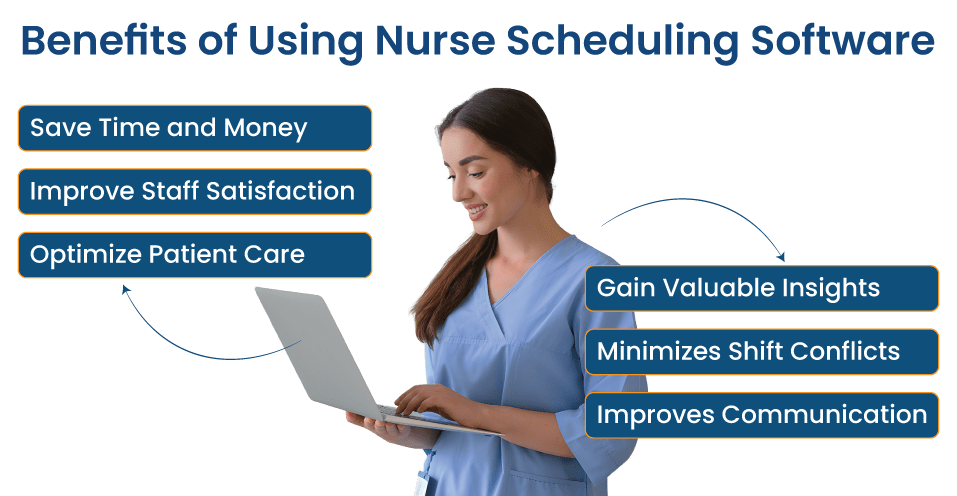
1. Save Time and Money
Software-based smart scheduling saves nursing managers and administrators up to 80% of scheduling administration time. It also identifies unnecessary overtime automatically – reducing labor costs without compromising coverage. For large hospital networks, this translates to hundreds of thousands of dollars in annual savings.
2. Improve Staff Satisfaction
With paper-based or Excel-based scheduling, it is rarely possible to meet the preferences and needs of all nursing staff within a reasonable timeframe. Nurse scheduling software ensures nurses get schedules that respect their preferences and commitments – leading to higher job satisfaction, better work-life balance, and measurably lower voluntary turnover rates.
3. Optimize Patient Care
A balanced nurse-to-patient ratio – maintained consistently across every shift – is a direct outcome of effective scheduling. Software makes it easy to adjust schedules on the fly when patient census changes, ensuring the right skill mix is always present. This translates to higher quality care, fewer adverse events, and better patient outcomes.
4. Gain Valuable Insights
Built-in reporting and analytics give nurse managers and executives data-driven visibility into staffing performance. Key metrics – overtime costs, shift fill rates, nurse-to-patient ratios, absenteeism trends, and scheduling effectiveness – are tracked automatically, enabling smarter workforce planning decisions over time.
5. Minimizes Shift Conflicts
Nurse scheduling software prevents double-booking, overlapping assignments, and overcrowding in specific shifts automatically. Managers can balance workloads across the nursing team, reduce confusion caused by scheduling errors, and improve overall operational efficiency – all without manual cross-checking.
6. Improves Communication
Effective communication is critical in healthcare. Nurse scheduling software enables managers to update rosters instantly with real-time notifications pushed to all affected staff. Nurses can coordinate shift swaps directly within the platform. Patients can leave notes when booking appointments. Everyone stays informed – reducing the costly miscommunications that lead to care gaps.
7. Fatigue Risk Management
Nurse scheduling software with fatigue management features tracks cumulative working hours, mandatory rest periods, and maximum consecutive shifts – automatically flagging at-risk schedules before they are published. This is particularly important in US facilities subject to Joint Commission standards and in countries like Australia with regulated nurse fatigue protocols. Preventing fatigue-related scheduling errors directly reduces clinical risk.
8. Agency and Float Pool Management
For nursing agencies and healthcare staffing companies, nurse scheduling software manages float pool nurses, agency staff, and per-diem workers alongside permanent employees – giving staffing managers a single unified view of all available resources and enabling faster gap-filling when permanent staff are unavailable.
How Does Nurse Scheduling Software Help?
Nurse scheduling software provides measurable benefits for staff, patients, administrators, and the bottom line. Here is a breakdown by stakeholder group:
Benefits for Nurse Managers
Nurse managers can easily assign shifts, manage time-off requests, and accommodate preferences — all while avoiding conflicts, overtime violations, and compliance breaches. Access to key metrics like labor costs, nurse-to-patient ratios, and fill rates enables data-driven staffing decisions that improve both care quality and cost efficiency.
Benefits for Nurses
Nurses gain flexibility and autonomy. They can request time off, set shift preferences, and swap shifts with qualified colleagues within the system – without going through a manager for every change. The software simplifies work schedules, reduces administrative friction, and enables better work-life balance – all of which contribute to lower burnout rates and higher job satisfaction.
Benefits for Patients
Nurse scheduling software improves patient wellbeing by ensuring consistent staffing levels and care continuity. Proper staffing means nurses are less stressed and more focused on patient needs – leading to better outcomes, higher satisfaction scores, and fewer adverse care events.
Benefits for Nursing Homes & Long-Term Care Facilities
Nursing home scheduling software helps directors of nursing maintain CMS-compliant staffing ratios, track care continuity for residents, and manage the mix of RNs, LPNs, and CNAs across all shifts. Automated alerts flag when staffing falls below required minimums – preventing regulatory violations and ensuring resident safety around the clock.
Benefits for Nursing Agencies & Staffing Companies
For nursing agencies managing dozens or hundreds of per-diem and contract nurses, rostering software for nurses enables centralized shift posting, credential verification, automated compliance checks, and instant booking confirmations. The result is faster shift filling, fewer no-shows, lower agency overhead, and higher client satisfaction.
Read Also: Healthcare Staffing Software for Hospitals, Nursing Agencies, and Medical Companies
Global Market for Nurse Scheduling Software – Current Outlook
Understanding the market trajectory helps healthcare organizations recognize the urgency and ROI potential of investing in nurse scheduling technology:
- According to Grand View Research, the nurse scheduling software market was valued at USD 267.83 million in 2018 and is projected to reach USD 789.56 million by 2027 at a CAGR of 13%.
- The broader healthcare workforce management market is projected to exceed USD 2.5 billion by 2028.
- In the USA alone, California leads nurse shortages with 44,500 fewer nurses than required – driving urgent demand for efficient scheduling tools (US Bureau of Labor Statistics, 2024)
- 95% of nurses reported experiencing burnout in the past 3 years (American Nurses Foundation, Pulse on the Nation’s Nurses Survey) – making fatigue-aware scheduling a clinical necessity.
- Hospitals using automated nurse scheduling software report up to 80% reduction in scheduling administration time.
- The WHO projects a global shortage of 5.9 million nurses by 2030 – making optimized scheduling of existing staff a strategic priority for every healthcare organization.
Key Features of Nurse Scheduling Software – What to Look For in 2026
The most important features in nurse scheduling software are automated shift assignment, fatigue management, self-scheduling, shift swap management, credential tracking, EHR integration, and real-time analytics – each addressing a specific operational challenge in healthcare workforce management.
Here is a detailed breakdown of every feature you should evaluate:
Available Shifts Alert
Filling last-minute gaps is one of the most common scheduling challenges. With this feature, real-time alerts are sent via push notification, email, or SMS when shifts become available due to cancellations or callouts – notifying qualified available nurses instantly and enabling gap-filling without manager intervention.
Employee Preferences and Time-Off Requests
Nurses can mark their availability in advance and submit time-off requests directly within the app — eliminating paperwork and reducing the back-and-forth communication that consumes nurse manager time. The system automatically considers preferences when generating schedules, improving fairness and staff satisfaction simultaneously.
Shift Trading
Nurses can request shift swaps with qualified colleagues who meet the same skill and certification requirements – maintaining schedule integrity while accommodating individual needs. Swap requests are routed for manager approval automatically, with credential checks performed before any swap is confirmed.
Integrated Messaging
Built-in communication tools streamline all scheduling-related communication – shift confirmations, swap requests, schedule updates, and urgent notifications – within a single platform. This eliminates the fragmented communication across text messages, emails, and phone calls that creates confusion and missed updates in manual scheduling environments.
Reporting and Analytics
Comprehensive reporting gives nurse managers and executives visibility into labor costs, overtime usage, shift fill rates, nurse-to-patient ratios, absenteeism patterns, and scheduling effectiveness. Automatic payroll calculations based on scheduled and worked shifts reduce errors and streamline the pay cycle. Overstaffing alerts help control unnecessary labor costs proactively.
Certifications and Skills Tracker
The credential management module monitors expiry dates for nursing licenses, certifications, and competencies – automatically notifying nurses when renewals are due and preventing unqualified nurses from being scheduled for shifts that require specific credentials. This is critical for regulatory compliance in all healthcare environments.
Automated Scheduling
The auto-scheduling engine generates complete nurse rosters based on predefined parameters – staffing requirements, shift patterns, skill profiles, certification status, labor cost targets, and nurse preferences – in minutes rather than hours. Managers review and approve, rather than build from scratch, dramatically reducing scheduling administration time.
Mobile-Friendly Access
Nurses and managers need to access schedules, submit requests, and receive notifications from any device – smartphone, tablet, or desktop. Mobile-first nurse scheduling software ensures full functionality on all screen sizes, enabling real-time schedule management from anywhere in the facility or at home.
Fatigue Management & Safe Hours Tracking
One of the most critical features in nurse scheduling software -particularly for USA, UK, and Australian facilities – is fatigue risk management. This module tracks cumulative working hours, mandatory rest intervals, and maximum consecutive shifts against predefined safe working hour thresholds. When a proposed schedule breaches safe limits, the system alerts managers before the schedule is published – preventing regulatory violations and the clinical errors associated with fatigued nursing staff.
This feature aligns with Joint Commission standards in the USA and regulated safe hours legislation in the UK, Australia, and Canada.
Self-Scheduling Module
Self-scheduling software for nurses is a rapidly growing feature request – particularly among millennial and Gen Z nursing staff who prioritize work-life balance and schedule autonomy. With a self-scheduling module, nurses browse available shifts, select preferred slots within manager-defined parameters, and submit choices for automatic or manual approval.
This reduces scheduling admin burden, improves staff satisfaction, and has been shown to significantly reduce voluntary nursing turnover rates.
Multi-Facility & Multi-Location Management
For hospital networks, nursing home chains, and healthcare staffing agencies managing nurses across multiple sites, multi-facility scheduling is essential. A centralized dashboard manages rosters across all locations – with site-specific rules, credential requirements, and shift patterns – while giving executives a consolidated view of staffing levels, labor costs, and compliance status across the entire organization.
Need All These Features Built for Your Hospital, Nursing Home, or Staffing Agency?
DreamSoft4u delivers custom nurse scheduling systems in 3–6 months.
Discuss Your Project →Read Also: Top 9 Healthcare Software Development Companies Catering To Global Clients
How AI & Machine Learning Are Transforming Nurse Rostering Software in 2026
AI is transforming nurse rostering software capabilities in ways that were unimaginable just five years ago. Here is how artificial intelligence is making nurse scheduling smarter, faster, and more accurate:
Automated Schedule Generation
AI algorithms generate complete nurse rosters automatically – considering all staffing requirements, shift constraints, nurse preferences, qualification requirements, and compliance rules simultaneously. What previously took a nurse manager 4–6 hours now takes minutes, with higher accuracy and fewer compliance gaps.
Shift Assignment Recommendations
AI recommends the optimal shift assignment for each nurse based on their skills, experience, workload preferences, fatigue levels, and scheduling history. Rather than the manager manually matching nurses to shifts, the system surfaces the best-fit options – and explains why – enabling faster, more informed decisions.
Continuous Optimization
AI-powered nurse scheduling systems continuously improve their recommendations based on real-world outcome data. As the system accumulates data on scheduling patterns, nurse satisfaction, patient outcomes, and operational results, its recommendations become progressively more accurate and aligned with your facility’s specific needs.
Increased Nurse Satisfaction
AI-powered scheduling gives nurses more control over their work hours, more fair workload distribution, and better alignment with their personal preferences – leading to higher satisfaction and lower burnout.
When nurses are satisfied, patient care quality improves directly – creating a measurable clinical benefit from AI scheduling investment.
Predictive Staffing & Demand Forecasting
Advanced AI-powered nurse scheduling systems analyze historical patient admission data, seasonal trends, and real-time census to predict staffing demand up to 4 weeks ahead. This enables nurse managers to proactively fill gaps before they become crises – rather than scrambling for last-minute agency staff at premium rates. For nursing homes, predictive AI also flags when resident acuity levels are likely to increase, prompting proactive upskilling or additional staffing in advance.
Compliance & Credential Verification Automation
AI-powered credential management automatically cross-references each nurse’s current certifications, license expiry dates, and specialty qualifications against the requirements of each scheduled shift – in real time. If a nurse’s certification is due to expire before a scheduled shift, the system flags the issue and prevents the assignment – ensuring facilities are never exposed to a compliance violation due to an unverified credential.
DreamSoft4u’s Approach to Custom Nurse Scheduling Software Development
At DreamSoft4u, we build nurse scheduling software that goes beyond basic shift assignment. We deliver intelligent, compliant, and scalable rostering systems. Every solution is tailored to hospitals, nursing homes, home care agencies, and staffing companies worldwide.
We bring 23+ years of healthcare software experience to every project. Our team has delivered 1,600+ projects across the USA, UK, Canada, and Australia. We understand the operational, regulatory, and clinical nuances of healthcare scheduling.
Simplicity Without Sacrificing Power
Our systems are designed for busy nurse managers — not IT professionals. Drag-and-drop scheduling, one-click shift publishing, and mobile-friendly access save admin time. Nurses view schedules, request swaps, and manage availability from their smartphones. Zero training required.
Compliance-First Architecture
Every system we build has compliance at its core. We cover HIPAA (USA), CQC requirements (UK), AHPRA standards (Australia), and CMS nursing home staffing ratios. Our fatigue management engine enforces safe working hour rules automatically. Managers are alerted before any non-compliant schedule is published.
AI-Powered Intelligent Rostering
Our AI rostering engine considers dozens of variables simultaneously. These include nurse qualifications, fatigue levels, certification status, patient acuity, and labor cost targets. Optimized schedules are generated in minutes. The system improves its recommendations over time based on real-world data.
Seamless EHR & System Integrations
Our software integrates with Epic, Cerner, and Meditech for EHR connectivity. HR platforms like Workday and SAP are also supported. All integrations use HL7 and FHIR standards. Zero duplicate data entry across your entire ecosystem.
Real-Time Analytics & Reporting
Custom dashboards track overtime costs, shift fill rates, nurse-to-patient ratios, and fatigue risk scores. Nurse managers get actionable data at a glance. C-suite executives can monitor scheduling effectiveness in real time. Every decision becomes data-driven.
Learn more about our custom healthcare software development services or contact our team to discuss your nurse scheduling project.
How DreamSoft4u Builds Your Custom Nurse Scheduling Software – Step by Step
Our proven 6-stage process delivers nurse scheduling software on time and within budget.
We tailor every solution to your facility’s workflows, compliance needs, and staffing model – whether you are a hospital, nursing home chain, or nursing agency.
1. Discovery & Requirements Analysis
We start with discovery sessions with your nurse managers, IT team, and compliance officers. We map your current workflows, regulatory requirements, and integration needs. This forms the foundation of everything that follows.
2. Solution Architecture & Concrete Project Plan
We translate findings into a detailed architecture and project plan. This covers the technology stack, feature set, integration points, timeline, and budget. You review and approve before development begins.
3. MVP Development & Stakeholder Validation
We build a Minimum Viable Product with core scheduling features. Your nurse managers test it in a real workflow environment. Their feedback shapes the final product directly.
4. Full-Scale Custom Software Development
We build the complete feature set in 2-week Agile sprints. A dedicated project manager keeps you updated daily. You have full visibility at every stage.
5. Compliance Testing, QA & Security Audit
Every module undergoes rigorous QA testing. This includes HIPAA audits, safe hours validation, credential logic checks, and performance testing. We do not release software that has not cleared our compliance checklist.
6. Deployment, Training & Ongoing Maintenance
We handle end-to-end deployment with zero-downtime rollouts. Full staff training and documentation are included. Post-launch support covers 24/7 monitoring, updates, and compliance reviews.
Planning to Build Nurse Scheduling Software for Your Healthcare Organization?
DreamSoft4u builds HIPAA-compliant, AI-powered nurse scheduling systems tailored to your workflows — delivered in 3 to 6 months.
Get a Free Consultation Today →Conclusion
Nurse scheduling is one of the most complex – and most consequential – operational challenges in healthcare. The right nurse scheduling software transforms this complexity into a manageable, automated, and data-driven process – reducing burnout, improving patient outcomes, cutting overtime costs, and keeping your facility compliant with ever-evolving staffing regulations.
Whether you need a standalone nurse rostering system, a nursing home scheduling platform, self-scheduling software for nurses, or a multi-facility staffing solution for a nursing agency – DreamSoft4u has the domain expertise, technical capability, and proven track record to deliver it.
Ready to build nurse scheduling software that works the way your team actually works? Contact DreamSoft4u today for a free consultation.
FAQs
Nurse scheduling software is a digital platform that automates nurse shift assignments based on availability, qualifications, fatigue levels, and compliance rules – replacing manual rosters for hospitals, nursing homes, and healthcare agencies.
It ensures the right qualified nurse is assigned to each patient at the right time – preventing understaffing, double-booking, and fatigued assignments – which directly improves care quality and patient outcomes.
Automated shift scheduling, fatigue management, self-scheduling, shift swaps, credential tracking, real-time notifications, EHR integration, analytics, mobile access, and multi-facility management.
Yes. Nurses request swaps with qualified colleagues within the app. For callouts, real-time alerts notify available nurses via push notification, SMS, or email — enabling instant gap-filling.
Yes, if self-scheduling is enabled. Nurses browse available shifts and select preferred slots within manager-defined parameters — improving satisfaction and reducing voluntary turnover.
Same as nurse scheduling software — rostering is the preferred term in the UK, Australia, and New Zealand; scheduling is used in the USA and Canada. Both cover shift assignment, compliance tracking, and reporting.
Yes. Nursing home scheduling software includes CMS staffing ratio compliance, resident care continuity tracking, RN/LPN/CNA skill-mix management, and automated alerts when staffing falls below required minimums.
Basic module – $15,000–$30,000
Mid-tier with AI rostering and EHR integration – $30,000–$80,000
Full enterprise multi-facility system – $80,000–$200,000+. Contact DreamSoft4u for a detailed estimate.
Yes. Modern platforms integrate with Epic, Cerner, Meditech, and major payroll systems via HL7 and FHIR – syncing patient census data and calculating payroll automatically.