






Building a multi-agent AI system, but unsure whether to choose LangChain vs CrewAI vs AutoGen?
It is a decision that can impact everything from development speed and scalability to maintenance costs and long-term flexibility.
While all three frameworks help build AI agent workflows, they take very different approaches to orchestration, collaboration, and control.
In this guide, we’ll compare LangChain vs CrewAI vs AutoGen across the factors that matter most, helping you choose the right framework for your use case and avoid costly mistakes before moving into production.
Quick Answer: LangChain vs CrewAI vs AutoGen at a Glance
Here’s a quick overview of LangChain vs CrewAI vs AutoGen:
| Aspect | LangChain | CrewAI | AutoGen |
|---|---|---|---|
| Creator | LangChain Inc. | João Moura (open-source) | Microsoft Research |
| Best for | Complex custom apps, RAG, broad tool use | Role-based agent crews, fast delivery | Conversational multi-agent, coding, research |
| Core concept | Composable chains and graphs | Crews, roles, and tasks | Conversational agents |
| Multi-agent model | Graph-based via LangGraph | Native (crews and flows) | Native (conversational) |
| Learning curve | Steep | Gentle | Moderate |
| Adoption (GitHub stars, approx.) | 90k to 130k | 25k to 48k | 32k to 56k |
| Primary language | Python, JavaScript | Python | Python, .NET |
| RAG support | Excellent | Good | Good |
| Code execution | Good | Good (via tools) | Excellent (sandboxed) |
| Observability | LangSmith (best in class) | Growing | Improving (AutoGen Studio) |
| License | MIT | MIT | MIT |
| Native governance layer | No | No | No |
In short,
- Choose LangChain when you need the broadest tool ecosystem and graph-level control over complex agent workflows.
- Choose CrewAI when you want role-based agent teams running fast with minimal setup.
- Choose AutoGen when conversational, multi-agent collaboration sits at the core of your product, especially for code and research tasks.
Thinking About Building a Multi-Agent AI System?
Our AI experts will help you find the right framework — no guesswork, no wasted budget.
Book Your Free Strategy CallWhat Is LangChain?
LangChain is one of the most widely used frameworks for building AI applications powered by large language models (LLMs). It helps developers connect AI models with tools, data sources, memory, and workflows to create more capable applications. For multi-agent systems, LangChain uses LangGraph, which allows developers to design and manage complex agent workflows with greater control, flexibility, and reliability.
Pros and Cons of LangChain
Pros:
- Largest ecosystem: Hundreds of integrations across models, tools, and vector stores through one standard interface.
- Deepest community: The most support, examples, and battle-tested patterns of the three.
- Best-in-class observability: LangSmith offers trace visualisation, latency breakdowns, and cost tracking.
- Explicit control: LangGraph gives you graph-level command over complex, stateful workflows.
Cons:
- Steep learning curve: Developers spend days on abstractions before shipping, and docs shift often.
- Overengineering risk: Simple tasks get pushed through unnecessary layers of abstraction.
- Consistency drift: Without strict conventions, large codebases fragment across teams.
Best for: Teams that want maximum control over complex, custom RAG-heavy applications and have Python experience, especially where production observability is non-negotiable.
What Is CrewAI?
CrewAI is a multi-agent framework designed to make agent development simpler and faster. It organizes agents into roles, goals, and tasks, making it easy to build collaborative AI teams without managing complex orchestration logic. Built on top of LangChain, CrewAI gives developers access to a rich ecosystem of tools while offering a more beginner-friendly and structured approach to multi-agent workflows.
Pros and Cons of CrewAI
Pros:
- Fast to start: A shallow learning curve and a role-task-crew model that maps to how real teams work.
- Accessible to non-specialists: Developers reach a working multi-agent system quickly.
- LangChain tools built in: Access to that tool and the RAG ecosystem without the boilerplate.
- Production controls: Role-based access, encrypted data, and on-prem deployment options.
Cons:
- Rigid abstraction: Custom routing means dropping below the high-level flow and writing more logic.
- Younger ecosystem: Support and examples lag behind LangChain.
- Black-box feel: Harder to debug deeply, and observability depends on your surrounding platform.
Best for: Clear-cut business processes with defined roles and deliverables, like content pipelines or tiered support, and rapid prototyping before migrating complex orchestration to LangGraph.
What Is AutoGen?
AutoGen is a multi-agent framework developed by Microsoft that focuses on agent-to-agent collaboration through conversations. Instead of relying on fixed workflows, it allows agents to communicate, share information, execute code, and work together to solve complex tasks. This makes AutoGen particularly useful for coding assistants, research workflows, and applications where multiple agents need to reason and collaborate to reach a goal.
Pros and Cons of AutoGen
Pros:
- Native multi-agent: Many-to-many agent conversations work out of the box, no add-ons.
- Strong for code and research: One agent writes code, another runs it in a sandboxed Docker container.
- Flexible at model and tool level: Mix providers, combine tools, and inject human input.
- Microsoft and Azure aligned: Slots in naturally for teams already in that ecosystem.
Cons:
- Conversation control is hard: Agents can loop, argue over termination, or wander off topic.
- Token spend climbs fast: Long dialogues inflate cost quickly without tight constraints.
- Not beginner-friendly: Documentation veers academic, and the roadmap is merging into the unified Microsoft Agent Framework.
Best for: Iterative, conversational workflows like coding assistants, automated testing, and research synthesis, where agents cross-check each other, and your team is comfortable with the Microsoft stack.
📖 Also Read: How Generative AI Helps in Healthcare
LangChain vs CrewAI vs AutoGen: Head-to-Head Comparison
Now that you have met each framework, here is the LangChain vs CrewAI vs AutoGen comparison head-to-head, across the seven criteria that decide production fit.
1. Architecture and Orchestration Model
LangChain hands you the building blocks and a graph runtime to wire them together, so every step is something you define on purpose. When you need execution that runs the same way twice and can be audited later, that explicit graph structure is the safest bet of the three.
CrewAI works more like briefing a small team: you describe the roles and the mission, and it handles the coordination underneath. You give up a little low-level control in exchange for speed and code that a product manager can actually read, then add deterministic Flows when a workflow needs them.
AutoGen takes the opposite stance and lets structure emerge from conversation between agents. It is a natural fit for exploratory, collaborative tasks, as long as you put firm guardrails around how and when those conversations are allowed to stop.
2. Integrations and Ecosystem
LangChain is the obvious winner here. Hundreds of pre-built connectors to models, vector stores, and tools sit behind one consistent interface, so swapping a provider rarely means rewriting your app.
CrewAI does not try to out-integrate LangChain. Instead, it borrows the entire LangChain tool library it is built on, adds its own ready-made tools, and now treats Model Context Protocol support as a first-class feature.
AutoGen keeps its integration story lean but capable, mixing model providers and tools cleanly and slotting human input into the loop when you want it. Its native extension catalogue is younger, so expect to write a little more glue code.
3. Performance, Scalability, and Concurrency
LangChain is quick in simple flows, though overhead creeps in as you chain more agents together. LangGraph’s efficient graph execution claws much of that back once your deployment gets serious.
CrewAI stays fast by keeping its abstractions thin. It handles concurrent agents comfortably and scales from a script on your laptop to a full cluster without a rearchitecture.
AutoGen was built with scale in mind from the start, leaning on an asynchronous event loop to push high-throughput, multi-agent workloads. Just treat any published benchmark with caution, because results shift with the model, the prompt style, and your retry strategy, and token volume usually drives your bill more than orchestration overhead ever will.
4. Security, Reliability, and Guardrails
LangChain gives you the raw materials for safety rather than safety itself. Output parsers, retries, and callback hooks are all there, and LangSmith handles tracing, but the sandboxing and the rules are yours to build.
CrewAI arrives with more in the box: role-based access control, encrypted data, on-prem deployment, and live monitoring. That makes it a dependable choice for mission-critical work, even though it stops short of sandboxing code by default.
AutoGen leans on isolation as its headline safety feature, running risky code inside Docker containers and letting you define exactly when an agent conversation must end. Beyond that, security is on you, with Microsoft’s engineering weight as reassurance.
5. Pricing and Total Cost of Ownership
LangChain costs nothing as a library. The spend shows up later through commercial add-ons like LangSmith and hosted LangGraph, which scale with how much you use them and how big your team gets.
CrewAI is similar, free to run until your execution volume climbs, at which point paid tiers cover real-time, high-throughput pipelines.
AutoGen has the simplest pricing of all, since the only direct costs are your own infrastructure and the model API calls you make. Across every option, the real money is in token spend and execution volume, not the licence, so model those numbers before you commit.
6. Developer Experience and Learning Curve
LangChain asks most of you upfront. The learning curve is steep, and the documentation keeps moving, but the payoff is precise control once you have climbed it.
CrewAI flips that experience around. Its role-based model mirrors how teams already think, so a new developer reaches a working agent faster here than anywhere else.
AutoGen lands in between. AutoGen Studio makes early experiments easy and fun, yet taming conversation flow for production takes real discipline once the novelty wears off.
7. Observability and Debugging
LangChain is in a class of its own thanks to LangSmith, which serves up trace visualisation, latency breakdowns, token-cost tracking, and a built-in evaluation suite. If you need to see exactly what your agents did, start here.
CrewAI is catching up, and its Flows make individual execution steps easier to follow, though how much you can see still depends on the platform you wrap around it.
AutoGen is improving through third-party integrations, but free-form agent conversations are simply harder to debug. Working out why three agents looped is a different kind of detective work than reading a tidy server log.
Not Sure Which AI Framework Fits Your Use Case?
Get expert guidance tailored to your stack and compliance needs — before you commit.
Book Your Free ConsultationHow to Choose the Right Multi-Agent Framework: A 6-Step Decision Framework
Skip the three-month architecture review. This six-step framework turns the LangChain vs CrewAI vs AutoGen question into a defensible choice in days, grounded in evidence rather than the framework with the slickest demo.
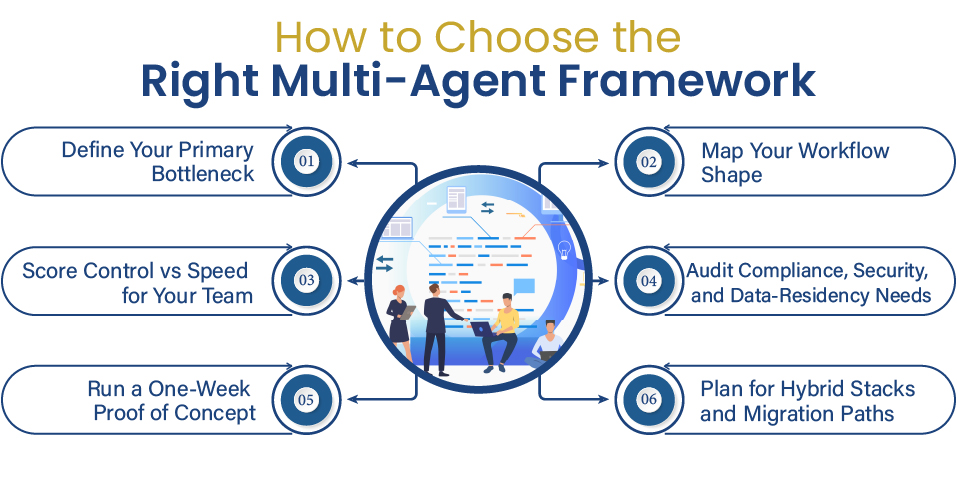
Step 1. Define Your Primary Bottleneck
Start with what is actually slowing you down, because that single answer narrows the field fast. If agent-orchestration complexity is the bottleneck, you are looking at LangChain or LangGraph. If team velocity and developer experience are the bottleneck, CrewAI moves you fastest.
Whether your value depends on agents iterating through conversations, like writing and testing code, AutoGen fits. Name the bottleneck in one sentence before evaluating anything else. Most teams that pick badly never did this; they chose on hype and discovered the real bottleneck later.
Step 2. Map Your Workflow Shape
Your workflow has a shape, and the right framework matches it. Linear, deterministic flows where steps run in a fixed order fit graph or flow structures that make execution explicit and auditable.
Role-based workflows, where the task decomposes into a planner, a researcher, a verifier, and an executor, map naturally onto CrewAI’s crews. Dynamic, exploratory work that benefits from agents debating and cross-checking fits AutoGen’s conversational model. Draw your workflow on a whiteboard first; the shape usually points straight at the answer.
Step 3. Score Control vs Speed for Your Team
Every framework trades control against speed, and the right balance depends on your team and timeline. More structure, like CrewAI, reduces inconsistency across contributors and ships faster, but you hit its ceiling sooner on complex requirements.
More flexibility, like LangChain, demands governance to avoid component sprawl but pays off in long-term control. AutoGen sits between, fast to experiment, harder to constrain. Be honest about whether you are optimising for a two-week pilot or a three-year platform, because the answer flips the recommendation.
Step 4. Audit Compliance, Security, and Data-Residency Needs
Before you commit, list your hard compliance constraints. Which models are allowed, and where can data live? Do you need HIPAA, GDPR, or ISO 27001 alignment? Do any actions require human approval or a full audit trail?
If you are in a regulated sector, this step often outweighs every capability comparison. Decide here whether you need on-prem deployment, role-based access, and pre-dispatch policy checks, because retrofitting those later is painful and expensive.
Step 5. Run a One-Week Proof of Concept
Do not decide on an opinion. Run a tight, one-week proof of concept with the same model, same tools, same data, and same task rubric across the frameworks you shortlisted. Ten realistic tasks with clear pass, partial, and fail criteria beat any leaderboard screenshot.
Capture real evidence: tool-call logs to catch tool misuse, a cost snapshot with budget and step limits, step traces for debugging, and a short risk register. Measure success rate, failure modes, cost per run, and time to root cause. That evidence, not vendor marketing, is what you take to leadership.
Step 6. Plan for Hybrid Stacks and Migration Paths
The most resilient production architectures are rarely single-framework. A common pattern uses LangChain or LangGraph for orchestration, CrewAI for role-based modules, and AutoGen for a coding sub-task, each doing what it does best.
Plan your migration path, too. Many teams start in CrewAI to validate fast, then move the complex orchestration to LangGraph as requirements grow. Treating these frameworks as complementary tools, not rival camps, is what separates teams shipping confidently from teams stuck in evaluation.
When to Choose LangChain, CrewAI, or AutoGen?
If you want the LangChain vs CrewAI vs AutoGen decision boiled down to a few lines, here it is, mapped to the most common scenarios enterprises face.
Choose LangChain If:
- You need the broadest tool and integration ecosystem with fast model and provider swaps.
- You are building complex, custom, RAG-heavy applications that go beyond simple agent chat.
- Graph-level control and strong production observability are non-negotiable for your team.
Use CrewAI When:
- Your product maps naturally to roles, tasks, and crews that product teams can read.
- You need to ship a working multi-agent pilot fast, without deep framework expertise.
- Your workflows are clear-cut business processes with defined roles and deliverables.
Choose AutoGen If:
- Conversational, multi-agent collaboration is the core of your product.
- You are building coding assistants, automated testing, or research synthesis tools.
- Your team is comfortable with the Microsoft and Azure ecosystem and iterative agent dialogue.
One more rule worth stating: skip a framework entirely when your task is one or two model calls with no branching, no long-lived state, and no complex routing. Plain SDK calls are cheaper to run and easier to debug.
LangGraph vs CrewAI vs AutoGen: How Does LangGraph Fit In?
LangGraph is not a separate framework – it is LangChain’s graph-based runtime for building stateful, multi-actor applications. Where LangChain gives you the building blocks, LangGraph gives you the execution engine for complex, cyclic agent workflows. If you are already using LangChain and need deterministic graph-level control, LangGraph is the natural next step – not a replacement for CrewAI or AutoGen, but a complement to them.
Common Mistakes Enterprises Make When Adopting Agent Frameworks
Most agent projects do not fail on the LangChain vs CrewAI vs AutoGen choice itself. They fail on predictable, avoidable mistakes around it. Here are the ones that cost teams the most.
1. Over-Agenting Simple Workflows
Multi-agent systems are easy to overuse and easy to break, bringing loops, tool misuse, and runaway costs. Teams reach for five collaborating agents when a single deterministic workflow would do the job faster and cheaper. Add agents only when the task genuinely decomposes into distinct roles.
2. Ignoring Debugging Until It Hurts
Parsing why three agents triangulated one query until the system ran out of memory is a new class of problem, very different from reading a server log. Teams that skip tracing, step logging, and rollback planning at the start pay for it badly the first time a run goes wrong in production.
3. Treating Whiteboard Designs as Production-Ready
Five agents, five roles, five tasks look clean on a slide. It turns gnarly the moment requirements shift, or agents start ingesting content nobody planned for. Validate the design against real, messy inputs before you assume it scales beyond the demo.
4. Assuming the Framework Handles Governance
This is the most expensive mistake. None of these frameworks enforces policy, approvals, or audit trails before a risky action runs. Skipped approvals, unclear ownership of prompts and tools, and incomplete audit timelines are post-launch failures that a control layer would have prevented.
5. Letting Token Costs Run Unchecked
Long agent conversations and unnecessary reasoning turns inflate token spend fast, and one wasteful loop can cost more than any orchestration overhead. Set budgets, max-step limits, and cost alerts early, because token volume, not licence fees, dominates the bill in real systems.
📖 Also Read: 15 Top Mobile App Development Frameworks in 2026
Why Partner with DreamSoft4U for Multi-Agent AI Development?
Building a successful multi-agent system requires more than selecting the right framework. It requires the right expertise to ensure security, scalability, compliance, and long-term reliability.
DreamSoft4u helps businesses turn AI concepts into production-ready solutions with:
- 23+ years of industry experiencedelivering software solutions across multiple industries.
- 1,600+ successful projects completed for clients worldwide.
- Expertise in healthcare, fintech, logistics, and eCommerce with a strong focus on regulated environments.
- End-to-end AI development services from strategy and architecture to deployment and optimization.
- Specialized experience in agentic AI, generative AI development services, RPA, and AI chatbots for real-world business applications.
Thinking About Building a Production-Ready Multi-Agent AI System?
Our engineers will shortlist, test, and validate the right framework for you — in days, not months.
Book Your Free ConsultationConclusion
Choosing between LangChain, CrewAI, and AutoGen is not about finding the single best framework. It is about matching the tool to your workload, your team, and your compliance needs.
LangChain gives you control and ecosystem, CrewAI gives you speed and readable structure, and AutoGen gives you conversational, code-centric collaboration.
None of them governs itself in production, which is the detail that separates a prototype from a deployable system.
We hope this guide helped you understand how the LangChain vs CrewAI vs AutoGen decision really works, and how to defend your choice with evidence instead of hype.
Now it is your turn. Run the six-step framework, ship a one-week proof of concept, and build the governance layer before any agent touches a real system.
FAQs
There is no single best framework for every business. LangChain is ideal for complex and highly customized applications, CrewAI works well for role-based workflows, and AutoGen is best suited for conversational and code-driven agent systems.
CrewAI is generally the easiest framework to learn because of its simple role, task, and crew structure. Teams can build and deploy multi-agent workflows faster without dealing with complex orchestration logic.
Yes. Many organizations use multiple frameworks together. For example, LangChain can handle integrations, CrewAI can manage business workflows, and AutoGen can power coding or research-focused agent collaboration.
Yes. All three frameworks support leading AI models such as Claude, Gemini, GPT, and local models through tools like Ollama, giving teams flexibility in how they build and deploy AI systems.
No. While they manage agent workflows, they do not enforce approvals, compliance policies, or audit trails. Businesses in regulated industries need additional governance and security controls to ensure safe production deployment.
OpenAI Agents SDK is a newer, lightweight framework designed specifically for building agents with OpenAI models. It offers simpler setup than LangChain but less flexibility than CrewAI or AutoGen for complex multi-agent workflows. For enterprise use cases requiring model-agnostic deployment, LangChain, CrewAI, or AutoGen remain stronger choices.